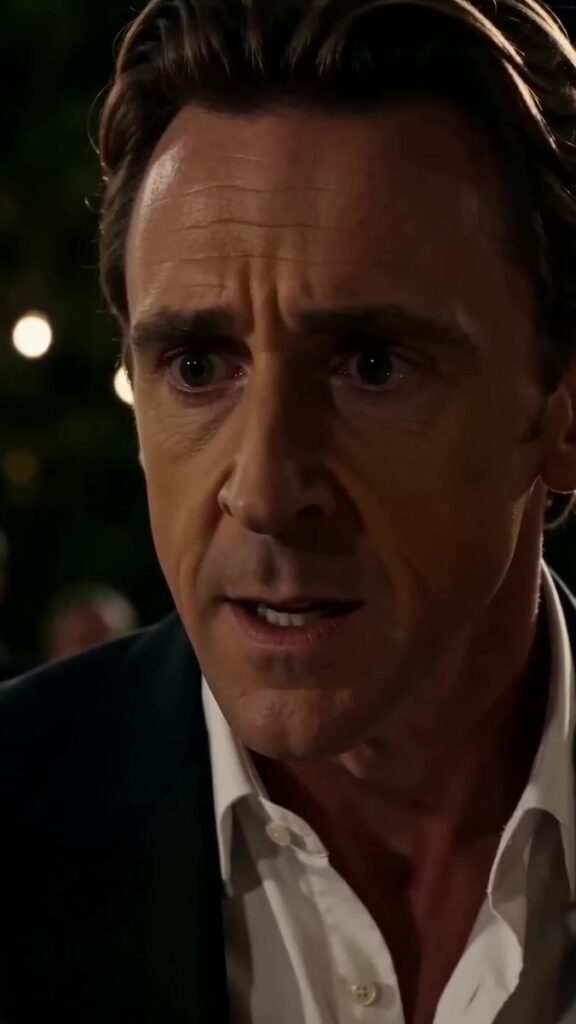
The corridor was drowning in noise—alarms shredding the air, soles slapping tile like gunfire, voices ricocheting off white walls in clipped commands and half-swallowed prayers. Every fluorescent panel seemed too bright, every second too sharp. A red light pulsed above the double doors, bathing the hallway in a warning that felt almost personal.
“Clear the way!” someone bellowed.
A stretcher tore through the doors as if chased by something invisible. On it lay a small girl, too light for the chaos around her, her ribs counting beneath a blanket, an oxygen mask fogging with each uneven breath. Her arms were wrapped tight around a teddy bear the color of old parchment, its fur rubbed bald in places, one ear stitched back on with thick black thread.
Dr. Daniel Hayes fell into step without thinking. Instinct drove him forward—hands already gloved, mind already narrowing to a list of protocols he could recite in his sleep. His badge swung against his chest. His jaw clenched.
“Vitals?” he asked, not looking away from the girl’s face.
“Pressure’s falling. Heart rate erratic,” a nurse answered, her voice steady in a way that only came from terror learned and managed. “She’s crashing.”
Daniel leaned closer, keeping pace as doors opened and shut in their wake. “Hey,” he said, forcing warmth into a tone built for command. “Stay with me, okay? You’re not going anywhere.”
Her eyelids fluttered like a moth’s wings. She was pale—paler than the sheets, as if the hospital had already begun to erase her. Daniel reached to adjust the mask and felt a small hand slide out from under the blanket.
Weak. Shaking. But deliberate.
Fingers closed around his wrist.
Daniel’s stride faltered. The stretcher kept moving; his body moved with it, but his mind stopped cold, as though someone had plunged him into winter water. The noise of the corridor thinned. The alarms became distant, muffled by a sudden, impossible hush.
The girl’s eyes opened. They were dark and lucid in a face that shouldn’t have been capable of focus. They locked onto his with the intensity of recognition.
Her lips moved under the mask. A whisper scraped through plastic and breath.
“Don’t let me die again,” she said.
The word again landed like a dropped scalpel: small, shining, and sharp.
Then—so softly he thought he might have imagined it—she added, “Daniel.”
He felt the name in his bones. His pulse stuttered. He heard, absurdly, the old sound of rain on a windshield, the rattle of a cheap heater, a child’s laughter turning into a cough.
“Doctor?” the nurse beside him said, frowning. “You with us?”
Daniel couldn’t answer. He stared at the girl’s face, searching for an explanation that could fit inside physics, inside medicine, inside the rules that kept the world from tearing open.
“How do you know that?” he asked, his voice low, almost private.
The girl’s grip loosened but didn’t let go. Instead, she lifted the teddy bear as if it weighed a hundred pounds. Something dangled from the bear’s arm by a frayed piece of elastic.
A hospital bracelet.
Old. Yellowed. Cracked with age. The printed letters faded, but not beyond recognition.
Daniel stopped breathing.
He knew that bracelet.
He had held it once in his palm the way people hold the last warm thing after the heat has gone. He had peeled it from a tiny wrist that had gone still. He had stared at the name stamped in block letters until it burned into him and became a brand he carried everywhere.
NOA HAYES.
“No,” he murmured, the word barely audible over the alarms. “That’s not possible.”
The gurney swung into Trauma Two. The doors slammed. The world snapped back into motion, violent and loud.
“On my count—transfer!” someone called.
They moved her onto the bed. The teddy bear was set aside with an odd gentleness, as if it were a living thing that might feel pain. Daniel’s hands worked automatically—checking pulses, ordering meds, scanning monitors—while his mind clawed at the past.
Noa.
Eight years old. His niece. His sister’s only child. A winter that wouldn’t end. A fever that rose like a tide. A rural clinic with one ancient defibrillator and a power grid that failed when the storm hit. Daniel back then wasn’t Dr. Hayes—he was just Daniel, a third-year medical student home for the holidays, kneeling beside a little girl and trying to out-argue death with textbook knowledge and shaking hands.
The night ended with a flat line and his sister’s scream. He remembered how the nurses had avoided his eyes as if he were contagious. He remembered leaving the clinic before dawn, the bracelet in his pocket because he couldn’t bear to let them throw it away.
He remembered promising—swearing—he would never be powerless again.
Now the name stared at him from a bracelet tied to a teddy bear in a city hospital hundreds of miles away.
“Daniel,” the charge nurse snapped, using his first name only when something was wrong. “We need you. Focus.”
He forced his gaze to the monitor. Ventricular tachycardia. Oxygen saturation dropping. The line wavered with a stubborn, failing rhythm.
“Prep to shock if she arrests,” he said, voice steadier than he felt. “Epi ready. Get me a rapid blood gas.”
He leaned over the child again. Her eyes had drifted shut, lashes resting like ink strokes on her cheeks. Her hand had slipped away from his wrist, but the impression remained—five small fingers printed into his skin as if she had branded him in return.
He spoke close to her ear, not for the team, not for the chart, but for whatever thread connected this moment to the one he couldn’t forget.
“If you’re Noa,” he whispered, “tell me something only you would know.”
Her mouth moved. The words came out in a thin stream of air, timed between the hiss of oxygen.
“You… promised,” she said. “On the stairs. You said… you’d make it… so I didn’t have to be scared.”
Daniel’s throat closed. He saw the clinic’s concrete steps slick with sleet. He saw himself crouched beside her, wrapping his coat around her shoulders while his sister argued with the receptionist. He heard his own voice—too confident, too desperate—telling her he’d fix everything. That he’d become the kind of doctor who could stop nights like this from happening.
He had made that promise to a child who died an hour later.
Or so he’d believed.
“Doctor,” a resident said urgently. “She’s dropping. We’re losing her.”
Daniel looked at the girl’s face again. So many children looked alike when they were sick—faces reduced to pallor and sweat. But there was something about the angle of her brow, the stubborn set of her chin even in weakness. Something familiar in the way her fingers had found him without sight.
He turned toward the teddy bear on the counter. The bracelet hung there like a relic. For a split second he imagined it wasn’t proof of a miracle at all, but bait. A cruel coincidence. A mistake. A prank pulled by a universe that delighted in repeating pain.
Then the monitor screamed.
Flat.
“She’s arrested!” the resident shouted.
“Start compressions,” Daniel ordered, stepping in. His palms met the small sternum and began the brutal rhythm of keeping a heart’s place. “One, two, three—”
Each push was a plea. Each breath he bagged into her lungs was a refusal to accept the story he’d lived with for years. Around him, the team moved in practiced choreography, but Daniel felt as if he were standing alone on those clinic stairs again, the storm howling, the power gone, a child slipping away.
“Charging,” the nurse called. “Clear!”
Daniel lifted his hands. The shock jolted through the small body. The line trembled, a wavering attempt at rhythm that faltered and tried again.
“Come on,” Daniel whispered, not caring who heard. “Not this time.”
The line steadied into a fragile beat.
Her chest rose, shallow but real. Color began, slowly, to return like dawn.
Relief washed through the room in ragged breaths and exhaled curses. Someone laughed once, sharp with disbelief. Someone else pressed a hand to their mouth.
Daniel stayed leaned over the bed, staring at the girl as if she might vanish if he blinked. The corridor outside still roared with its ceaseless urgency, but inside Trauma Two there was a pocket of silence where he could hear his own heart hammering.
He reached for the teddy bear and carefully unhooked the old bracelet. The cracked plastic creaked in his fingers. He turned it over, as if the back might reveal an answer.
“Who are you?” he asked the girl, though she was drifting under sedation now, her breathing eased by machines and medicine.
Her eyes opened a sliver. Just enough to find him again.
“You… left me,” she whispered, voice barely there. Not an accusation so much as a fact. A memory. “You said… you’d come back.”
Daniel’s stomach dropped. He had never come back. He had run from that town, from his sister’s grief, from the clinic steps, and had buried everything beneath achievements and distance and a new name on a new badge.
He felt the corridor’s noise press against the walls again, hungry to swallow this room whole.
He held the bracelet tighter until the edges bit his skin. “I’m here,” he said, the words trembling out of him. “I’m here now.”
Outside, another alarm began to wail, summoning them back into the relentless flood. But Daniel stayed one second longer, looking at the child and the bear and the bracelet as if they were a door that had opened in the middle of his life.
And somewhere behind the machines, behind the shouting, behind the years he had tried to outrun, he felt the past breathe—alive, unfinished, and demanding to be answered.