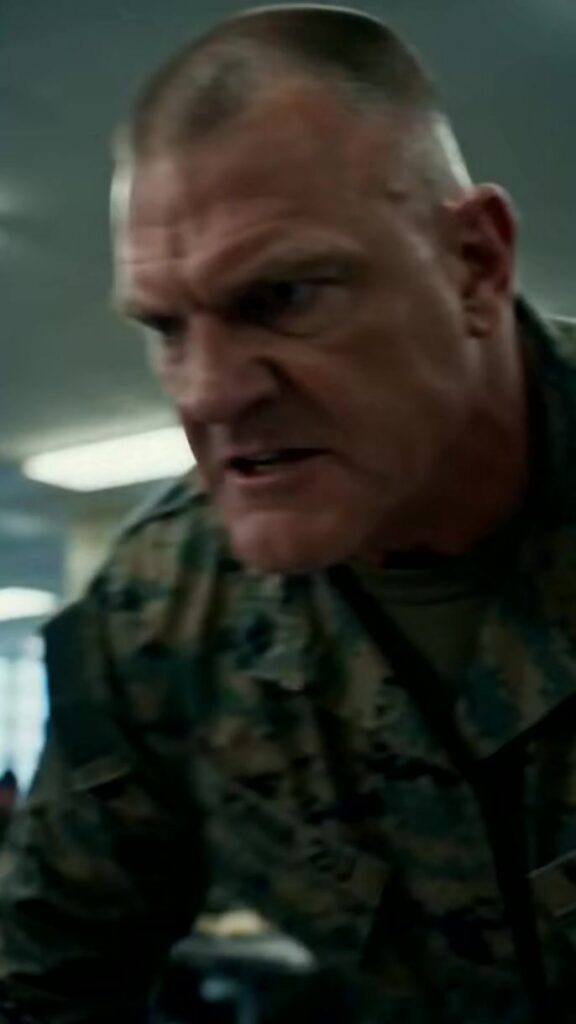
The dining hall at Camp Valiant always sounded like a machine trying to tear itself apart. Trays shrieked against stainless steel. Boots thudded in uneven rhythms. Conversations overlapped into a single loud, careless roar beneath fluorescent lights that bleached faces and erased shadows. It was the safest place on base—so many eyes, so many witnesses—that men forgot to measure their voices. They laughed too hard. They called each other names too freely. They told stories with the reckless confidence of people who believed tomorrow was guaranteed.
Sofia chose a table near the center for the same reason a diver chooses the brightest patch of water. Visibility. No corners. No blind spots. She kept her hood up anyway, a gray sweatshirt at odds with the camouflage around her, and ate with the calm focus of someone alone at a kitchen counter. The food tasted like steam and salt. The noise tasted like years.
She wasn’t supposed to be there—not as herself. Her file said she was a civilian contractor assigned to supply oversight, temporary clearance, minimal footprint. A name that matched a badge, a badge that matched a database entry built in an office far from Camp Valiant. The Marines passing her table saw what the paperwork suggested: an unremarkable woman with a quiet posture and a fork in her hand.
They didn’t see the thin wire taped beneath her hoodie seam. They didn’t see the small transmitter strapped to her ribs. They didn’t see the tremor in her left thumb that came and went like a pulse of weather.
She heard him before she saw him.
The sound arrived as a shift in the room’s rhythm—bootfalls that didn’t hesitate, a silence that preceded his path as if the air had learned to move aside. Sergeant Major Mercer didn’t need to shout to be felt. The dining hall bent around him. Heads stayed forward, eyes lowered, jokes swallowed. Even the servers behind the counter straightened as though bracing for impact.
Mercer moved through the rows of tables like an iron wedge, broad shoulders under a perfectly pressed blouse, the kind of body that had been trained into hardness and then enjoyed it. He wore authority the way others wore cologne: too much, on purpose, so you couldn’t breathe without him in your lungs.
He stopped at Sofia’s table.
The roar of the hall faltered, then surged again with forced normalcy. There was always a moment where people pretended not to notice the storm. It was a ritual, a lie everyone helped maintain.
Mercer leaned over her, his shadow staining her tray. His hands—scarred, thick-knuckled—came down on the metal tabletop with a crack that made cups jump and a spoon spin in place.
“Move. Now.” His voice didn’t need amplification.
Sofia lifted her eyes slowly, as if the command had to travel a long distance to reach her. Calm eyes. No flinch. No hurry. She swallowed, placed her fork down with deliberate care, and said, soft enough that it forced him to lean closer to hear her.
“No.”
Somewhere to her right, a chair leg squealed. A laugh died halfway through. The room held its breath without realizing it had been breathing for him.
Mercer’s mouth tightened. He bent further, the smell of coffee and aftershave and something sour beneath. “You deaf?” he asked, the corners of his words sharpened for cutting. “This is my table.”
Sofia’s gaze didn’t break. “Then sit somewhere else.”
A fork fell in the distance and clattered like a warning bell. The sound of it rang too loud.
Mercer straightened just enough to look down at her as if she were an insect refusing to die. His jaw flexed. He was used to fear. Used to compliance. Used to the way men would rearrange the world to make him comfortable, because discomfort meant punishment, and punishment under Mercer had a long memory.
For a heartbeat, Sofia saw what everyone else had never allowed themselves to look at: not power, but hunger. Not discipline, but pleasure.
He moved faster than the room could process. His hand arced across the air and struck her face with a sharp crack. The sound cut through the fluorescent hum and landed heavy, undeniable. Coffee tipped, spilling across the table in a brown flood. Her chair skidded sideways; metal screamed against tile.
Silence detonated. The dining hall stopped breathing altogether.
Sofia’s head turned with the slap, hair shifting beneath her hood. She tasted copper. She let the chair settle. Then she turned back slowly, as if obeying some old, patient clock, and a faint smile touched her mouth—small, almost gentle, like a candle lit in a storm.
Mercer’s confidence wavered. Confusion flashed across his face, the first crack in a wall that had never known weather. He expected tears or rage. He expected noise. He did not expect composure.
Movement rose from three different corners of the dining hall like synchronized waves. Men who hadn’t looked like Marines, who had worn plain shirts and forgettable faces, stood up at once. One flipped open a leather wallet. A badge gleamed under the lights.
“Federal agents!” a voice shouted. “Don’t move!”
Chairs scraped violently back. Trays rattled as hands instinctively lifted, froze, hovered in disbelief. A murmur began—then died again as Mercer’s skin drained of color so quickly it was like watching a photograph fade.
“This is insane,” Mercer said, backing away with palms half-raised, trying to find an exit that wasn’t suddenly blocked by bodies.
Marines stood between him and the doors without being told, not quite sure when they decided to. The instinct felt new and ancient at once: protect the room from him.
Sofia reached into her hoodie with unhurried precision and pulled out a thin wire microphone, the kind that looked too delicate to hold a life. She held it up so the room could see, then spoke into it with a voice that carried like steel across water.
“Charge him with the murders.”
The word dropped into the silence and split it open.
“Murders?” someone whispered, the syllables trembling.
Mercer’s mouth opened, closed. He jabbed a finger at Sofia, frantic now. “She assaulted me first! She—she’s lying—”
“Sir,” an older staff sergeant near the wall said, voice raw with something that sounded like relief and grief mixed together, “we all saw you hit her.”
Other voices rose, hesitant at first, then gathering strength the way a fire gathers air. “And Torres.” “And Kim.” “And Jenkins before he vanished.” Names spoke aloud as if saying them could pull them back from wherever they’d gone.
Mercer spun toward them, eyes wild. “Shut your mouths!” he barked, and the old fear should have snapped them quiet.
It didn’t.
Sofia stood, wiping coffee from her cheek with the back of her hand as though it were only rain. She stepped closer, close enough that Mercer saw in her eyes not defiance but calculation—an endless, patient accounting.
“You liked crowded rooms,” she said quietly. “You thought witnesses meant safety.”
The lead agent moved in, took Mercer’s wrist, and snapped a cuff around it. Mercer jerked hard, trying to rip free on pure habit. Another agent caught his other arm. Metal clicked again, final as a door locking.
Mercer’s breathing turned ragged, as if he’d forgotten how to do it without people around him pretending everything was fine.
Sofia pulled a small recorder from her pocket and held it up, her fingers steady. “You confessed in the parking lot,” she said. “You couldn’t help yourself. You thought you were untouchable.”
Mercer stopped fighting. His lips parted on a sound that wasn’t quite a word. “No…”
Sofia leaned in close enough that only he could hear her, though the entire room watched his face change as if her whisper were a blade.
“They found the graves this morning.”
Whatever remained of him collapsed inward. His shoulders sagged. His eyes darted, searching for the old world to return—the world where silence covered everything like snow.
A young private at the back, pale and shaking, stepped out from behind a taller Marine and raised a trembling hand into a salute. His voice broke, but it came out clear.
“Ma’am… who are you?”
Sofia turned toward him. The dining hall held still, waiting for her name like it might change the shape of what had happened.
She pulled her hood back, exposing hair flattened by fabric, a bruise blooming along her jaw where Mercer’s hand had left its signature. Her voice did not rise. It didn’t need to. It carried anyway, filling the room with something heavier than sound.
“I’m the sister of the first man he killed.”
The fluorescent lights hummed on, indifferent. But the hall was no longer a machine roaring over its own secrets. It was a room full of witnesses who had finally learned what their eyes were for. And as Mercer was led out past the tables he once ruled, the silence that followed him felt less like fear and more like the start of reckoning.