The door didn’t open.
Micah drove his shoulder into it once, twice, the wood groaning like it had something to confess. The lock had been replaced—he could see the bright new metal, fresh against the old paint—yet no one had told him. No one had answered his calls all morning. No one had answered last night either, not since the message that said only: come home.
He stepped back, sucked in a breath that tasted like rain and panic, and hit the door again.
This time it didn’t surrender. It ruptured.
A cracking roar filled the hallway as the frame splintered and the deadbolt ripped free. Dust and tiny shards of wood sprayed outward. For a beat he stood in the cloud, hearing his own pulse thunder louder than the wreckage, and then he was moving, lungs dragging air like they were trying to escape his body.
“Micah! Where are you?!” he shouted into the darkness.
The house answered with emptiness. Not the peaceful emptiness of a place no one had woken yet—this was hollow, drained, as if sound itself had been taken away.
The smell hit him next. Cold, sour, and stale, like old water left in a cup too long. It wasn’t rot. It was neglect. It reminded him of hospital hallways at night: antiseptic fading under the weight of human fear.
His boots thudded across the entryway tile. A picture frame lay face down on the floor. Another leaned sideways, glass spiderwebbed. The thermostat was dark. The living room curtains were drawn though the day outside was bright.
“Micah!”
A soft click answered—like a camera shutter, quick and mechanical. He stopped, instinctively turning toward the sound.
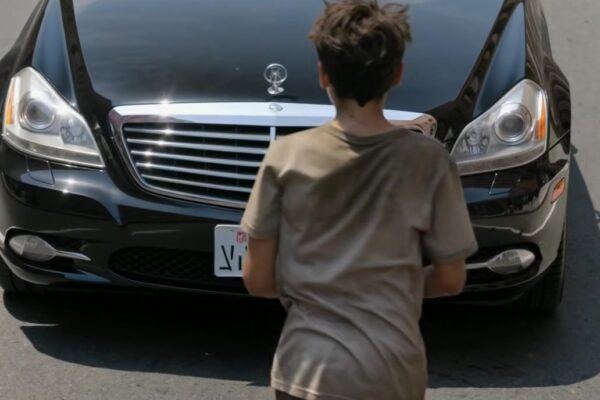
In the corner, between the bookshelf and the window, a small boy stood rigid as a coat rack. Micah’s hair stuck up in uneven tufts as if he’d been tugging at it for hours. He held a pillow to his chest so tightly his knuckles were pale. His eyes were swollen and red, his cheeks streaked with dried tears.
“Dad,” Micah whispered, voice breaking as if it had been bent too many times. “She won’t wake up.”
The world narrowed to the boy’s face. The words seemed to pass through Micah’s father like wind through an open door. He tried to speak, but his tongue felt like it didn’t belong to him. His gaze slid past Micah’s shoulder to the couch.
Elsie lay there in her yellow pajamas, one sock missing, her hair spread in a dark fan across the cushion. She looked like she’d fallen asleep mid-thought. But her chest did not rise. The quiet around her was wrong—too complete, too final.
“No,” he breathed. It came out as a sound someone else made. “No, no, no—”
He lunged, scooping her up before he even registered that she was heavy in the way bodies become heavy when they aren’t helping you hold them. Her head tipped back, loose, her mouth slightly open. Her skin was cool. Too cool.
“Elsie?” His voice cracked on her name. “Elsie! Elsie!”
Nothing.
He pressed his ear to her chest, as if he could will his hearing to become a stethoscope. Silence. He lifted her, jostling her gently at first, then harder, then harder still, as though he could shake life back into her bones.
Micah made a small, frightened sound behind him. “I tried,” the boy said. “I tried to get her to drink. I… I put the blanket on her.”
Guilt surged up so fast it stole his breath. His mind grabbed at details: the missed calls, the unanswered texts, the last argument about overtime, the promise he’d made to come home early. He had been angry at the world for demanding so much. He hadn’t been afraid—because fear would have meant admitting they could break.
He didn’t think anymore. Thinking was a luxury. He ran.
He barreled through the hallway with Elsie clutched against him, holding her too tightly, as if pressure could force her heart into motion. His shoulder clipped the wall, sending another picture crashing to the floor. His foot caught on a toy—one of the plastic unicorns Elsie collected—and he stumbled but didn’t fall.
Micah chased after him, barefoot, the pillow dragging behind like a tail. “Dad—wait!”
They cut through the kitchen. The light above the sink flickered weakly, as if it was undecided about existing. The refrigerator door hung slightly open; when he passed it, he saw nothing but empty shelves and a lone jar of mustard. The trash can overflowed with crumpled paper towels. Plates were stacked in the sink in a gray tower, crusted with the dried memory of meals that never came.
“We didn’t eat,” Micah said, voice trembling. “Not really. For three days. She said she wasn’t hungry. And then she… she got sleepy. She got so sleepy.”
Three days. His mind screamed the number. He had been in the city, signing papers, meeting deadlines, answering to people who didn’t even know his children’s middle names.
He shoved open the back door with his hip and ran into the yard. The air outside tasted shockingly clean, like the world was mocking him. He sprinted toward his car.
“Stay with me,” he whispered against Elsie’s temple. “Please. Stay with me. I’m here. I’m here. I’m sorry.”
As he reached for the door handle, a sound pierced him—thin, electronic, flat.
Beep.
His body seized. His hand froze inches from the car.
That sound wasn’t in the yard. There was no machine here. No monitor. Yet he heard it as clearly as if it had been clipped to his ear.
Beep.
A memory slammed into him: a sterile room lit by harsh fluorescents; his wife’s hand in his, cold with exhaustion; a tiny hospital bed; a smaller body with too many wires; the rhythmic chirp of a heart monitor until it became—
He swallowed a sob so hard it hurt. His voice dropped to a ragged whisper. “Not again.”
His arms tightened around Elsie, desperate and terrified, as if refusing to loosen his hold could prevent the past from repeating itself. The world tilted. The yard blurred. His vision tunneled into the space between his daughter’s face and his own guilt.
Behind him Micah screamed, sharp enough to cut glass.
“Dad—wait—she moved—!”
Everything stopped.
He turned so fast his knee nearly buckled. For a heartbeat he saw only Micah’s wild eyes and the wrecked doorway behind him, sunlight pouring into the house like an accusation.
Then he looked down.
Elsie’s fingers—two of them—trembled against his shirt, a faint flutter like a moth trapped under a lampshade.
Hope collided with terror inside his chest. It was so sudden it felt violent. “Elsie?” he gasped, lowering her just enough to see her face. Her eyelids did not open. Her lips did not part. But her hand moved again, smaller this time, a weak insistence.
Micah stumbled closer, clutching the pillow like a shield. “I saw it,” he pleaded. “I saw her. She did it.”
His father’s mind snapped into motion, no longer drowning—calculating. Dehydration. Hypoglycemia. Exposure. The cold house. The empty fridge. The drawn curtains. He remembered the new lock on the door, the one that had kept him out until he broke in. He remembered the camera click, and the way Micah had been standing like he’d been told not to move.
“Micah,” he said, voice suddenly steady with fear sharpened into purpose. “Where’s your mom?”
Micah flinched. His gaze slid toward the shadowed hallway. “She’s… in the bedroom. She told me to stay quiet.”
Another click sounded from inside the house, faint but unmistakable, like something documenting everything.
He looked from the doorway to Elsie’s trembling fingers to Micah’s bruised-looking eyes, and he understood, with sick clarity, that the locked door hadn’t been meant to keep strangers out.
It had been meant to keep him from coming in.
He pulled his phone from his pocket with shaking hands, thumb hovering over emergency services. His daughter’s fingers twitched again, a fragile sign that time still existed for her.
“Hold on,” he whispered, not sure whether he meant Elsie, Micah, or himself. “Just hold on.”
Inside the house, something shifted in the hallway—soft footsteps, deliberate—and the air seemed to thin, as if the walls were listening.
He backed toward the car, keeping his eyes on the doorway, feeling the weight of the past closing in and the future demanding a price.
And somewhere deep in his head, the imagined monitor sounded once more—less like a memory now, more like a warning.
Beep.