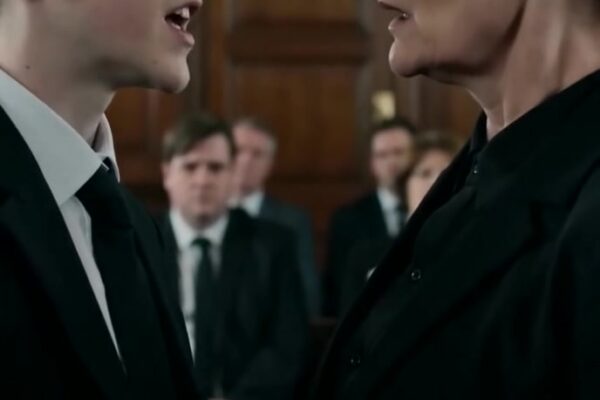
“Maybe try the toy store next door,” the manager smirked, leaning his hip against the reception desk as if it belonged to him and him alone. The lobby of Huxley & Crane sparkled with expensive quiet—glass walls, marble floors, and a chandelier that looked like frozen rain. The employees behind him laughed loud enough for the sound to ricochet up the atrium. Even the security guard’s mouth twitched.
The boy didn’t flinch. He stood in scuffed sneakers and a jacket that had once been navy but now looked like it had weathered too many bus rides. His hair was combed but stubborn, curling over his brow. In his hands was a folder, its edges softened by use. He had asked, politely, for Mr. Darrow—the manager. He had asked again when the first receptionist waved him away. And now Darrow had come out, grinning, enjoying the theater of it.
“I’m not here to play,” the boy said. His voice was calm in a way that made the laughter sound suddenly childish, like something done to cover fear.
Darrow’s grin widened. “No? Then what is it? You want an internship? A tour? You lost from a school trip?” He turned to the nearest cluster of employees, inviting them into the joke. “We don’t hire kids, champ.”
The boy held Darrow’s gaze. “I’m here to deliver something. To you.”
“Deliver?” Darrow drew the word out as if it tasted bad. “We have mailrooms for that.”
The boy’s fingers slid into the folder, and he pulled out a single envelope—cream-colored, heavy-stock, sealed with a dark red wax mark. Not a sticker. Not a stamp. Wax, pressed with a signet shape that caught the light. It looked old in the way antiques look old: deliberate, preserved, important.
The laughter fell apart, one chuckle at a time. A woman in a gray blazer stopped mid-sip of her coffee. The security guard straightened, his hand moving to his belt as if the envelope might be a weapon. Darrow’s smirk faltered for a fraction of a second—just long enough to be noticed.
“What’s that supposed to be?” Darrow asked, but he didn’t sound amused anymore.
The boy lifted the envelope so everyone could see the seal. “It’s for you. You’ll understand when you read it.”
Darrow’s eyes flicked to the seal. The color drained from his face as if someone had opened a valve beneath his skin. He reached for the envelope with two fingers, careful like it might burn.
“Where did you get this?” he demanded, voice lower now.
“From the person it belongs to,” the boy said. “And I’m supposed to wait while you open it.”
Darrow looked around the lobby. The employees pretended to resume what they were doing, but their bodies leaned toward the scene. He gestured sharply. “Conference room. Now.”
The boy followed without hesitation. The security guard trailed them, and so did the silence—thick, pressing, filling the space where laughter had been. Inside the glass-walled conference room, Darrow shut the door as if closing a lid.
He sat at the head of the table, the envelope in front of him, his fingers trembling. “Tell me your name,” he said.
The boy stood, hands at his sides. “Eli.”
“Last name?”
Eli blinked once. “You won’t need it.”
Darrow’s jaw tightened. He broke the seal with a fingernail and slid the paper free. The letter inside was folded with crisp precision. He scanned the first line—then his eyes widened. He read faster, breathing shallow, as if the words were tightening around his throat.
Eli watched him as if watching a man sink.
Darrow’s face went through stages: confusion, outrage, panic, then something like recognition that hurt. At the bottom of the letter was a signature, the ink thick and dark. Beneath it, pressed into the paper, was the same symbol from the wax seal.
“This is—” Darrow swallowed hard. “This is impossible.”
Eli’s voice stayed even. “It’s not.”
The security guard shifted his weight, uneasy. “Sir, do you want me to—”
“No,” Darrow snapped. Then, quieter, to Eli: “Who sent you?”
Eli reached back into the folder and placed a second item on the table: a photograph, glossy and newer than the envelope. It showed a younger Darrow in a cheap suit, standing beside a man with silver hair and an easy smile—someone who looked too kind to belong in this building. The younger Darrow’s arm was around the man’s shoulders like a friend, like family. But the expression on Darrow’s face now, as he stared at the image, was not fondness. It was the look of someone remembering where the bones are buried.
“He did,” Eli said, tapping the photograph gently. “Before he died. He left instructions.”
Darrow’s eyes snapped up. “Died?”
Eli nodded once. “Last week.”
The manager’s throat bobbed. His hands gripped the letter so hard the paper creased. “You’re lying,” he said, but it sounded like pleading.
“His name was Martin Vale,” Eli continued. “You knew him as Mr. Vale. I knew him as Grandpa.”
That word hit like a gavel. Darrow’s gaze darted across Eli’s face, measuring bone structure, the set of the jaw, the eyes. The boy had the same gray-green eyes as Martin Vale. The same stubborn calm, too.
“Grandpa,” Darrow echoed, voice rough. “So you’re—”
“His blood,” Eli said. “And his witness.”
Darrow shoved his chair back. He stood, towering, trying to reclaim the space with his height. “This letter… this is extortion.”
“It’s accounting,” Eli corrected. “He kept records.”
Darrow’s eyes flicked to the security guard, to the glass wall beyond where silhouettes hovered, hungry for drama. “What does he want?”
Eli’s gaze didn’t move. “Not what he wants. What he asked for.”
He slid the letter back toward Darrow with two fingers, gentle as a judge returning a verdict. “You should read the whole thing. Out loud, if you can. It says what you did, what you took, and what you promised when he made you. It says where the money went. It says who signed the approvals. It says which accounts are still open.”
Darrow’s lips parted. No sound came out at first. “You don’t understand,” he whispered. “That was years ago. I was—”
“You were an adult,” Eli said. “He was sick. You were supposed to help him keep the company alive. Instead you made yourself comfortable.”
The manager’s eyes flashed. “You have no idea what this world is like.”
“I know what it’s like,” Eli replied. “I watched him sell his watch to pay for medication. I watched him pretend his hands didn’t shake when he signed checks. I watched him smile at people who called him ‘sir’ while you called him ‘a relic’ behind his back.”
Darrow’s shoulders sagged, as if the building had suddenly grown heavier. “What do you want, Eli? Money?”
“No,” Eli said. “I want you to stop laughing at people who show up with hope in their hands.”
Darrow scoffed weakly, as if trying to drag the moment back into the shallow waters of cruelty, where he could breathe. But the scoff died when Eli opened the folder again and revealed a third item: a USB drive, plain black, with a small white label. On it, written in careful block letters, were three words: FOR THE BOARD.
“There’s a copy,” Eli said. “And another copy already scheduled to be sent if I don’t cancel it.”
Darrow’s eyes went unfocused, calculating. “You can’t be serious.”
“I am,” Eli replied. “Grandpa didn’t want revenge. He wanted correction. He asked me to give you a choice.”
Darrow swallowed. “What choice?”
Eli’s voice softened, just slightly. Not mercy—clarity. “Resign today, quietly. Return what you took through the channels he documented. And fund the scholarship he drafted—the one you buried. Or I walk out of this building and the board receives everything. The investigators too.”
Darrow stared at the boy who had walked into his lobby and turned his smirk into ash. The manager’s hand hovered over the letter as if it might either save him or condemn him. Through the glass wall, the silhouettes pressed closer, sensing a shift they couldn’t yet name.
Finally, Darrow sank back into his chair. He looked smaller now, not because he had changed, but because the room had stopped honoring his performance. “How old are you?” he asked hoarsely.
“Seventeen,” Eli said.
Darrow let out a shaky breath. “And he trusted you with this.”
“He said I was the only person left who would do it without enjoying it,” Eli answered. “He said you would expect anger. So he gave you calm.”
Darrow’s eyes glistened, whether from rage or regret it was impossible to tell. He picked up the pen lying on the conference table, the company’s logo printed on its side, and rolled it between his fingers as if it were a tiny baton conducting the end of his career.
Outside, the lobby waited—still, bright, full of people who had laughed at a boy like it was sport. Eli stood unmoving. He did not smile. He did not threaten. He simply held his ground, the way truth does when it finally enters a room.
“I’ll need time,” Darrow whispered.
Eli shook his head. “You already used your time.”
The manager closed his eyes for a long moment, then opened them with the exhausted sharpness of someone seeing daylight after years underground. He reached for his phone. His voice, when he spoke, was barely audible.
“Get me HR,” he said. “And call the board’s secretary. I have… something to announce.”
Eli waited, as instructed, while the tower of glass and marble adjusted to the weight of a single envelope—and the laughter that had filled the lobby did not return.