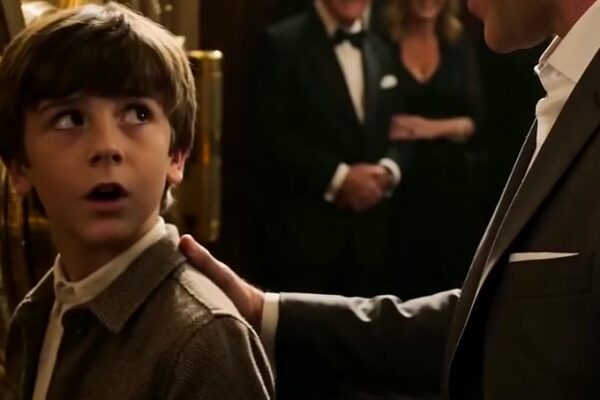
“Careful, kid… the floor here costs more than your shoes,” the manager said, voice sharp enough to cut through the lobby’s soft music. His smile was practiced, the kind that lived on his face whenever someone walked in without a suit.
The boy stood just inside the revolving doors, blinking as if the brightness had physical weight. Rainwater beaded on his dark hair and slid down the collar of his too-thin jacket. His sneakers—gray once, now a tired, uneven color—left a damp print on the marble that the manager seemed to feel in his bones.
Behind the desk, two receptionists exchanged glances and laughed too loudly, eager to join the manager’s joke. A bellhop, half-turned toward the elevators, snorted like it was the funniest thing he’d heard all day. Even the concierge, who looked as if he’d been born in a tuxedo, let his mouth twitch with amusement.
The hotel lobby was a cathedral of wealth: chandeliers glowing like captured constellations, columns polished until they reflected faces back in perfect disdain, and an enormous arrangement of white lilies that smelled like funerals. The boy’s gaze took it in without awe. He looked tired, not impressed.
“Do you have a reservation?” the manager asked, the words polite, the tone not. His name tag said MARTIN in silver letters. He leaned forward as if the boy might be hard of hearing, or less than human.
The boy didn’t answer immediately. He stepped farther onto the marble. His sneakers squeaked faintly, and Martin’s eyes narrowed, tracking the sound as if it were vandalism. The boy’s hand went into the inner pocket of his jacket and stayed there for a moment, as though he were checking that something important was still real.
“Listen,” Martin said, lowering his voice as if offering a kind warning. “This isn’t a shelter. If you’re looking for somewhere warm, there’s a church three blocks down.”
“I’m looking for someone,” the boy said. His voice was calm and surprisingly steady. He was young—fifteen, sixteen at most—but there was something older behind his eyes, something that didn’t flinch at laughter.
“Someone?” One of the receptionists—Sloan, according to her badge—tilted her head. “Who could you possibly know here?”
The boy glanced toward the elevators, then back to the desk. “The person in charge.”
Martin barked a laugh and looked to his staff as if to share the moment. “That would be me, kid. And I’m telling you, you’re in the wrong place.”
The boy’s hand came out of his jacket with an envelope. It wasn’t flashy—no wax seal, no gold embossing—just thick cream paper, slightly wrinkled as if it had been gripped too tightly. He held it up between two fingers, the way someone might hold a match before striking it.
“This is for you,” he said. “And for the owner.”
Martin’s laugh died halfway through his exhale. The envelope bore a crest—subtle, pressed into the paper. A serif letter at its center. The manager’s face changed, not into kindness, but into calculation. He reached for it like a man reaching for a weapon first and a letter second.
“Where did you get that?” Martin asked, voice suddenly thin.
“It was given to me,” the boy replied. “With instructions.”
Martin’s fingers trembled almost imperceptibly as he flipped it over. There was a signature across the flap—ink dark, decisive. The concierge’s posture shifted, attention sharpening. The bellhop stopped moving. The lobby, which had been humming with low conversation and the soft clink of glassware from the bar, seemed to hush around the envelope as if it had sucked the air from the room.
Martin looked up, his eyes narrowing. “Your name,” he demanded.
“Elias,” the boy said. Then, after a pause: “Elias Rourke.”
Something passed across Sloan’s face—recognition like a rumor becoming solid. Martin’s mouth tightened. He glanced toward the hallway leading to the private offices behind the front desk, then back to the boy’s shoes, as if his brain couldn’t reconcile the two images: poverty and the crest on the envelope.
“Wait here,” Martin said quickly, already stepping away. His tone was different now—still not respectful, but careful, the way people become careful when they realize they’ve been standing near a cliff.
Elias didn’t move. He stood with the envelope still raised, arm steady, while Martin disappeared behind a door marked STAFF ONLY. For a moment, the lobby held its breath. The lilies’ scent grew stronger. Somewhere, an elevator chimed softly, like a distant warning.
“Is that… him?” Sloan whispered to the concierge. She tried to sound casual, but her voice cracked.
“No one asks that name out loud,” the concierge murmured. His eyes remained fixed on Elias. “Not unless they want to invite trouble.”
Elias heard them anyway. His face didn’t change. He didn’t look angry, exactly—more like he’d already spent whatever anger he had, long before he stepped onto this marble. In his mind, perhaps, he was somewhere else: a cramped apartment with a sickly smell of damp plaster, a woman’s hands shaking as she signed papers she didn’t understand, a final phone call cut short.
Martin returned with a man in a charcoal suit who looked too refined to be real. The man’s hair was silver at the temples; his watch could have paid off a mortgage. He moved with the composed urgency of someone who had been told a door was about to open that should never open.
“Mr. Kessler,” Martin said, voice suddenly eager. “This is… this is the boy.”
Mr. Kessler didn’t acknowledge Martin. His gaze went straight to Elias and then to the envelope. He extended his hand, palm up, careful.
Elias didn’t give it immediately. He lowered the envelope slightly and asked, “Are you the owner?”
“I represent the owner,” Kessler answered. “In every legal capacity.”
Elias nodded once, as if that was enough. Then he placed the envelope into Kessler’s hand with deliberate precision, like setting a chess piece down where it could not be moved back.
Kessler opened it right there, ignoring the lobby’s eyes. He unfolded a single sheet. As he read, the color drained from his face in a slow, unmistakable wash. His grip tightened on the paper until it bent.
Martin tried to peer over his shoulder. “What is it?” he asked, too loudly. “Is it—”
“Quiet,” Kessler said. Not shouted. Not even harsh. But it struck like a gavel. Martin’s mouth snapped shut.
Kessler read again, slower, as if hoping the words might rearrange themselves into something less disastrous. Then he looked at Elias with an expression that belonged on a man viewing a storm through a window: awe, fear, and the instinct to lock everything down.
“Where is she?” Elias asked.
Kessler swallowed. “Your mother… is not on the property.”
“I didn’t ask that,” Elias said. “Where is the account?”
The question landed heavy. Sloan’s eyes widened. The concierge’s lips pressed into a tight line. Martin’s hands flexed at his sides like he wanted to grab something—authority, dignity, a weapon, anything.
Kessler lowered his voice. “This letter instructs the hotel to release the contents of the Rourke Trust’s safety holdings into your custody—effective immediately. It also suspends Mr. Martin Pierce pending investigation.”
Martin made a sound, half gasp, half protest. “Investigation? For what?”
Kessler glanced at him, and the look was not cruel. It was final. “For falsifying guest invoices, rerouting vendor payments, and coercing staff into signing nondisclosure agreements under threat of termination,” he recited, as if reading from the air. “And for actions taken against Ms. Rourke two years ago.”
The words turned the lobby colder than the rain outside. Martin’s face became a mask struggling to hold itself together. “This is insane,” he whispered. “He’s just—he’s a kid.”
Elias shifted his weight, and the damp print of his sneaker smeared slightly across the marble. He looked down at it as if considering the manager’s original insult. Then he looked up, meeting Martin’s eyes without flinching.
“You’re right,” Elias said softly. “I’m a kid.”
He let that hang there for a beat, letting everyone remember the laughter. Then he continued, voice steady and clean.
“And I still brought proof.”
Kessler refolded the letter with care, like it might cut him if handled incorrectly. He nodded once, brisk. “Mr. Pierce,” he said, “hand over your keys and your access card. Now.”
Martin’s jaw worked soundlessly. The staff—his staff—did not laugh anymore. They watched him as if seeing him for the first time, stripped of the suit’s illusion. Sloan’s hands hovered over the keyboard, frozen. The bellhop stared at the floor. The concierge exhaled through his nose, almost like relief.
Martin reached into his pocket, slow, as though time might save him if he delayed long enough. He set the keys down on the desk. They made a small, bright sound that echoed in the quiet.
Elias didn’t smile. He didn’t gloat. He simply stood in the center of the marble cathedral, rain-soaked and unbowed, holding the silence like a torch.
“One more thing,” Elias said, and Kessler looked at him immediately, attentive in a way Martin had never been.
“Yes?”
Elias glanced around at the lilies, the chandeliers, the polished floor. “Tell whoever owns this place,” he said, “that the marble isn’t what makes it expensive.” His eyes flicked back to Martin. “It’s what you let happen on top of it.”
Outside, the rain continued to fall, washing the city in gray. Inside, on the flawless floor that had inspired a mockery, a boy in worn shoes stood like a verdict—quiet, irreversible, and finally heard.