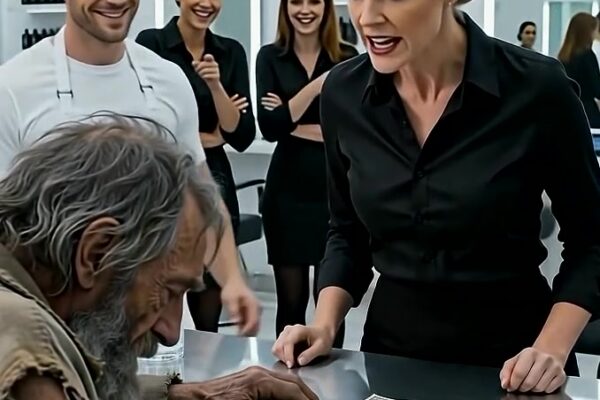
The first time Milo stepped into Alder & Rowe’s marble lobby, nobody looked up. That was the trick of polished floors and people who believed their own reflections mattered more than anyone else’s. He moved like a shadow between suits and leather briefcases, his sneakers whispering apologies against stone, the envelope in his hands held so tightly the edges began to curl.
The security desk sat beneath a chandelier like a crown. Milo kept his eyes low, as if the light might ask questions. He could hear his own breath, thin and fast, as he crossed toward the elevators—until a voice snapped through the lobby like a whip.
“Hey.”
Milo froze. The guard, broad-shouldered with a radio clipped to his chest, had risen from his chair. His gaze swept Milo from head to toe the way some people inspected bruised fruit at a market.
“Deliveries go around back,” the guard said.
“I’m not—” Milo began. The words stuck to his tongue. He wasn’t sure what he was, exactly, except a boy who had promised his mother he’d try.
The guard’s eyes landed on the envelope. Thick paper. Official. Not the kind someone like Milo carried into a building like this. “You got an appointment?”
“Yes.” Milo swallowed. “Tenth floor.”
The guard’s mouth bent into a line that wasn’t quite a smile. “Name?”
“Milo Carter.”
The guard’s fingers hovered over the keyboard, tapping in a rhythm that sounded like judgment. After a beat he shook his head. “Nothing. There’s no you.”
Heat climbed Milo’s neck. It wasn’t the first time he’d heard some version of that sentence. There’s no you on the list. There’s no you in this neighborhood. There’s no you in this world we built for ourselves.
“Maybe it’s under—” Milo tried again.
“Listen,” the guard cut in, louder now. A few heads turned. “This is a private firm. Important people. You can’t just wander in off the street.”
Milo tightened his grip on the envelope. The paper crinkled softly, like it was afraid too. “I have to give this to someone. To Ms. Rowe.”
At the mention of that name—one of the two etched in brass by the revolving door—something changed. The guard’s posture stiffened. “Ms. Rowe doesn’t see walk-ins. Especially not kids.”
“It’s from my mom.” Milo’s voice came out smaller than he meant. He hated that. He hated that fear made him sound like he needed permission to exist.
“Your mom can mail it.”
Milo’s throat ached. “She can’t.”
Before he could say why, a woman in a gray blazer appeared beside the desk, drawn by the disturbance. Her hair was pinned so neatly it looked like it had never encountered wind. “Is there a problem?” she asked, eyes already narrowed at Milo.
“Kid’s trying to get upstairs,” the guard said. “Says he’s got an appointment. No record.”
The woman looked at Milo as if he were an ink stain. “Who are you here to see?”
“Ms. Rowe,” Milo repeated.
Her laugh was short and sharp. “And I’m here to see the President. Do you have any idea where you are?”
Milo nodded because he did. He’d stared at photos of this building online for weeks, memorizing its angles the way other boys memorized football stats. He’d practiced his route from the bus stop. He’d rehearsed what to say if someone questioned him, though nothing in his rehearsals accounted for the way a room could turn its attention into a weapon.
“You don’t belong here,” the woman said plainly. Like she was stating a rule of nature.
The guard stepped closer, one hand hovering near Milo’s shoulder. “Come on, kid. Out.”
Milo’s pulse hammered so hard he thought the envelope might shake loose. His mother’s handwriting was on the front, careful and slanted. She’d written it last night at the kitchen table, the overhead light flickering the way it always did when the landlord promised repairs and delivered nothing. She’d sealed it with tape because she didn’t have a proper wax seal, not that anyone in their world used wax anyway.
“Please,” Milo said, and he hated the word as soon as it left him. “Just let me give it to her. That’s all.”
“No.” The woman’s voice softened into something that was worse than cruelty: certainty. “You can leave it with security. Or you can leave with security.”
Behind her, the lobby continued its pristine life. A man in a tailored suit laughed at something on his phone. A woman adjusted her earrings in the reflective elevator doors. Everyone moved as though Milo’s humiliation was background music.
Milo looked down at the envelope. His mother had said, Hold it like it’s the last piece of our family. Not because paper was precious, but because truth was.
He took a breath. Then another. The trembling in his hands steadied, not from calm, but from decision.
“I can’t leave it here,” Milo said.
The guard reached for him.
Milo stepped back and raised the envelope, holding it up as if it were a badge. “I have to give it to her because it’s her signature.”
The woman blinked. “Excuse me?”
Milo’s fingers found the flap. He opened it with a deliberate slowness, as if the act itself deserved ceremony. He drew out a single sheet of paper—creased, but intact—and turned it so they could see.
The header at the top read: Estate & Trust Division—Alder & Rowe Legal. The room seemed to inhale.
“That’s stationery,” the woman said quickly, as if she could explain it away. “Anyone can—”
“It’s not about the paper.” Milo’s voice surprised even him. It had sharpened. “It’s about the name.”
He pointed to the bottom, where a signature rested like a verdict: Vivian Rowe. But beneath it—an addendum line, smaller, nearly hidden—sat another name, written in the same hand.
Custodial beneficiary: Milo James Carter.
The guard’s hand dropped away from Milo’s shoulder as if he’d been burned. The woman’s face drained of color. For a moment, the only sound in the lobby was the soft rush of the revolving door.
“That can’t be right,” she whispered, no longer addressing Milo so much as the universe.
Milo held the document steadier than he’d held anything in his life. “My mom said she used to work here,” he said. “Not like you. Not in an office. She cleaned. Nights.”
He didn’t mention the asthma that had made her cough until her ribs ached. Or the way she sometimes stared at her hands after scrubbing other people’s floors, as if the polish had erased her fingerprints. He didn’t mention the day she’d come home with bruises on her wrist and a whisper of panic in her eyes, telling Milo they had to move, that some doors were dangerous when you knew what was behind them.
“She told me Ms. Rowe promised her something,” Milo continued. “And she told me promises don’t matter unless you make people look at them.”
Across the lobby, the elevator dinged. A cluster of associates spilled out, mid-conversation, and faltered as they noticed the tableau at the security desk—guard rigid, receptionist pale, a boy holding up paper like a torch.
One of them—a man with silver hair and a tie the color of old wine—stepped forward. His gaze fixed on the letterhead. Then on the signature. Something tightened around his mouth.
“Where did you get that?” he asked.
“From my mother,” Milo said. “She’s sick. She told me to bring it. She told me if I came here and they said I didn’t belong, I should show them this and wait for the silence.”
The silver-haired man reached out, hesitated, then took the paper carefully, as if it were fragile evidence. He read it once. Twice. His eyes flicked up to Milo, and for the first time someone looked at him like he was real.
“Ms. Rowe is in a meeting,” the man said, voice low. “But she will see this.”
The woman in the blazer found her voice again, brittle with alarm. “Gerald, this is highly irregular. We don’t—”
“We do,” the man—Gerald—interrupted. He didn’t raise his voice, but authority hung off him like a coat. “Because it’s signed.”
The guard shifted, suddenly unsure what role he played in a story that was changing shape. “Should I… call upstairs?” he asked.
Gerald nodded once. “And tell them to clear Ms. Rowe’s schedule.”
Milo’s lungs felt too small for his chest. The victory wasn’t clean. It didn’t taste sweet. It tasted like fear with the edge knocked off, like standing on a ledge and realizing the drop might not take you after all.
As the guard spoke into his radio, Milo stared at the brass letters on the wall: ALDER & ROWE. He’d imagined them as untouchable, a symbol of a world that refused him. Now they looked like something else: a door with a crack in it, forced open by a promise written in ink.
Gerald handed the paper back. “What did your mother say this was?” he asked.
Milo slid it into the envelope with care. “She said it was proof,” he answered. “That she didn’t just clean this place. She carried something out of it.”
“And what is that?” Gerald asked, though he already seemed to suspect.
Milo lifted his chin, the envelope pressed to his chest like armor. “Me,” he said.
The lobby, once so sure of itself, stayed quiet. Not because Milo had become invisible again—but because everyone, for the first time, understood they were the ones being watched.