The funeral home was painfully quiet in that way that made you notice your own breathing, like it was rude to be alive. Even the air felt upholstered—heavy, polite, and scented with lilies that tried too hard to be comforting. White flowers crowded the room in careful bunches, soft and bright against the darker corners, like somebody had attempted to decorate over the fact that a person was gone.
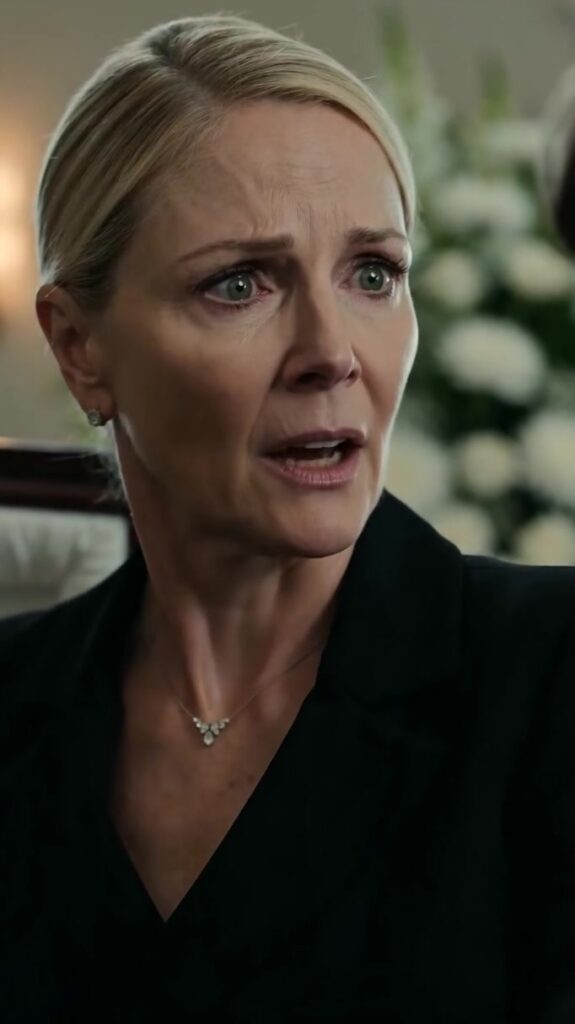
Ruth Caldwell stood at the edge of the open casket with her hands folded so tightly her knuckles looked bleached. Someone had suggested she sit, but sitting felt like admitting things were real. She kept her chin up, shoulders locked into the black blazer she’d worn to every important meeting of her adult life. The blazer had always made her feel protected. Today it just made her feel like a statue someone forgot to finish carving.
Charles lay inside the polished wood as if he’d been arranged instead of lost. His gray hair was combed back, his jaw relaxed, his mouth fixed into that nearly-smile he used when he was about to say something charming and infuriating in the same breath. The funeral director had done an impressive job of making him look like he could sit up any minute and complain about the coffee.
Behind Ruth, mourners hovered in dark coats and quieter versions of themselves. Colleagues from the foundation. A few distant relatives. Neighbors Charles had charmed during their short-lived phase of hosting dinner parties. Everyone spoke in murmurs, shifting their weight carefully, like the floor might crack if they moved too honestly.
Ruth had learned how to receive condolences the same way she’d learned to sign checks: nod, smile small, hold steady. She could do steady. Steady was the only setting she trusted.
Then she felt someone beside her.
Not a hand on her shoulder, not a whisper, just presence—close enough that her skin registered it. She turned her head and saw a teenage boy standing a half step back from the casket, as if he wasn’t sure he was allowed to get any nearer.
He wore a black hoodie, the kind that looked more like armor than clothing, with the hood down and the sleeves tugged over his hands. His sneakers were clean but cheap, out of place among polished leather and mourners who looked like they’d dressed for a board meeting. His face was pale in the too-soft lighting. His eyes were red in a way that didn’t come from one tidy cry. This was hours of swallowing something bitter.
For a moment, he just stared at her. Not at the casket, not at the flowers, not at the polite crowd. At her. Like he’d rehearsed this, and now the rehearsal was done and the real version was worse.
When he spoke, his voice came out low and controlled, but it shook around the edges anyway.
“He told me if anything ever happened to him,” the boy said, each word paced like stepping stones across a river, “you’d take care of me.”
The room didn’t exactly go silent—it already was—but it changed shape. Conversations stalled. A cough died halfway. Someone’s heels stopped clicking. It was like all the air decided to wait and see what would happen next.
Ruth turned fully toward him. Grief was still there on her face, stiff and glassy, but something else slid under it. Confusion first. Then calculation. Then the sharp, unmistakable dart of fear.
“Take care of you?” she repeated, her voice tightening, her mouth pulling into the thinnest line. “Who are you?”
The boy didn’t answer right away. His jaw worked as if he was chewing something he didn’t want to swallow. He glanced down toward the casket, and the look he gave Charles was not reverent. It was complicated—love caught in a net with anger, longing tangled with betrayal.
Ruth’s fingers clenched against the edge of the casket’s polished wood. The varnish felt too smooth, like it was trying to erase fingerprints.
“I’m not here to make a scene,” the boy said, quieter now, as if he could feel the eyes gathering on him like static. “But I’m… I’m here because he said I should come.”
“He said a lot of things,” Ruth snapped before she could stop herself. The words sounded harsher than she intended, and she saw one of the women from the foundation—Marjorie, always ready to gossip—tilt her head like a bird catching a scent.
The boy flinched, then steadied himself. His gaze locked back onto Ruth’s, wounded but determined.
“He said,” the boy continued, “you’d ask me that.”
Ruth’s stomach tightened. A prickle moved across her scalp. Charles had been sick, yes, but he’d still been Charles: planning, arranging, leaving little surprises. He’d insisted everything was taken care of. He’d made her promise to “be kind,” whatever that meant.
“Listen,” Ruth said, lowering her voice, trying to return the situation to something she could manage. “If you need money, there are services—”
“It’s not money,” the boy cut in, and his voice cracked on the last word. He swallowed, hard, like it hurt. “I don’t want your money.”
He reached into the pocket of his hoodie.
Ruth’s breath caught—not because she thought he had a weapon, but because the movement felt like a door swinging open. Several mourners shifted. A man near the back straightened, alert, like he’d spent too many years in security to ignore sudden gestures.
The boy pulled his hand out slowly.
In his fingers was a photograph. Small, worn, softened at the edges like it had been rubbed a thousand times. The corners were creased. The surface carried faint scratches that looked like years.
He held it up between them.
Ruth’s eyes dropped to it and her mind rejected it at first, the way you reject a wrong answer even when it’s written in your own handwriting.
She was in the picture. Much younger. Her hair darker and longer, her face less sharpened by decisions. Charles stood beside her, grinning like he’d just gotten away with something. And in Ruth’s arms—held close, wrapped in a pale blanket—was a baby.
Her hand flew to her mouth on instinct, fingers pressing against lips that suddenly didn’t remember how to move. The room blurred at the edges. The lilies’ scent became too sweet, almost rotten.
“No,” she whispered, but it came out more like air escaping a punctured tire.
The boy watched her, eyes glossy but steady, like he’d already cried out everything dramatic earlier, alone, and now there was only the truth left.
He turned the photograph slightly.
On the back, visible where the light caught it, was writing in Charles’s unmistakable slanted hand—dark ink faded but legible. Ruth recognized it instantly. She’d seen it on sticky notes stuck to the fridge, on the envelopes Charles pretended he didn’t care about, on the backs of napkins when he had an idea in a restaurant.
The words weren’t a dramatic confession. They were simple, almost annoyingly practical, like Charles couldn’t resist leaving instructions even from beyond the grave.
Ruth read them anyway, because her eyes wouldn’t stop.
And something inside her—something she’d sealed behind work and distance and the neat story she’d told herself for seventeen years—shifted, then cracked, then spilled forward.
The boy’s voice came softer, barely there. “My name’s Leo,” he said. “And I think you already know the rest.”
Ruth’s knees went weak, but she didn’t fall. She’d built a whole life out of not falling. She stared at the photograph until the young woman in it felt like a stranger and a warning at the same time.
In the casket, Charles looked peacefully unaware, which somehow made Ruth want to shake him awake and demand explanations like it was just another one of his secrets that could be argued into something manageable.
Instead she looked at Leo—at the line of his nose that echoed Charles’s, at the shape of his mouth that wasn’t Charles at all, at the familiar stubbornness in his eyes—and felt the room tilt into a future she hadn’t planned for.
Behind them, the murmurs started up again, the soft ripple of people pretending they weren’t listening while listening harder than ever.
Ruth lowered her hand from her mouth. Her fingers trembled, betraying her. She took the photograph carefully, like it might burn her skin, and held it close.
“I…” Her voice broke, and she cleared her throat, furious at the weakness of it. “I need to sit down.”
Leo nodded once, small and tense, as if he’d been bracing for rejection and hadn’t decided yet if this was acceptance.
Ruth looked at the casket one last time. “You absolute liar,” she thought at Charles, because it was easier than thinking the other thing: you kept your promise and left me to deal with it.
Then, with a steadiness that was more habit than strength, Ruth turned away from the flowers and the polished grief and motioned for Leo to follow.
The funeral home stayed painfully quiet, but now the silence wasn’t just about death.
It was about everything that had been hidden, finally stepping into the light.