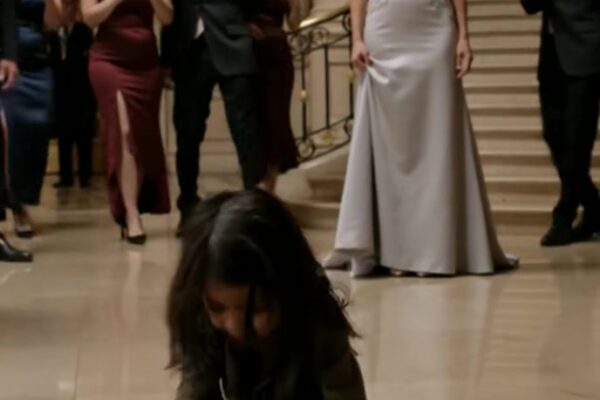
The gala was supposed to be elegant, controlled, and perfect. That was the whole pitch: money with manners, power with a string quartet, guilt scrubbed clean by a donation pledge. The ballroom in the Hart Museum glittered like it had been polished with moonlight. Everyone looked expensive. Everyone sounded delighted. Everyone, if you stood close enough, smelled faintly of stress.
Evelyn Hart sat at the center of it like an exhibit the crowd had paid to see. Her emerald gown draped over her wheelchair in a way that made the chair look almost intentional, like part of the outfit. The photographer kept asking her for “just one more angle,” as if angles could fix the fact that Evelyn’s smile never quite made it past her lips.
Adrian Cole hovered at her shoulder with the smooth patience of someone who’d practiced being indispensable. Navy suit, crisp posture, polite gaze that could sharpen into a blade the moment someone got too close. People called him loyal. People called him a saint. People also didn’t have to wake up with him standing in their doorway reminding them what pills to take and which memories were “too upsetting to chase.”
Evelyn knew she was supposed to be grateful. And she was, sometimes. Other times she felt like gratitude was just another lock on a door she couldn’t find the key to. Two years after the accident, she still couldn’t remember full weeks at a time. Her past came in fragments: the smell of rain on warm pavement, the taste of cinnamon gum, the sound of a baby crying somewhere far away. She’d asked Adrian about the baby once. He’d gone very still and then told her it was probably a TV show.
The auction began. A painting. A vintage watch. A vacation home someone donated because they were tired of it. The bids rose in silky voices. Evelyn watched the room the way you watched a pond, waiting to see if anything moved beneath the surface.
That was when the boy appeared.
He didn’t match the room. No tux, no invitation lanyard, no confident glide. Just a green hoodie pulled tight at the neck and sneakers that had clearly met too many sidewalks. He moved through the crowd like he’d been holding his breath for miles, eyes fixed straight ahead.
Adrian saw him at the same time Evelyn did. Adrian’s body shifted—subtle, but immediate—like a door swinging shut. He stepped into the boy’s path, one hand lifted in a calm, firm stop.
“You’re in the wrong place,” Adrian said, voice low and polite in that way that wasn’t actually polite.
The boy flinched. He didn’t back away. He looked past Adrian, straight at Evelyn, as if Adrian was just furniture. “I’m not here to cause trouble,” he said. His voice wobbled on the last word like it didn’t want to cooperate.
“Then leave,” Adrian replied, still smiling for the people nearby who were starting to notice.
The boy’s gaze dropped to Evelyn’s hand resting on the wheelchair arm, her fingers pale against the green fabric. “I just… I need to touch your hand,” he said. “Just for a second.”
A laugh bubbled from somewhere to Evelyn’s right—someone enjoying the drama without understanding it. Adrian’s jaw tightened. “Absolutely not.”
Evelyn should’ve been offended. Evelyn should’ve been scared. Instead a strange, aching familiarity bloomed in her chest, sudden and sharp like a bruise pressed by accident. The boy looked terrified, but his eyes held a kind of determination that felt older than his face.
Adrian leaned closer to Evelyn, his mouth near her ear. “Please don’t entertain this,” he murmured. “It’s a stunt.”
Evelyn didn’t answer him. She lifted her chin and looked at the boy. “Your name?” she asked, surprising herself with how steady she sounded.
His throat bobbed. “Miles.”
The name hit her like a dropped glass. Not the sound of it—she didn’t remember the sound. The feeling. A hallway. Bare feet on cold tile. A whispered, desperate promise: Miles, my love, I’m coming back.
Evelyn’s fingers twitched. Adrian’s hand tightened on the wheelchair handle, a warning disguised as support.
“Evelyn,” he said, sharper now, “no.”
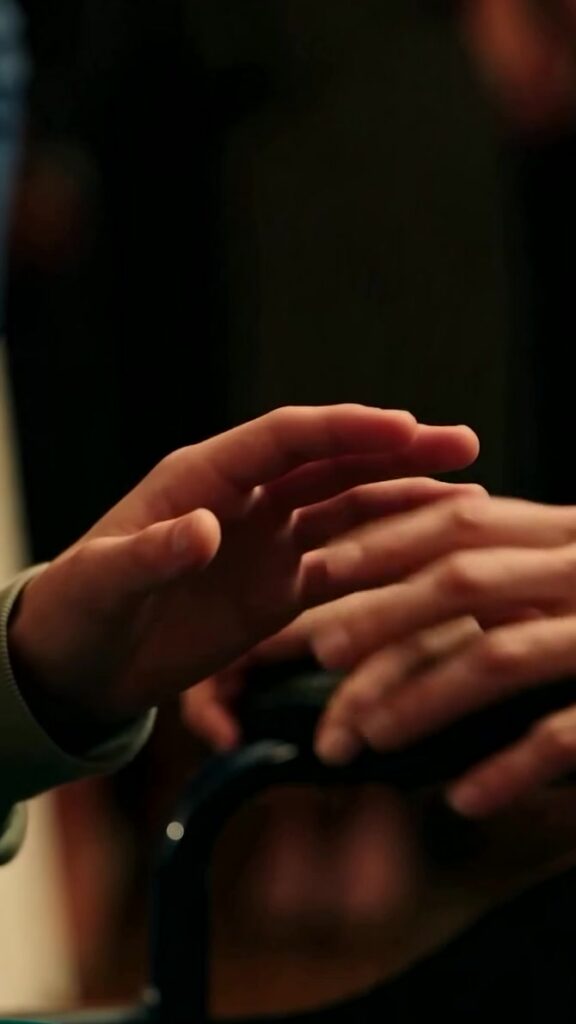
But Evelyn lifted her hand anyway, slow, deliberate, as if she were testing whether her own body still belonged to her. Miles stepped forward, trembling, and placed his hand in hers.
The world snapped.
Not like a gentle memory returning. Like a door kicked in.
White hospital light. The chemical bite of disinfectant. A nurse’s bracelet sliding against Evelyn’s wrist. A baby’s cry, ragged and furious, then suddenly muffled. Evelyn’s own voice—raw, animal—begging, “Wait, wait, please, let me hold him.” A man’s voice—Adrian’s—soft as velvet: “She’s confused. It’s for the best.”
Evelyn gasped so hard her throat hurt. Her grip on Miles’s hand tightened. Her heart hammered against her ribs like it wanted out.
Adrian’s face drained of color. For a split second, his expression wasn’t protective. It was panicked.
“Let go,” Adrian said, and it wasn’t directed at Miles. It was directed at Evelyn. Like she was the one misbehaving.
Evelyn ignored him. Her free hand slid under her sleeve, fingers hunting for a familiar edge. She found it, the broken silver half she’d worn for years without understanding why she couldn’t take it off, even when it snagged on sweaters and irritated her skin. She’d told people it was sentimental. She’d told herself it was superstition. The truth was it felt like a question she’d been carrying.
Miles reached into his hoodie pocket and pulled out the other half.
The bracelet pieces looked like they’d been snapped apart in a hurry. The metal was worn down, the clasp mangled. Two jagged edges, made to meet.
Adrian took one step forward. “Give me that.”
Miles backed up half a step without letting go of Evelyn’s hand. His voice broke. “My mom said if you ever held my hand, you’d remember.”
“Your mom?” Evelyn whispered. The room around them kept moving—auctioneer talking, glasses clinking—but it sounded far away, like she was underwater.
“You,” Miles said. “You’re my mom.”
Someone near the front actually dropped a glass. It shattered, bright and small, and heads turned like sunflowers tracking light.
Evelyn stared at Miles. He had her eyes. Not exactly, but close enough to make her stomach flip. He had the same slight tilt to his eyebrows when he tried not to cry, the same stubborn line to his mouth when he decided he would anyway.
“That’s not possible,” Adrian snapped. The polish was gone now. “This is—this is extortion. Security!”
Two guards in black suits started threading through the crowd.
Evelyn’s voice came out low, shaking. “Adrian.” She said his name like she’d just found it written in a file labeled WARNING. “Why would he have the other half?”
Adrian’s eyes flicked around—calculating, cornered. “Because someone stole it. Because people know you’re vulnerable.”
“I’m not vulnerable,” Evelyn said, and the statement surprised her with how true it felt. “I’m injured. That’s different.”
Adrian’s smile returned for a millisecond, a weapon. “Evelyn, you’re confused.”
The phrase slammed into her memory like a stamp: CONFUSED. NOT COMPETENT. TEMPORARY GUARDIANSHIP APPROVED.
Her hands went cold. “You did this,” she said. “You used the accident.”
Miles nodded fast, tears running now. “I’ve been trying to get to you for months. They wouldn’t let me. The lawyers said I didn’t have standing. The schools—” He choked. “They moved me around. Like I was a box.”
One of the guards arrived. Adrian lifted a hand, pointing at Miles as if ordering a removal of a stain.
Evelyn’s voice cut through the room, louder than she meant it to be. “Don’t touch him.”
The guard hesitated, eyes darting between Adrian and Evelyn like a tennis match.
Adrian’s tone turned coaxing, dangerous in its softness. “Evelyn, you’re making a scene.”
“Good,” she said. “I want witnesses.”
She turned her chair slightly so she faced the crowd. Dozens of faces stared back—donors, board members, reporters, people who’d spent years nodding at Adrian and calling him admirable. Evelyn felt something new rise in her throat, not panic. Anger. Clean and bright.
“Someone call my attorney,” she said. “Not Adrian’s. Mine. The one I had before my accident.” A name surfaced, sudden and solid. “Maya Rios.”
Adrian’s eyes widened. “You don’t remember—”
“I remember enough,” Evelyn said. She held up the two broken bracelet halves, hers and Miles’s, like proof. “And I’m going to remember the rest.”
Miles squeezed her hand, like he was afraid she’d disappear if he let go. “I didn’t come for money,” he whispered. “I just wanted you to look at me and know.”
Evelyn looked at him, really looked. The ache in her chest shifted into something steadier, something that made her feel less like a museum piece and more like a person.
“I know,” she said, and she didn’t pretend she knew everything. “I know you’re mine. And I know he’s been lying.”
Adrian stepped forward again, but the crowd had changed. Murmurs turned sharp. Phones came out. A reporter’s camera light flicked on, sudden and harsh.
Evelyn leaned closer to Miles, voice low, urgent, casual in the way you got when you were trying not to fall apart. “Stay by me,” she said. “No matter what he says. Okay?”
Miles nodded, wiping his face with his sleeve like a kid and not like someone who’d just walked into a room full of strangers to claim his mother.
And as the gala finally cracked open—perfect manners splitting to show the ugly machinery underneath—Evelyn felt something she hadn’t felt in two years.
Control.