The ballroom looked like it had been designed to keep reality out. Everything shimmered—glass, marble, jewelry, even the air seemed expensive. It was the kind of place where people laughed with their whole mouths open because they’d never had to learn how to laugh quietly to avoid waking someone up.
Lena stood just inside the doorway, one hand curled around the strap of a thrift-store purse that had seen better decades. Her light-blue dress wasn’t exactly torn, but it had that soft, worn look of fabric that had survived too many washes and too many prayers. She felt eyes land on her like little darts—quick, amused, and sharp.
She hadn’t planned to be here. That part was the most ridiculous. A week ago she was stacking sheet music at a community arts center, trying to keep the pages from falling apart, when an old man with a velvet voice asked her to deliver an envelope to a hotel downtown. “Ballroom. Tonight. Don’t open it,” he’d said, like he was handing her state secrets instead of stationery.
She didn’t open it. She just showed up, because curiosity is a stubborn kind of hunger.
Now the envelope sat in her purse like a small, heavy heartbeat.
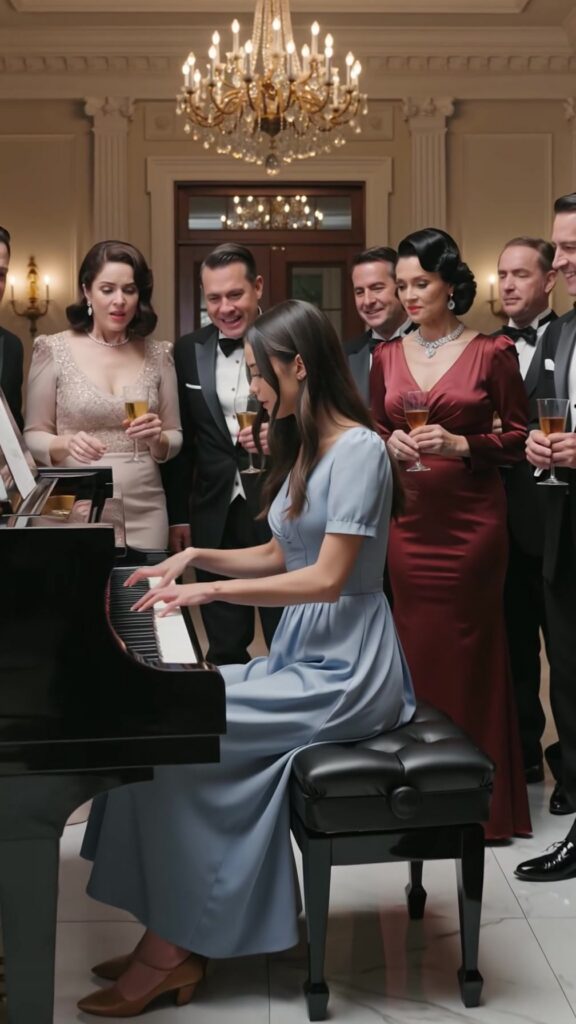
Near the center of the room, a black grand piano sat under the chandeliers like it belonged to them more than any of the guests did. The piano was glossy, spotless, and sealed shut in the way rich people seal things: not to protect it, but to announce that it didn’t need anyone.
Someone noticed her by the piano first. Then someone else. Lena watched the recognition spread in the room the same way gossip spreads in a small town: fast, delighted, and hungry for a punchline.
“Is she… staff?” a woman whispered too loudly, her diamonds winking as she turned her head.
“Maybe she’s the entertainment,” a man said, and laughed before anyone else could decide if it was funny.
Lena kept her eyes down. Not because she was ashamed—she’d outgrown shame a while ago—but because she was counting breaths, trying to stay steady. She was here for a reason. She just didn’t know which reason yet.
Then the woman in red noticed her.
It wasn’t subtle. The woman in red was the kind of person who made the room shift around her without realizing it. Her gown was the exact shade of “look at me,” and the diamonds at her throat were bright enough to make you wonder if she slept with them on. She wore her smile like a weapon that had been polished daily.
She moved toward Lena with the confidence of someone who had never been told no in a way that mattered.
“Oh,” she said, drawing the word out as if she’d discovered a strange new species. “You’re with the piano?”
Lena’s throat tightened. “I’m just—”
“Just,” the woman repeated, amused. She angled her head, eyeing Lena’s dress, her hands, her shoes. “You look like you wandered in from a bus stop.”
A few guests laughed, soft and polite like they were trained. Lena felt heat rise in her face, not from embarrassment but from anger—pure, clean anger, the kind that doesn’t need permission.
The woman in red glanced at the piano, then back at Lena. “Tell you what,” she said, loud enough for everyone to hear. “If you can play that piano, I’ll give you a hundred thousand dollars.”
That got a real laugh. The room loosened, delighted. People leaned closer. A few lifted phones like they were about to film a cute disaster.
Lena stared at the piano lid. She could leave. She should leave. She could go home to her small apartment where the radiator clanked and the upstairs neighbor practiced tap dancing for fun. She could pretend she hadn’t come here on purpose, like the envelope in her purse wasn’t burning a hole through the lining.
But then she noticed something small: the piano’s brass nameplate near the keys. It wasn’t the brand. It was an engraved plaque, almost like a dedication.
She could make out the last name.
Her last name.
Rossi.
The room kept laughing, but Lena stopped hearing it the way you stop hearing traffic when you’re about to step into the street.
She lifted her chin.
“Okay,” she said, and her voice landed soft but solid.
The woman in red blinked, almost disappointed that the girl hadn’t begged or cried. “Wonderful,” she said. “Give us a show, then.”
Lena walked to the bench. Each step felt like stepping onto ice that might crack, except the ice was their attention. She sat, smoothed her dress out of habit, and rested her hands above the keys without touching them yet.
For a second she let herself remember a different room. A cramped studio with peeling paint. A battered upright piano with sticky keys. A man with warm hands guiding hers while he hummed the melody before she could play it. Her father’s voice, low and patient: Not fast, Len. Let it breathe.
She put her fingers down.
The first notes didn’t announce themselves. They slipped into the ballroom like a secret. Not loud, not showy, but certain—clean as cold water. The kind of music that makes people stop moving without realizing why.
The laughter stuttered and died.
Glasses paused midway to mouths. Conversations unraveled. One man near the back lowered his champagne as if the bubbles suddenly felt inappropriate. An older woman near the dance floor pressed her fingertips to her lips and stared at the chandelier like she was trying to see a different ceiling through it.
Because the melody wasn’t just pretty. It was familiar in a way that made your chest ache. It sounded like something you’d heard years ago, back when you still believed in things you’d later pretend you never needed. It carried the kind of tenderness rich rooms try to buy but can’t.
The woman in red stopped smiling.
Lena watched her in the reflection of the piano’s polished surface. The woman’s posture stiffened, like someone had pulled a string tight behind her spine. Her face lost color in slow motion. Her eyes fixed on Lena’s hands as if they were doing something illegal.
Lena kept playing.
She let the melody build, letting it open into the part her father used to call the truth of the song. She didn’t rush. She didn’t show off. She just told the story the notes were designed to tell—about love that didn’t last, promises that broke, and the stubbornness of memory.
When she reached the final phrase, the room was so quiet she could hear someone’s bracelet slide down their wrist.
The last note rang and faded into the chandelier light.
Silence held on, heavy and uncomfortable. Not the silence of awe, exactly—more like the silence people make when they realize they’re not in control of the narrative anymore.
Lena lifted her hands from the keys and turned on the bench.
She looked directly at the woman in red.
“I don’t want your money,” Lena said. Her voice was calm, which surprised even her. She reached into her purse and pulled out the envelope. She didn’t open it yet. She just held it up between two fingers. “I didn’t come here for that.”
The woman in red swallowed. Her diamonds glittered like they were trying to distract everyone. “Then why are you here?” she asked, but the question came out thinner than she’d probably intended.
Lena nodded toward the piano’s nameplate, toward the engraved plaque that still said Rossi like it belonged there.
She leaned forward just a little, enough for her words to carry without shouting.
“I want you to tell them,” she said, “why that piano has my last name.”
The room shifted. People glanced at the plaque, then back at the woman in red, suddenly interested in the kind of gossip that doesn’t feel harmless anymore.
Lena finally opened the envelope. Inside was a single sheet of paper, aged at the edges, the ink slightly faded but still readable. A letter with a signature at the bottom: Giovanni Rossi.
Her father.
She didn’t read it aloud yet. She didn’t have to. She just held it where the woman in red could see the signature.
The woman’s mouth opened, then closed again. Her sharp smile tried to come back and couldn’t find its way.
Lena stood up from the bench, letting the bench creak in the quiet like punctuation.
“You made a joke out of me,” Lena said, still softly. “But that piano isn’t a toy. It’s a receipt.”
Behind the woman in red, the crowd waited, hungry in a different way now—less amused, more alert. The ballroom didn’t look untouchable anymore. It looked like it had secrets embedded in the marble.
Lena stepped away from the piano and faced the room as if it were a jury. Then she turned back to the woman in red, eyes steady.
“So,” Lena said, “are you going to tell them what you did with my father’s music… or should I?”