They had named the charity gala after a virtue no one intended to practice. Compassion Night, the invitations declared in looping silver script, as if the word itself could be bought and framed. The ballroom of the Valemont Hotel glowed with chandelier light that made every diamond seem warmer than it was, every smile more honest than it felt. A string quartet played the sort of music that never asked anyone to listen.
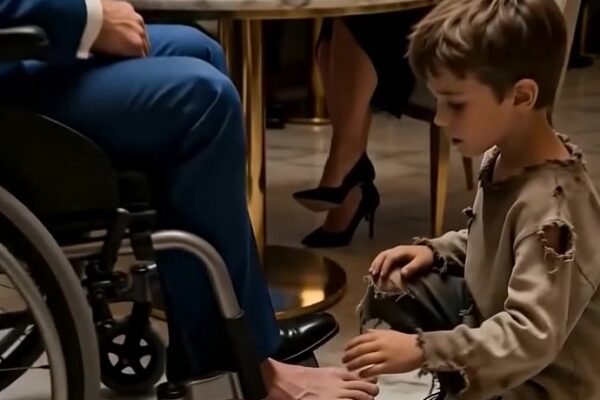
At the edge of the marble floor, a girl appeared as if the building had exhaled her from a service hallway. Bare feet, ankles gray with city dust. A dress the color of old paper hung loose on her shoulders, too big in places and too short in others, as though it had been stitched for a different life. Her hair had been brushed once, carefully, and then surrendered to the night.
Conversation snagged and snapped. Heads turned in a smooth, synchronized motion. The guests—men in tuxedos, women in lacquered gowns—watched her with the same curiosity they might give a spill: not because it mattered, but because it disrupted the shine.
She stood in the very center of the room, small as a misplaced note. One hand pressed lightly against her stomach, not dramatic, just protective, as if she feared it might betray her with a sound. Her gaze fixed on the black grand piano on the dais, its lid raised like a mouth ready to swallow anything offered.
“Could I play,” she asked, voice thin but steady, “and have something to eat?”
The words landed and waited. For a heartbeat the room held its breath, stunned by the audacity of need spoken aloud in a place built for performance.
Then laughter broke, bright and brittle. It rolled from table to table, gathering confidence. A woman in a gold-sequined gown tilted her champagne flute as if to toast the joke. “This isn’t a shelter,” she said lightly, not even bothering to lower her voice.
A man with a crimson pocket square smirked toward his friends. Another turned his shoulder away, as though hunger were contagious. Someone murmured about security, and the word “vagrant” floated across the room like perfume.
The girl’s mouth trembled, but she did not cry. She looked once at the nearest platter of untouched canapés—tiny towers of smoked salmon no one wanted because they were waiting for the entrée—and for a moment something sharper than longing flickered behind her eyes. Then she bowed her head, as if accepting the rules of the stage she’d walked onto, and climbed onto the piano bench.
The bench was too high; her legs dangled. She placed her hands above the keys, fingers hovering, uncertain only in posture. The room’s laughter thinned to a simmer. A bored guest muttered, “This should be good.”
And then she played.
The first notes were quiet enough that they seemed like a mistake, the piano barely touched. But the melody found its spine quickly. It rose with a clarity that did not belong to a child who had been sleeping, by rumor, on the streets. It was not flashy. It did not beg for applause. It simply unfolded—clean, precise, and heartbreakingly familiar, like a lullaby remembered by a body before the mind can name it.
The room changed in the way weather changes: abruptly, and with no permission asked. Conversations died mid-syllable. Glasses stopped halfway to lips. The quartet, sensing an invisible hand, fell silent, their instruments lowered like bows after a defeat. Guests leaned forward without realizing they were moving.
At the back of the ballroom, the host stood frozen beside the podium, a man in a black tuxedo with a philanthropic smile he had practiced in mirrors. Marcus Halden had built a fortune turning buildings into gleaming luxury apartments, and he had bought forgiveness in large, tax-deductible checks. Tonight he was meant to be celebrated for announcing a new foundation.
But as the child played, his face lost the smooth polish of public life. His eyes widened, not with admiration, but with recognition so sudden it seemed to bruise him.
“That tune…” he whispered, as if the words might break it. “No.”
He stepped into the aisle between tables. A waiter tried to intercept him with a tray, then thought better of it and slipped aside. Marcus moved as if pulled by a line tied to the melody itself. His chest tightened, and he pressed a hand against it, an old reflex from nights he’d thought his heart might burst with grief and guilt and the kind of regret that no money could drown.
The girl’s torn sleeve slid back with the motion of her wrist. On the inside of her arm, just above the bone, a small mark showed—faded, like ink that had tried and failed to leave. It wasn’t dramatic: a shape like a comma, pale against her skin.
Marcus halted so sharply that a woman behind him bumped his shoulder. He did not apologize. His gaze locked on that mark with the intensity of a man who has been haunted by a detail too specific to be coincidence.
“I have seen that,” he breathed. His voice was almost lost beneath the music. “I have held that arm.”
The girl did not look up. Her focus did not waver. She played as if the keys were the only solid ground she had left. The melody grew darker, sliding into chords that carried the weight of winter, of empty rooms, of a child listening for footsteps that never came.
Marcus moved closer. The guests shifted away from him like reeds parting for a storm. His wife, Lillian, rose from her table, her face tightening in confusion and irritation. “Marcus, what are you doing?” she hissed, but he did not hear her. His eyes were wet, and he seemed surprised by it, as if tears were another expense he had not authorized.
“What is your name?” he asked the girl, voice shaking.
Her hands kept moving. “Mara,” she said, barely audible, as though the word had to pass through the music to become safe. “They call me Mara.”
The name struck him like a door slamming. He had not heard it spoken aloud in eight years. Eight years of searching, of private investigators and quiet bribes, of a file in his office drawer thick with dead ends. Eight years of waking up with the same image: a hospital nursery at dawn, his newborn daughter’s wrist tagged and then, impossibly, empty.
“That’s… impossible,” Lillian whispered behind him. Her voice held a crack that the guests noticed, and for the first time the room turned its attention to her, not in admiration, but in suspicion.
Marcus’s gaze flicked to his wife—quick, sharp, like a blade. Then back to the girl. The music shifted again, and suddenly it was the lullaby he had once hummed, off-key and nervous, into a tiny bundle while rain tapped the window. He had composed it on a cheap keyboard in a hospital waiting room, thinking he could build a melody strong enough to keep the world from taking anything else from him.
“Who taught you that?” he asked.
Mara’s fingers faltered for the first time, a soft stumble that made the room flinch. She recovered instantly, but her shoulders tightened. “No one,” she said. “I just… had it in my head. Like a door that won’t close.”
Marcus swallowed hard. “Mara,” he said again, testing the word as if it could cut him. “Where did you come from?”
At that, the girl finally looked up. Her eyes were too old, their dark irises rimmed with the kind of vigilance that children learn when adults cannot be trusted. She studied his face without awe, without fear, as if he were just another person deciding whether she deserved to exist.
“From the river district,” she said. “From the shelter by the train tracks. From wherever the night puts me.” Her chin lifted a fraction. “But I think I used to come from somewhere else.”
The last chord rang out and held, vibrating through the floor, through the guests’ bones. Silence followed—real silence, not the polite pause before applause. In that silence, a truth that had been hiding beneath perfume and velvet pressed upward like a body against ice.
Marcus reached toward her wrist with a hand that trembled. “May I?” he asked, as if asking permission mattered after everything.
Mara hesitated. Then, slowly, she extended her arm.
His fingertips barely touched the faded mark. The contact seemed to undo him. A sound escaped his throat that was not a word. The guests stared, their faces drained of laughter. Somewhere, a camera shutter clicked once and then stopped, as though even curiosity had turned respectful.
“You were taken,” Marcus said, voice raw. “My baby was taken.” His gaze snapped to Lillian, and the air around her seemed to thin. “And you—”
Lillian’s lips parted. For a moment she looked like she might faint, and then her expression hardened into something desperate. “You’re making a scene,” she said, too brightly. “It’s some street con—”
Mara slid off the bench, light on her feet, ready to run. Marcus saw it—the instinct to vanish before the world could hit her again. He stepped back, palms open, forcing himself not to grab. “No,” he said softly. “No running. Not tonight.”
He turned and lifted his voice, not to command but to confess. “Someone call the police,” he said, and the word landed like thunder in a room that had always assumed the law belonged to the wealthy. “And an ambulance. And a social worker. And—” He looked at the platters of untouched food. “Bring her a plate. Now.”
Chairs scraped. A waiter hurried forward, hands shaking, and set a dish in Mara’s reach. She did not touch it immediately. She watched Marcus as if waiting for the punchline, for the laughter to return and swallow her again.
Marcus knelt, lowering himself until they were eye level. His voice softened, but it carried through the room with the weight of a vow. “They laughed at you,” he said, eyes fixed on hers, “because they could not imagine someone like you belonging in a room like this. But you do not belong to their laughter.” He swallowed. “If you’ll let me, you belong with me.”
Mara’s throat moved as she swallowed nothing at all. “Do you mean for a night?” she asked. “Like a donation?”
The question cut deeper than any accusation. Marcus’s breath shuddered. “No,” he said. “For all the nights we lost. For the rest of them.”
Behind him, the glittering room had begun to fracture. People whispered, phones slipped from pockets, eyes darted toward Lillian, whose gold bracelet suddenly looked like a shackle. The gala’s virtue, printed on invitations and engraved on crystal, finally had to face the cost of being real.
Mara glanced at the plate. Her fingers reached, trembling, and she took a small roll. She bit into it carefully, as if expecting it to vanish. When it did not, her eyes closed for the briefest moment—not in relief, but in mourning for how long it had taken to be offered something without a price.
Marcus watched her eat, and the melody she had played continued inside his skull, opening doors he had nailed shut with money and denial. In the center of the ballroom, under chandeliers that had witnessed a thousand empty toasts, the girl they had laughed at sat with crumbs on her lips and a birthmark on her wrist, and the truth rose at last—uninvited, undeniable, and far more dramatic than any performance the night had planned.