The glove lay in the gutter like a bruised petal, half-sunk in rainwater that smelled of iron and old perfume. It was too small to be a woman’s, too carefully knit to be a stray scrap, too stubbornly intact to have been chewed by the city. Mara lifted it between two fingers and felt the weight of it settle in her palm as if it had been waiting there for years.
She pressed it to her chest and walked toward the hotel because the hotel was where the warm air came from. The Grand Bellerive rose from the street like a promise made to someone else, its glass doors opening and closing with soft certainty, swallowing laughter, exhaling music. Mara had no shoes. The stone under her feet held the night’s cold like a grudge.
Guests streamed past her in coats that whispered when they moved. Their faces were practiced—eyes trained to look over what might be asked of them. Some gave her that quick sideways glance that pretended to be nothing. One man stepped wider around her without breaking his conversation. Mara stood where the revolving door’s breath could touch her cheeks and held the glove tighter, as if it could be warmer than her own hands.
Then the elderly woman emerged.
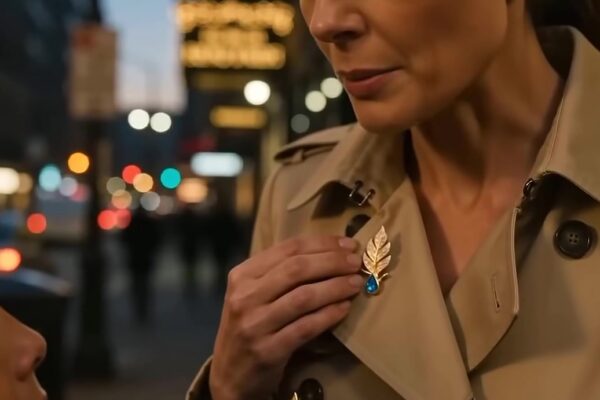
She was all quiet authority: a pale camel coat cut to the exact shape of her spine, hair pinned in a silver roll, handbag held like an extension of her wrist. She looked out at the street with the faint irritation of someone who expects the world to be arranged properly. On her right hand, a gemstone ring threw off daylight in sharp blue flashes. The stone seemed too alive for winter.
Mara’s eyes found the ring and locked. Her breath snagged. She didn’t stare because it was pretty. She stared because she knew it.
“My mom…” The words scraped out of her, hardly louder than the traffic.
The woman turned with a small, tired frown, ready to dismiss another street child. Her gaze dropped to Mara’s bare feet, then to the glove held against her chest, and the frown sharpened into impatience. “What is it you want?” she asked, the way a person speaks to a problem rather than a child.
Mara didn’t answer. She slowly raised the glove, the knit sagging at the fingers, and pointed with her other hand at the ring. The air between them tightened. For a moment, the hotel’s lights and the street’s grayness seemed to dim around that single blue stone.
The woman’s face emptied, as if some careful paint had been wiped away. Her hand tightened around the handbag so hard the leather creaked. Her chin lifted by reflex—an old defense—and then fell, a fraction, when she saw how steadily the child’s finger trembled.
A doorman, broad-shouldered in a dark uniform, noticed the silence before he noticed the cause. He stepped closer, irritation ready on his tongue, and then hesitated when he saw the woman’s expression. He’d known her for years—Mrs. Elowen Ashford, patron of the hotel’s charity gala, a name spoken with respect by the staff. He had never seen her look frightened.
Mara swallowed. Her throat ached, raw from nights spent trying not to cry. “She wore that ring,” she said, and her voice cracked on the last word. “She promised… she promised I could borrow it when I got big.”
“That’s ridiculous,” the woman said too quickly. “Many people have—” But she stopped. The glove had caught her eye now, not the pointing finger. The glove itself, the particular weave, the little snag near the thumb. Recognition moved across her like a shadow.
Mara’s hands were shaking as she began to open the glove. It was stiff from the cold and damp, but she worked the lining loose with careful, practiced motions—like someone opening a secret they’d been told to protect. “Look,” she whispered.
Inside, where no one would look unless they knew to, a name had been stitched in tiny, uneven letters, thread the color of dried rose. It wasn’t a label from a store. It was the sort of sewing done late at night by someone who couldn’t afford to lose anything. The doorman leaned in despite himself, and the letters snapped into focus.
LYDIA HART. And beneath it, smaller: FOR MARA. ALWAYS COME BACK.
The doorman went pale. He knew the name. Not because he’d met the woman, but because he’d heard it in the back corridors weeks ago, in the way staff talk when they think guests can’t hear. A missing person report. A young woman who’d worked private events. A coat found at the river. A rumor that the case had been smoothed quiet because of the people involved.
Mara looked from the glove to the ring again. Tears filled her eyes but didn’t fall. “She had this,” she said. “She made it for me. She said if I got lost, I should show it to someone safe.”
Mrs. Ashford stared at the stitched name, then at the child, as if two ghosts had stepped out of the streetlight and demanded to be acknowledged. Her lips parted. Her hand lifted toward the glove and stopped halfway, as if touching it might burn her.
Her voice came out thinner than paper. “That glove was… buried with the coat.”
Mara blinked. The word buried didn’t belong in her world, not with her mother’s name. “No,” she said, and the single syllable carried all the stubbornness she’d survived on. “I found it. I found it where the gutter runs by the river steps. Someone dropped it. Someone wanted it gone.”
Mrs. Ashford’s gemstone ring flashed again as her hand began to shake. “You don’t understand,” she murmured, but her eyes said she understood too well. “You don’t understand what you’re holding.”
“It’s my mom’s,” Mara insisted. “And that ring is hers too.”
The doorman’s mouth opened and closed. He’d been trained to keep trouble outside. But this trouble had a name, stitched in thread, and a child’s bare feet. He looked from the glove to the woman’s ring, and something in him shifted, like a bolt sliding into place.
“Mrs. Ashford,” he said quietly, “should I call—”
“No.” The word snapped out of her, sudden and sharp. She drew her hand back as if the world had tried to grab it. Then she seemed to realize how it sounded and softened her tone, too late. “No, I mean… not here.” She glanced through the glass doors toward the lobby, toward the chandelier and the people who didn’t want to see hunger. “Not in front of everyone.”
Mara stepped closer. The hotel’s warmth washed over her for a second, and she hated herself for how much she wanted it. “Where is she?” she demanded. “Where’s my mom?”
Mrs. Ashford’s throat bobbed. “I never met your mother,” she said, and the lie came out with the ease of someone who had paid for it to be practiced. But her eyes kept flicking to the glove, to the tiny words: ALWAYS COME BACK.
Mara held the glove out like evidence, like a key. “Then why do you have her ring?”
The doorman watched the woman’s face collapse in small increments. Pride tried to hold. Fear ate through it. Guilt came last, heavy as wet wool. “Because,” Mrs. Ashford whispered, and her voice broke on the single word, “someone gave it to me.”
“Who?”
Mrs. Ashford’s gaze slid past Mara to the street, to a black car waiting at the curb with its engine idling like a patient animal. Behind the tinted glass sat a silhouette—still, watching. The woman’s fingers curled around her handbag as if it were a life preserver.
“Go home,” she pleaded suddenly, and the plea had panic in it. “Go anywhere else. Please.”
Mara’s tears finally spilled, hot against cold cheeks. “I don’t have home,” she said. “I had her.”
The doorman stepped between them by instinct, not to block the child but to keep the air from crushing her. He lowered his voice. “What do you want, kid?”
Mara lifted her chin. The glove was damp now from her grip, but the letters held. “I want my mom,” she said. Then, softer, like a prayer she’d been saving, “Or I want the truth.”
Mrs. Ashford’s eyes darted again toward the waiting car. A decision fought itself behind her pupils. At last she bent slightly, bringing her expensive face closer to the child’s level, and spoke as if each syllable cost her years.
“If you keep that glove,” she whispered, “they will come back for it.”
Mara’s fingers tightened around the tiny knit, stubborn and small and certain. “Then let them,” she said. “Because I came back.”
For the first time, the ring didn’t look like treasure. It looked like stolen daylight. And in the space between the revolving doors and the winter street, the hotel’s carefully managed world began to crack, one thread at a time.