The gravel driveway glittered in the late golden light, but the moment felt too strange to be beautiful. Everything on the Mercer estate always looked like it belonged in a brochure—trimmed hedges, pale stone steps, a fountain that never stopped whispering—but that evening the air felt bent, like it was holding its breath.
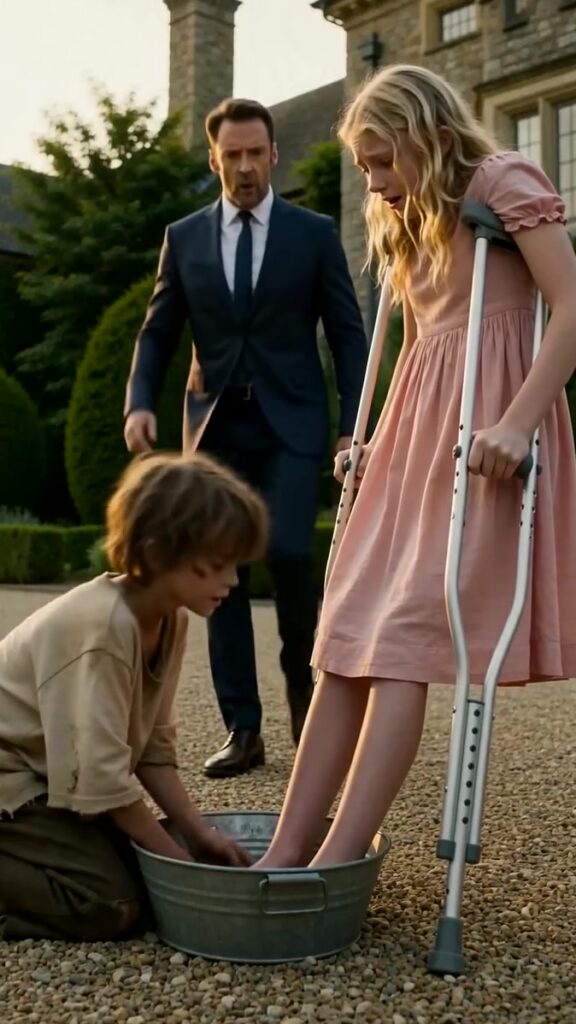
Clara Mercer stood at the edge of the driveway with her crutches wedged into the gravel, knuckles white around the handles. The tips kept sinking into the tiny stones, making her wobble in a way she hated. She’d learned how to smile through it for visitors. She’d learned how to say, “I’m fine,” like it was a joke. But right now there was nobody to impress, only a sunset and a silence that made her feel smaller than she already did.
She didn’t notice the boy at first. Not until he was already kneeling by a dented metal tub of water near the side gate, half-hidden by a row of lilacs. He looked like he’d been poured into clothes that weren’t his—beige pants too long at the cuffs, a shirt that hung off his shoulders like a borrowed curtain. His hair was dark and uneven, like someone had cut it with kitchen scissors and then given up. Dirt smudged his cheeks, but his eyes were clean and bright, the kind of bright that made Clara step back instinctively.
“You shouldn’t be here,” she said, because that’s what the rules sounded like in her head. Strays didn’t come past the gate. Workers didn’t bring their kids to the back drive. And Clara didn’t talk to strangers without someone hovering nearby to decide what she meant.
The boy looked up as if he’d been waiting for her voice. “I know,” he said. His voice wasn’t bold, exactly—more like he’d decided to be calm because panic wouldn’t help. He nodded at the tub. “Can I… can I wash your feet?”
Clara blinked. The question was so wrong it almost didn’t make sense. “What? No. Why would you—”
“Because they hurt,” he said simply, and the weird part was he didn’t say it like a guess. He said it like he’d been listening to her pain from somewhere inside it. “And because you need to feel them. You need to remember they’re yours.”
Her stomach tightened. Her accident—everyone called it that, as if the word could shrink it—had stolen half her life and then left the other half full of careful arrangements. Doctors. Therapists. A schedule of exercises that felt like chores for a body that didn’t want to cooperate. She did her work. She tried. But she’d started to believe the quiet part: that her legs were a problem to manage, not a place to live.
“I can’t,” she said automatically, because she’d said it a thousand times about a thousand things. I can’t go to the pool. I can’t climb stairs without help. I can’t run. I can’t dance. I can’t stop everyone from looking at me like I’m breakable.
The boy lowered his gaze to her bare feet—she’d slipped off her shoes because the gravel had been irritating the tender skin near her ankle brace. “You can,” he whispered, and it wasn’t a pep talk. It sounded like a promise.
Clara’s fingers tightened around the crutches. The metal felt cold even in the warm light. She should have backed away. She should have called for her father or the housekeeper. But something about the boy’s trembling hands—thin, but careful—made her stay.
He scooted the tub closer, the water catching the sunlight and breaking it into a hundred small flashes. “Just… sit,” he said, nodding at the low stone border near the lilacs. “Or lean. Whatever.”
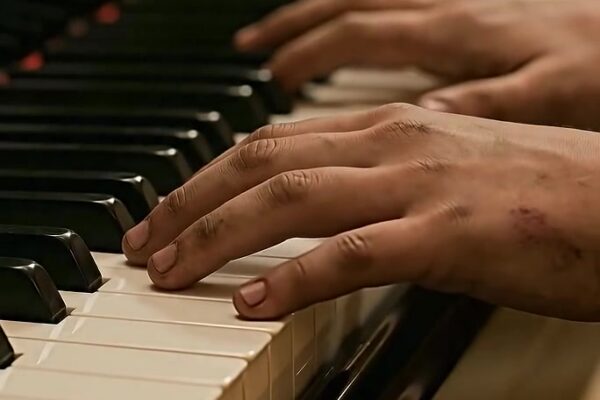
She leaned, awkward, and he guided one foot down into the water. The water was lukewarm, like it had been sitting in the sun, and it curled around her skin. He cupped water in his hands and poured it gently over her toes. The touch was so soft it almost tickled. Clara’s throat tightened with something she didn’t expect—grief, maybe, or relief, or both.
His hands shook like he was afraid of doing it wrong. Still, he moved like someone who’d done this before. Like he’d washed a lot of feet. Like he understood that sometimes kindness had to be quiet to be real.
“What’s your name?” Clara asked, and her voice came out smaller than she wanted.
“Eli,” he said. He hesitated, then added, “I used to come here. Sort of. When I was really little.”
“I’ve never seen you,” she said.
He gave a quick, almost apologetic smile. “Yeah. That makes sense.”
The gravel crunched hard behind them.
“Clara!” Her father’s voice cut through the dusk like a snapped rope. “What are you doing out here?”
Mr. Mercer strode down the driveway in a navy suit that looked too sharp for sunset. His shoes tore into the gravel, spraying stones. His expression was already halfway to furious before he even reached them, the way it always was when something happened outside the plan.
His eyes landed on Eli kneeling by the tub. The fury finished forming.
“Hey!” he barked. “Stop that. Get away from her.”
Eli flinched so hard Clara saw his shoulders jump. But he didn’t pull his hands away. He looked up, water dripping off his fingers, and said, “Please. Just a second. Please.”
Mr. Mercer was already reaching, ready to yank him back by the collar, when Clara felt it.
It wasn’t dramatic. It wasn’t like in movies where someone stands up and runs just because they believed. It was a tiny spark in a place that had been quiet for too long—a faint, unmistakable twitch in her toes.
Clara gasped, barely more than a breath, but it froze the moment the same way lightning freezes a room.
She stared down at the water. Her toes had moved again, a little ripple spreading outward as if the water itself was surprised.
“Dad,” she whispered, because her voice didn’t know what else to do. “I… I felt that.”
Mr. Mercer stopped mid-motion. His hand hung in the air, fingers curled like a claw that forgot what it came for. The anger fell off his face in pieces, replaced by shock so raw it made him look older.
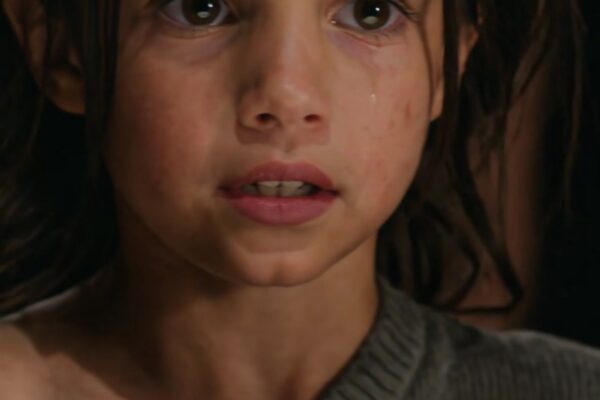
Clara’s eyes filled without permission. She hated crying in front of anyone, but this wasn’t embarrassment. This was proof. This was her body answering a question she’d stopped asking.
Eli slowly rose, water dripping from his wrists. He held his hands close to his chest like he was protecting something. Then, carefully, he opened his fist.
An old charm sat in his palm—small, worn, and familiar in a way Clara couldn’t place. It caught the last sun and glinted gold. A little medallion with a tiny engraved starburst. The kind of thing that belonged on a bracelet, or a keychain, or a life that had been lived long enough to gather meaning.
Mr. Mercer’s face changed again. The stunned silence didn’t leave, but it shifted, making room for recognition. His lips parted as if a name wanted to come out and got stuck behind old choices.
“Where did you get that?” he asked, and his voice wasn’t a command anymore. It was something weaker. Something like fear.
Eli swallowed. “My mom,” he said. “She kept it until she couldn’t. She said if I ever got desperate enough to come back here, you’d remember it.”
Clara looked between them, her heart hammering. “Dad… what is he talking about?”
Mr. Mercer’s jaw worked as if he was chewing on words he’d refused to taste for years. He stared at the charm like it was a mirror. “That’s—” he began, then stopped. His eyes flicked to Eli’s face, searching the shape of it, counting features like receipts.
Eli’s certainty didn’t waver, even though his hands still shook. “She said you used to call her Lena,” he said softly. “She said you promised you’d come back. She said you didn’t. And she said I shouldn’t hate you. Just… not trust you right away.”
The driveway glittered behind them, cruelly pretty, as if the world wanted to pretend this was just another sunset on an estate. Clara felt the ripple in her toes again—tiny, but there. Real. And suddenly it seemed connected to everything: the boy’s hands, the charm, her father’s face, the way the air held its breath.
Mr. Mercer’s shoulders sagged a fraction, like a suit suddenly too heavy. “Lena,” he repeated, and the name sounded like it had been buried and accidentally dug up. He looked at Clara, then back at Eli. “How old are you?”
“Thirteen,” Eli said. “Almost fourteen.”
Clara’s mind raced, doing math she didn’t want to do, connecting dots that made her stomach flip. She’d never had siblings. Her father had never mentioned anyone before her mother. But the charm in Eli’s hand wasn’t just familiar—it was from a photo frame in the study, half-hidden behind books. A little gold starburst charm on a chain. Clara had asked once, and her father had said, too quickly, “It was nothing.”
Apparently, it wasn’t nothing.
Eli held the charm out like an offering that might also be a test. “I didn’t come to make trouble,” he said. “I came because my mom’s gone and I don’t have anywhere that’s safe. And because… I don’t know, I thought maybe if Clara could feel her feet again, you’d have to believe something. That things can change.”
Clara’s breath shook. She stared at Eli like he was impossible. “You did that?” she whispered.
He looked embarrassed, like she’d accused him of magic. “I don’t know,” he admitted. “I just… I washed them. My grandma used to do it when my mom was sick. She said sometimes you have to remind the body it’s loved.”
Mr. Mercer’s eyes were wet now, though he didn’t let the tears fall. His voice came out rough. “Eli… I didn’t know.”
“Yeah,” Eli said, not cruelly. Just honestly. “That’s kind of the problem.”
Clara shifted her weight. The crutches sank into the gravel again, but she didn’t wobble as much. She looked down at her feet in the tub—small, pale, alive in the water—and wiggled her toes as hard as she could.
This time, they moved. Not much. Not enough to stand. But enough to make the water ripple like applause.
Clara laughed, a short, disbelieving sound that turned into a sob. “Dad,” she said again, but this time it wasn’t just a warning. It was a doorway.
Mr. Mercer stepped back like he’d been hit, then forward like he’d decided to stop running. He lowered himself onto the stone border, suit pants and all, gravel biting into the fabric. He looked at Eli, then at Clara’s feet, then at the charm still glinting in Eli’s palm.
“Come inside,” he said, and the words sounded like they cost him. “Both of you. We’re going to talk. We’re going to… we’re going to figure this out.”
Eli didn’t move right away. He watched Mr. Mercer with the cautious patience of someone who’d learned not to trust invitations. Then Clara did something that surprised herself: she reached out and touched Eli’s wrist, light as a question.
“I felt it,” she told him, voice thick. “Whatever you did… thank you.”
Eli’s mouth twitched like he wanted to smile but didn’t know if he was allowed. “Told you,” he murmured. “You can.”
The driveway still glittered, all those tiny stones catching the last gold like a thousand watching eyes. It should’ve been beautiful. But it was stranger than beauty—messier, sharper, more real. A boy with dirt on his cheeks. A girl with toes that remembered how to move. A father who suddenly had to look at the past he’d paved over.
And in the middle of it, a small, worn charm shining like it had been waiting years for the right moment to be held up to the light.