The graveyard was so quiet it felt like even grief had gone numb. The kind of quiet that didn’t soothe, but pressed against the ears until every thought turned into a bruise. Brown leaves lay matted to the ground as if the rain had hammered them there. The bare branches overhead combed the gray sky with skeletal fingers, scraping soundlessly at a world that refused to answer.
Elena had not realized she was shaking until she tasted salt at the corner of her mouth and found she had bitten her own lip. Her hands were still over her face, not to hide her tears—those had run out months ago—but to keep her from looking at the stone and believing it all over again. Beside her, Michael knelt as if his knees had been soldered to the earth. He stared at the headstone with a steady, punishing focus, like if he looked long enough, the granite would apologize.
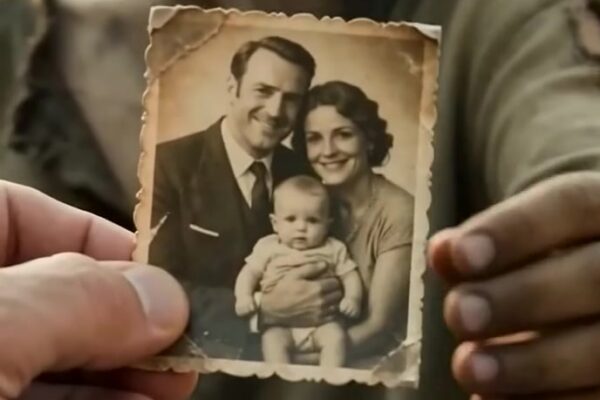
Between them, the stone held a photograph inset beneath a cloudy pane. Two little boys smiled from another season of the world: Oliver with his crooked tooth, Jonah with his dimples that arrived before laughter did. Forever young. Forever clean. Forever untouched by smoke.
Six months since the fire at St. Agnes Home. Six months since they were told there were no bodies to show. Six months since the closed caskets, the pastor’s careful words, the social worker’s eyes trained on the floor. There had been a bracelet recovered, they said. A scrap of clothing that could be recognized. Enough to allow grief to be filed and stamped, to let the system move on.
But Michael had never screamed at the stone, not once. It took too much oxygen. He saved what air he had for breathing, and even that felt like a debt he shouldn’t be allowed to keep.
The leaves shifted.
Elena’s first thought was that a fox had slipped through the rows of names, that some small animal had come to scavenge among the offerings left to the dead. She lowered her hands and looked through a veil of wet lashes.
A child stood on the other side of the grave.
She was barefoot. Her feet were raw-red, mottled with cold and dirt. She wore a thin smock that might once have been white, now torn at the hem and darkened by mud. Her hair was pale and tangled, stuck to her cheeks as if she had been crying for days, though her face held no tears now—only an odd stillness, as if she’d been waiting for the right moment to step into their sorrow.
Elena could not hear her own breath.
Michael’s head turned fast, the movement sharp enough to carry anger with it. His hand went to the ground as if searching for balance or a weapon, as if even here, among stones, the world could still take more from them.
The girl lifted one finger and pointed directly at the photograph.
“They’re not gone.”
The words fell into the quiet and struck it like a bell. Elena’s grief—numb, set, familiar—flinched. Confusion cut through her like a blade that made no blood but hurt just the same.
Michael half rose from his knees, his voice low and rough, built from months of swallowed sound. “What did you say?”
The girl did not step back. Her finger stayed steady against the glass covering the boys’ faces, reverent but not gentle. Her eyes were pale, too pale, the color of rainwater caught in a bucket.
“They stay with me.”
Elena’s mouth opened, but nothing came. Comfort would have been unbearable enough; this was something else. Knowledge. Certainty. The kind that didn’t belong in a child’s mouth.
Elena crawled one step closer on the wet leaves, as if her body had decided it needed to know before her mind could argue. “Who are you?” Her voice shook so hard it sounded like it belonged to someone else.
The girl pointed to one boy in the photograph, then the other. “Both of them.”
Michael stood too quickly. Leaves crunched beneath his shoes, loud as gunshots in the hush. “Where?”
The girl lowered her hand slowly, as if the gesture cost her. For a moment she looked past them, toward the cemetery gate, beyond the iron arch that marked the boundary between the city and this field of finished stories.
“At the orphanage,” she said, with impossible innocence.
Elena’s skin drained of color. Not pale—white, as if all the blood had fled to hide. The orphanage. St. Agnes. The same name spoken in the same way it had been spoken in the hospital waiting room while smoke still clung to Michael’s coat from when he’d tried to push through the cordon. Closed caskets. Smoke damage. Nothing recognizable except a bracelet and the last things the paperwork allowed.
Michael’s throat made a sound that was not a sob and not a laugh. It was the noise a man makes when the universe turns inside out. “Take us there,” he said, and his voice broke on the last word.
The girl turned toward the gate, and Elena stumbled upright. Her knees felt wrong, as if her body had been built for kneeling and not for walking forward again. Michael reached for the child, desperate not to lose her the way everything else had been lost—
His hand froze inches from her shoulder.
Something was tied around her wrist: a faded blue friendship string, frayed and dirty, looped twice and knotted the way Oliver had always done it, tongue caught between his teeth as he concentrated. Elena had made those strings from a bundle of embroidery floss in the summer before the boys were taken into St. Agnes “temporarily.” She had braided them at the kitchen table. She could still see Jonah’s little fingers trying to help, making the strands twist into useless knots.
Michael’s face tightened as if he’d been struck. “Where did you get that?”
The girl glanced down at the string as if she’d forgotten it was there. “He gave it to me,” she said. “So I’d remember.”
“Remember what?” Elena whispered, but she already knew the question was too small for whatever was happening.
The girl began walking. Not hurried. Not afraid. Her bare feet made no sound in the leaves, and yet the leaves still moved out of her way, as if the ground itself recognized her.
Michael and Elena followed, their bodies obeying an instinct older than reason: follow the one who might lead you to your children. Their breaths came harsh and visible in the cold. The cemetery gate stood open. Elena did not remember it being open when they arrived.
Outside, the road lay slick with rain. The city’s hum was muted by distance, as if even traffic had agreed to keep its voice down. The girl walked along the shoulder, her thin smock fluttering, her hair snagging on the wind like a flag no one had raised on purpose.
As they moved, memory marched beside them. The night of the fire. The sirens. The smoke swallowing the building’s windows until the glass looked black. The director of St. Agnes, Sister Catherine, standing in the chaos with her hands folded as if prayer could make the flames orderly. The list of names. The assurances. The paperwork that meant there would be no viewing. A sealed end to every question.
Elena had accepted it because there was no other option. Acceptance had been forced on her like a gag.
Now the gag loosened, and something wild rose in its place.
The orphanage appeared at the end of the road like a memory that refused to stay buried. St. Agnes was closed now, its windows boarded, the front doors chained. The sign had been taken down, leaving two pale rectangles on the brick where letters once cast shadows. The place looked dead, and that alone made Elena’s heart beat harder. Dead things were not supposed to hold children.
The girl stopped at the front steps. She looked up at the darkened doorway, then back at Michael and Elena. For the first time, her calm certainty cracked enough to show something like weariness.
“They’re inside,” she said. “But it’s not like you think.”
Michael’s hands trembled at his sides, fists clenched and unclenched as if he could squeeze an answer out of the air. “Open it,” he said, meaning the doors, meaning the world.
The girl lifted her wrist, the blue string dangling like a small drowned ribbon. “He said you would come,” she murmured, and her voice softened around the words as though she had carried them for a long time. “He said your love would be louder than the fire.”
Elena’s eyes filled then, not with the old grief but with something sharp and bright. Hope, painful as light after months in the dark.
The girl placed her palm against the chained doors. The chains did not rattle. The locks did not click. Instead, the air itself seemed to shift, thickening as if the building exhaled.
From inside, faintly, came a sound Elena would have recognized anywhere: a child’s laugh, quick and breathless, followed by another, two voices braiding together like blue thread.
Michael made a strangled noise and stepped forward, pressing his forehead to the cold wood. Elena reached for him, for the girl, for anything solid.
The graveyard behind them remained silent, but the silence was no longer numb. It had become a held breath, waiting to see whether the living would dare to reclaim what had been buried too soon.
And as the door began to give, Elena understood with terrifying clarity that whatever was on the other side would demand more than tears. It would demand every last ounce of courage grief had left untouched.