The concert was supposed to start the way these things always did: a polite cough, a few forced laughs, and then applause that sounded like somebody crinkling expensive wrapping paper. The Hawthorne Conservatory’s spring recital was less about music and more about proof—proof your kid was “cultured,” proof you donated, proof you belonged in velvet seats under chandeliers that had never seen a fingerprint.
Row A was basically a museum exhibit of local money. And right in the middle sat Graham Vale, the kind of man who had a building downtown with his last name in brushed steel. He wore a suit that probably had its own insurance policy. The headmistress leaned toward him every so often, like his nod alone kept the conservatory’s heating turned on.
Onstage, the grand piano waited in a perfect pool of light. The bench sat dead center like a dare. Parents glanced at their programs and checked phones set to silent but not really, because glowing screens still announced, “I’m busy being important.” The music teacher, Mr. Larkin, was ready to introduce the first student with a smile so rehearsed it could have been laminated.
Then the side doors opened, not dramatically, just… wrong. A thin squeak of hinges cut through the pre-concert murmur. People turned their heads like it was part of the show. A little girl stepped in, and at first the room tried to make sense of her the way it made sense of everything: by labeling it. Student? Lost? Costume? But her sweater was torn at the elbow, the kind of tear you don’t style on purpose. Her shoes looked like they’d given up last winter and were only still going because nobody had asked them to stop. She held her arms tight to her body like she was trying to keep all her heat from escaping.
A few whispers rose fast, the way gossip does when it thinks it’s doing a public service. Someone in the front row said, too loudly, “Is she from the shelter?” Another person replied, “Someone should get security.” A woman with pearl earrings leaned toward her husband and muttered, “She doesn’t belong on that stage,” as if the stage were a private club with a dress code.
The girl didn’t sprint. She didn’t apologize. She walked up the aisle like the building owed her an answer. When she reached the steps to the stage, Mr. Larkin moved toward her, palms out, gentle but panicked. “Sweetheart,” he started, voice low, “you can’t—”
She looked right past him, scanning the front row until her eyes found Graham Vale. For a second, something flickered across her face—fear mixed with determination, like she’d practiced this moment in her head a hundred times and still wasn’t ready. She swallowed so hard you could see it. “My mom said…” Her voice was barely more than breath. “…you’d know the last note.”
A couple people laughed, nervous little snorts like they wanted to break the tension before it became real. Graham’s expression didn’t change at first. Rich men were trained to be unbothered. But his gaze sharpened, not on her clothes now, not on the spectacle, but on her face. Like he was searching for something familiar in a photograph that had been damaged.
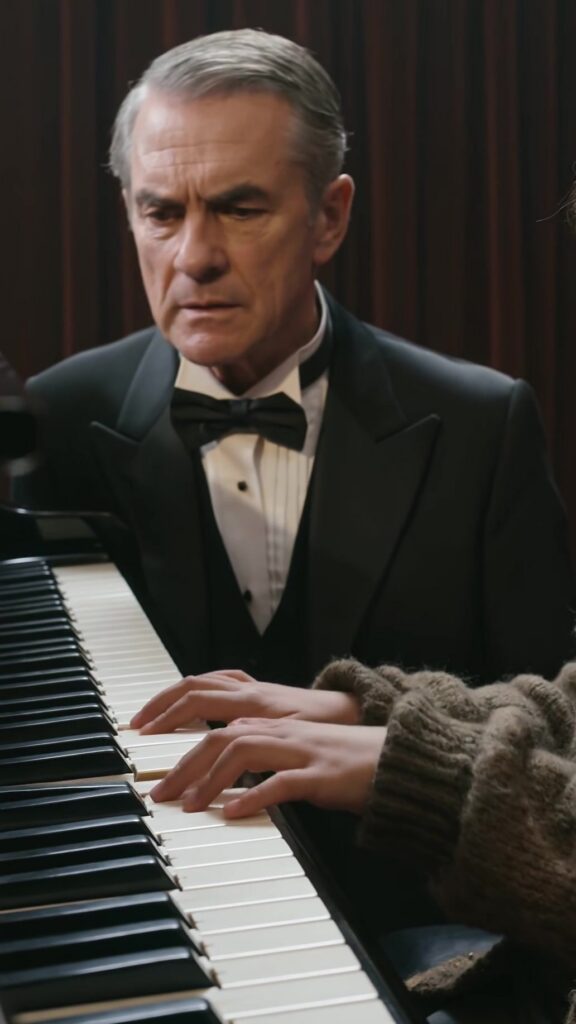
The girl reached the bench and hovered, hands shaking. She pressed her fingers together as if they might fly away. Mr. Larkin took one more step toward her, then stopped. Not because he suddenly approved, but because something in the air shifted. The girl sat. Her feet didn’t touch the floor. She lifted her fingers over the keys like she was about to touch a sleeping animal.
And then she played three notes.
Soft. Not showy. Not the beginning of any recital piece in the program. Three notes that sounded like a door opening in a dark hallway. The sound wasn’t loud, but it moved through the room anyway, slipping past silk and perfume and the careful walls people built around themselves. Graham Vale’s hand slid off the armrest as if his body forgot how furniture worked. His smile vanished. His chest lifted—then froze. It wasn’t dramatic; it was worse. It was involuntary, like his lungs had reached for air and found an old memory instead.
The girl kept playing, and the melody that followed wasn’t polished. It wobbled. It had tiny cracks where her fingers hesitated. But it carried a feeling so specific it made the room feel suddenly too small. It wasn’t a “piece.” It was a message. A tune remembered from someone humming it while doing dishes, while brushing hair, while trying to make a cheap apartment feel safe. It sounded like a lullaby that had learned how to survive.
Mr. Larkin stood rooted near the wing, eyes wide. He whispered without meaning to, “That ending…” The headmistress turned sharply. “What is it?” she hissed. Mr. Larkin didn’t look at her. He looked at Graham Vale and said, almost to himself, “Only one student ever learned it that way.”
Graham pushed himself up so abruptly his chair scraped the floor, a harsh, ugly noise that made several people flinch. He didn’t care. He stared at the girl like she’d reached into his chest and grabbed something he’d locked away. His mouth opened, then closed again. It looked like he wanted to speak but didn’t trust his voice. His eyes shone, not with tears yet—rich men didn’t cry in public—but with the kind of shock that comes right before the dam breaks.
The girl reached the last line of the melody. Her fingers hovered, trembling, and for a moment the whole hall seemed to hold its breath along with Graham Vale. She pressed one final key. The note rang out, thin and clear. It lingered, and in that lingering was the answer to some question nobody else in the room even knew existed.
She lifted her hands off the keys like they burned. Then she looked up at him, eyes wet but stubborn, like she refused to let the tears win in front of people who’d already decided she was nothing. “She said you’d know,” the girl whispered again, louder this time. “She said you’d remember.”
Graham took one step toward the stage, then another, moving like a man crossing ice he didn’t trust. “What’s your name?” he asked, and his voice came out rough, scraped raw. The girl’s chin quivered. “I’m Maya,” she said. “My mom was Elenie.”
His face changed in a way money couldn’t hide. The room watched the richest man in it go pale. Someone in Row B breathed, “Oh my God,” like they’d just realized this wasn’t a disruption, it was a collision.
Graham’s hands shook as he gripped the edge of the stage. “Elenie Vale?” he managed. The girl blinked hard. “She said you didn’t know about me,” Maya said, and the sentence landed like a stone dropped into still water. “She said you left before the last note. But she taught me anyway. She said if I ever needed you… I should play it exactly like this.”
For a long moment, nobody moved. Not the headmistress. Not Mr. Larkin. Not the parents with their expensive shoes. All they could do was watch as Graham Vale—man of mergers, man of headlines—stood there with his mouth slightly open, trying to remember how to breathe around the sound of a lullaby he’d thought was gone forever.
He nodded once, small and broken, and whispered, “I know the last note.” Then, louder, as if speaking to the whole room and also to himself, he said, “And I know your mother.” He reached out his hand toward Maya, not like a patron offering charity, but like a person asking permission. “Come here,” he said softly. “Please. Let’s get you warm.”
Somewhere in the back, a phone slipped from someone’s fingers and clattered to the floor. Nobody laughed this time. The hall that had been built for performance finally met something real, and it didn’t know what to do with it except go silent and listen.