The hotel lobby looked too beautiful for something cruel to happen there. Light spilled from chandeliers like molten gold, pooling on marble that had been polished to the point of dishonesty. Every surface was designed to reassure: velvet chairs that promised comfort, lilies that promised purity, a pianist above the mezzanine offering a melody soft enough to be mistaken for safety.
People moved through the space as if they belonged to it by birthright. Black coats, careful perfume, diamonds that caught the light and returned it sharpened. Laughter arrived in measured portions. Even the revolving door seemed to turn politely.
Near the grand staircase, where a red carpet climbed toward private floors and private lives, a small girl stood very still. Her sleeves were too short, her shoes split at the toes, her hair pulled into a knot that had given up. She clutched a stuffed rabbit—old, threadbare, one ear sagging—as if it were a living thing that might wander away if she loosened her grip. She watched the lobby not with curiosity, but with a patient dread, the kind that comes from keeping a promise no adult bothered to keep for you.
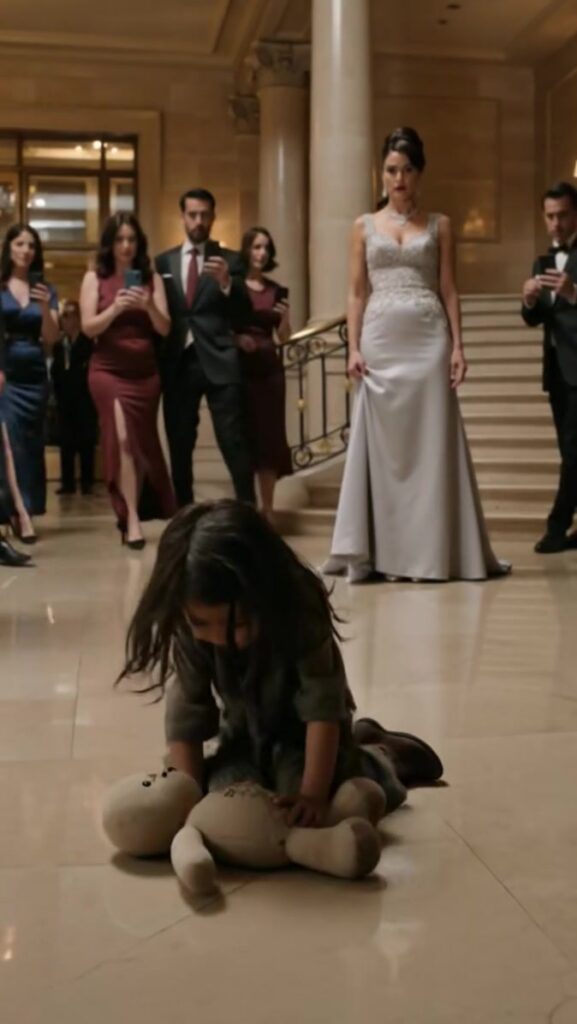
The cruelty arrived in a form the lobby understood: glossy heels, tailored wool, a handbag that looked like it had never touched the ground. A woman in a pearl-gray coat stepped out of a group of guests and paused, as though the sight of the child was a stain on the air. Her lips twisted with the practiced disgust of someone used to having staff erase inconveniences. Without asking a question, without lowering her voice, she reached out and tore the rabbit from the girl’s hands.
The toy arced across the marble and skidded, leaving a faint scrape as if the floor itself protested. “Take your trash and get out,” the woman said, crisp and loud enough for the pianist to falter. “Before guests think this place is a shelter.”
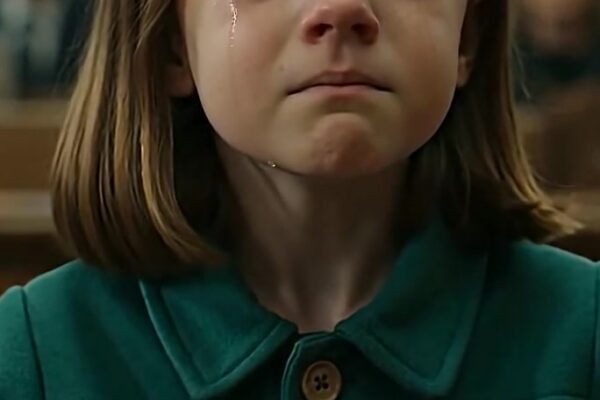
Heads turned as if pulled by string. A few guests laughed under their breath. Several phones rose—bright black rectangles ready to convert humiliation into entertainment. The doorman, a young man with immaculate gloves, shifted his weight and looked toward the front desk, searching for permission to act like a human being. The girl, for a heartbeat, seemed not to understand what had happened. Then her face collapsed. She ran, stumbled, and dropped to her knees on the cold stone, gathering the rabbit to her chest with both arms like it was her heart and she was trying to keep it inside her.
“Please,” she whispered, not to the woman, not to the lobby, but to the rabbit itself. Tears streaked through the grime on her cheeks. “My mother said to wait here,” she said, voice cracking, “until the man who gave me this saw me.”
The woman let out a thin laugh, the sound of a glass being tapped to demand attention. “What man? The one who taught you to beg? There’s a back entrance for deliveries. Use it.” She leaned closer, and her perfume cut through the scent of lilies with something sharp and metallic. “Or better—don’t come back.”
At the far side of the lobby, behind the front desk where the marble counter was veined with onyx, the hotel manager had stopped moving. He was an elderly man with silver hair combed into place and a suit that fit him like a uniform he had never been allowed to remove. His name badge read HENRY MAREK, though most employees simply called him Mr. Marek in the same tone they used for weather and warnings.
His gaze was fixed on the rabbit. Not on its raggedness, not on the fact that a child had bled her dignity onto the lobby floor for a stranger’s amusement. He was staring at the rabbit’s left paw, where a strip of faded blue fabric had been sewn on and stitched with two looping letters. The girl’s fingers trembled around the toy, and the paw turned just enough for him to see the initials clearly.
His face drained of color. Something in his posture—usually so precise, so controlled—buckled. He stepped out from behind the desk, forgetting the line of guests waiting to check in, forgetting the unspoken rules that kept the lobby smooth and silent. His shoes struck the marble with a sound too loud for such a beautiful room. “Those stitches,” he said, the words barely forming. “Those initials…”
The glamorous woman turned, annoyed at being interrupted, then caught the expression on the manager’s face and hesitated. Mr. Marek’s eyes were wet, and that alone was an outrage in this place. “Where did you get that?” he asked the girl, his voice trembling as if he were speaking to a ghost.
The girl hugged the rabbit tighter. She looked from his face to the chandelier light above him, as if deciding whether the world was about to hit her again. “A man gave it to my mother,” she said. “He had a ring with a lion on it. He said it belonged to this hotel. He said if anything ever happened, I should come here and wait where the stairs begin.” Her gaze flicked toward the staircase, the carpet, the glittering rail. “He said someone would know.”
A whisper moved through the lobby—soft at first, then swelling. Mr. Marek swallowed, and it looked painful. “The lion ring,” he repeated, as if tasting the memory. “The owner’s signet.” He took a step closer, careful, like approaching a frightened animal. “Little one,” he said, voice gentler now, “tell me your mother’s name.”
The girl’s mouth tightened. For a moment she looked impossibly old. “Mara,” she said. “Mara Halden.” The name fell into the lobby like a dropped plate. Somewhere behind them, the pianist stopped entirely.
The woman in pearls went rigid. Her hand, which had been resting lightly on her handbag, clenched. Her eyes darted to the phones, to the doorman, to the manager. “That’s—” she began, but her voice failed. In the silence that followed, people who had been smiling a moment ago looked away, as if elegance could protect them from guilt.
Mr. Marek’s jaw worked as though the words had thorns. “Mara Halden vanished eleven years ago,” he said, each syllable precise and lethal. “Her daughter was never found.” He knelt—actually knelt—on the immaculate marble in front of the crying child, and the sound of fabric against stone seemed to shock the room more than anything else. “I was here that night,” he whispered. “I sewed those initials myself, because the child was afraid her rabbit would get lost.”
The girl’s eyes widened. In them, the lobby lights finally reflected as something other than cold. “You… you know her?” she asked, voice small enough to disappear.
Mr. Marek nodded once, a motion full of unbearable regret. He reached into his inner pocket and drew out a keycard holder embossed with a tiny lion. His hand shook so hard the card rattled. “Stay with me,” he said, and it was not a request but a vow. He looked up, and the softness drained from his face as he stared across the lobby at the woman in pearls. “Call security,” he told the doorman, then corrected himself, voice cutting clean through the space. “No. Call the police.”
The woman’s composure cracked like ice. She took a step back, then another, heels clicking too fast for grace. “This is ridiculous,” she said, too loudly. “A street child with a story—”
But Mr. Marek was no longer listening to excuses. He was listening to the rabbit’s stitches. He was listening to the years he had spent working beneath chandeliers, keeping the hotel flawless, while a secret rotted quietly behind locked doors and polite smiles. He rose, and suddenly the lobby did not look like a sanctuary. It looked like a stage built to hide a trapdoor.
The guests stood frozen, their phones still raised, recording not a joke but the beginning of a reckoning. The chandeliers continued to glow. The lilies continued to pretend. Yet something had changed, irrevocably, in the space between the grand staircase and the child’s trembling arms.
She had not come by mistake. She had come carrying proof that this hotel’s beauty was not innocence—it was camouflage. And in the terrible, exquisite silence that followed, everyone understood that the cruel thing had not just happened here.
It had been living here all along.