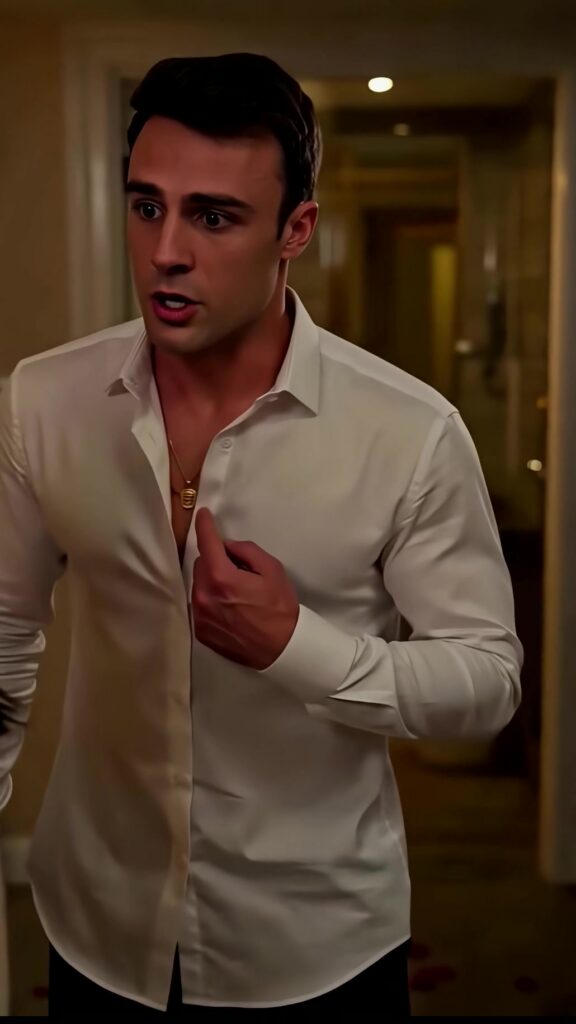
The hotel room was supposed to feel perfect. Mira had imagined it in little flashes for weeks—like a movie scene she could step into and finally stop holding her breath. The Grand Orsini had sent a polite email promising rose petals and chilled champagne, and the suite delivered on every promise with the precision of a stage set. Cream-colored sheets folded into an impossible smoothness. Lamps casting honeyed light onto burgundy drapes. A silver bucket sweating quietly in the corner, the ice collapsing in slow, private sighs.
She stood in the doorway for a moment, taking it in as if she could absorb calm through her skin. Her fingers tightened around the strap of her overnight bag. In the mirror across the room, she saw herself—hair pinned, lipstick carefully chosen, a robe that felt too luxurious to be real. She looked like a woman who belonged here. Like the kind of person who didn’t still wake up to smoke in her throat.
“You’re staring,” Adrian said, amused. He had already loosened his tie, already moved like he owned the space, like nothing had ever tried to take him away. He crossed the room, the light catching in his dark hair. “I wanted it to feel… right.”
“It does,” Mira whispered. She stepped inside and let the door click shut behind her. That sound—soft, final—made something in her chest unclench. For one evening, there would be no hospitals, no grief rituals, no sympathy voices telling her she’d been brave. Just this. A room where the air smelled of roses instead of antiseptic.
Adrian reached for her, guiding her to the bed with the ease of a man who knew how to be gentle without seeming careful. He kissed her temple. She laughed once, breathy and shy, and sat at the edge of the mattress. The petals clung to her knees like tiny red secrets.
He turned away to open the champagne, his shirt half unbuttoned. Mira watched him, letting the warmth of the lamps soften every sharp edge of thought.
And then the world snapped.
Adrian lifted the bottle, and his shirt gaped wider as he leaned. Mira’s gaze fell—unintentionally, innocently—to the pale skin beneath. Two details cut through her like sudden cold. First: a scar, old and dark, angled across his chest as if something had tried to carve him open. Second: a small pendant resting against his skin, gold and worn smooth, shaped like a tiny flame enclosed in a circle.
Mira’s mouth went dry. Her pulse leapt as if it recognized the shape before her mind could. She turned her head toward her open suitcase on the bed—the one she’d left half unpacked. In the top pocket, half visible, lay the same kind of pendant, its chain coiled like a sleeping snake. Identical. Not similar. The same design, the same tiny nick on the edge where metal had been scraped.
Her breath broke in the middle.
“Adrian,” she managed, and her voice didn’t sound like hers. “What is that?”
He froze mid-motion, champagne bottle angled awkwardly. His eyes flicked downward. For a heartbeat, he looked like he was trying to decide whether to lie. Then his face paled so fast it almost made him look younger, less composed, as though some inner boy had stepped forward and shoved the man aside.
“Mira,” he said, both hands lifting, the bottle abandoned on the dresser. “Please—let me talk.”
She shook her head before she even knew why. The room, perfect a second ago, turned dangerous. The petals looked like spilled blood. The warm lights felt theatrical, like they were hiding something rotten.
“No,” she whispered. “No, no.”
She backed away across the bed, moving on her knees, as if the distance mattered. As if space could keep her safe from whatever truth had just stepped out of his open shirt.
Adrian took a careful step toward her. “Don’t do this,” he pleaded. “Not yet.”
“Who are you?” The question tore itself from her. It wasn’t dramatic; it was pure, animal terror.
That stopped him cold.
His eyes dropped, not to her face but to the suitcase. Something had shifted when she moved—clothes sliding, the side pocket yawning open. A small photograph fluttered loose and landed on the cream bedspread between them like a fallen leaf.
Adrian stared at it. Whatever fear he’d worn a moment ago drained away and left something worse in its place: recognition so sharp it looked like pain.
He stepped closer without thinking, drawn to the photograph as if it held a magnet. His voice came out rough. “Where did you get that?”
Mira’s fingers clenched around a dress she’d grabbed without meaning to pack. She stared at the photo too: a faded image of a baby wrapped in a blanket, cheeks smudged, eyes wide and startled. On the baby’s wrist, even in the poor lighting of the old picture, was a thin bracelet with a charm shaped like a flame in a circle.
“My mother,” Mira said, and her throat burned. “She gave it to me before she… before she died. She said it was the only thing that survived.”
The suite went quiet in a way that felt wrong for a room built for romance. Even the air conditioner seemed to hush. Mira could hear the tiny drip of meltwater from the champagne bucket, steady as a clock.
Adrian’s gaze moved from the photo to the pendant in her suitcase, then back to the scar on his chest, and finally to her face. His eyes shone with something shattered. “Your mother,” he whispered, as though repeating the phrase could make it less impossible. “She’s gone?”
Mira swallowed. “A year. Cancer.”
Adrian flinched, as if the word had struck him. He sank to the edge of the bed, not touching her, hands clasped tightly enough to whiten his knuckles. “I didn’t know,” he said. “I swear to you, I didn’t know.”
“Know what?” Mira demanded. She hated how small her voice sounded. She hated how the room—this perfect room—had become a trap with no exits. “Why do you have that pendant?”
He looked up at her, and when he spoke, it wasn’t the polished tone of a man used to boardrooms and charming dinners. It was raw. “Because it was put on me when I was carried out of a building on fire.”
Mira’s stomach dropped. The word fire didn’t belong in a room with rose petals. It belonged to her nightmares. It belonged to the smell that still sometimes rose from her own skin on hot days, phantom smoke, phantom heat.
“What are you talking about?” she whispered, though some part of her already understood.
Adrian’s gaze slid to the photograph again. “There was a home,” he said slowly, as if each memory was a shard he had to lift carefully. “An old place on Lark Street. They called it an orphanage, but it wasn’t… not really. There were records, and secrets, and people who paid to keep children quiet. One night it burned. I remember heat. Screaming. Someone pulling me through smoke. Then nothing.” He touched the scar on his chest, fingers trembling. “I woke up in a hospital with this.” He held the pendant, letting it catch the lamplight. “They told me it was mine. That it was all I had.”
Mira couldn’t move. Her mind flashed to her mother’s tight grip on her hand in the hospital bed, the way she’d pressed the pendant into Mira’s palm as if it were a key. Keep it. If you ever feel lost, this will find you.
“My mother said she carried me out,” Mira said, and her voice broke apart. “She said she wasn’t supposed to be there, that she was trying to do the right thing for once. She never explained what that meant.”
Adrian’s eyes filled, but he didn’t let the tears fall. “Then you’re the girl,” he said, and the words sounded like a confession and a curse. “The one they said didn’t make it. The one I heard crying—behind me—right before the ceiling collapsed.”
Mira’s knees gave out, and she sat hard on the bed. The petals crushed beneath her like fragile bones. “Why are you here?” she demanded, though her anger had no place to land. “Why did you find me?”
Adrian shook his head, and he looked genuinely terrified. “I didn’t. Not on purpose.” He exhaled shakily, as though he’d been holding his breath for years. “I’ve spent my life trying to understand who I was before the smoke. I traced the pendant to a jeweler who said it was part of a small batch made for a charity gala decades ago. I found a list of donors. A name that matched yours. I thought it was coincidence.” His gaze lifted, aching. “Then I met you, and you felt familiar in a way that scared me. Like I’d known you before I knew anything.”
Mira stared at him, at the scar, at the pendant, at the man she’d let into her body and her bed and her carefully rebuilt life. Her hands went to her suitcase out of instinct, fingers touching the second pendant like proof she wasn’t imagining it.
The perfect room glittered around them, suddenly obscene in its romance. Two glasses waited untouched on a tray. The champagne sat unopened. A celebration planned for a love story, and instead a door had cracked open onto something older and darker.
“My mother,” Mira whispered, the realization rising like bile, “she didn’t just save me.”
Adrian’s jaw tightened. “No.”
“She took me,” Mira said, and the words tasted like ash. “Didn’t she?”
Adrian didn’t answer immediately, which was its own answer. He looked down at the photograph one more time, and when he finally spoke, his voice was quiet enough to be swallowed by the warm light. “I think we were meant to disappear. Both of us.”
Mira’s eyes burned. She grabbed the photo and the pendant from her suitcase, clutching them to her chest like armor. “Then why does it feel like you’re the one thing that’s been following me my whole life?”
Adrian’s gaze held hers, unflinching now. “Because you’ve been following me too,” he said. “And the people who set that place on fire didn’t finish the job.”
In the corner, the champagne bucket gave a final soft clink as the last cube of ice collapsed. The sound landed between them like a warning. The hotel room had been designed to make everything feel safe. But safety, Mira realized, had never been part of the story. Only survival. Only the terrible, miraculous fact that they were still here—and someone, somewhere, might not want them to stay that way.