The first thing you notice about the Hollis house isn’t the size or the chandeliers or the way the air smells like lemon polish and money. It’s the sound. Marble doesn’t forgive. Every footstep turns into an announcement. Every dropped spoon becomes a headline.
So when the mop clattered against the foyer floor, it didn’t just make a noise. It rang out like a bell. Like the house itself had decided to tattletale.
Mia, who was seven and skinny in the way kids get when growth spurts steal their appetite, stared at the mop handle like it had betrayed her. Her hands were red, raw around the fingers, the kind of red you get from scrubbing something that doesn’t want to come clean. Her knees folded under her before she even meant to kneel, and tears slipped out quiet at first, then heavier, like they were tired of being held in.
“Again,” said Dara from the beige armchair.
Dara wasn’t old, but she had the sort of face that looked permanently unimpressed, like she’d been born mid-eye-roll. She sat with one ankle on the other knee, one hand in a crinkly chip bag, the other lazily scrolling her phone. If you didn’t know better, you’d think she was babysitting a movie, not a kid.
Mia blinked hard and tried to wipe her cheeks with her wrist, but that only smeared the tears into little shiny streaks. “I did it,” she said, voice thin.
Dara tilted her head toward the floor as if the marble had personally offended her. “Do you see those streaks? Because I see streaks.” She popped another chip into her mouth and chewed like she had all the time in the world. “Clean it again.”
Mia looked down at her palms. Her fingers trembled. “My hands hurt.”
“Then cry quieter.” Dara’s words came out calm, almost bored, like she was offering weather advice.
Mia’s lower lip tried to hold steady and failed. “Please,” she whispered. “I want Dad.”
Dara smiled, small and sharp. “He’s busy. And he won’t see this.”
Above them, tucked into the molding where the foyer met the staircase, a security camera blinked a steady red light. The kind of red that means you’re being recorded, but not necessarily protected.
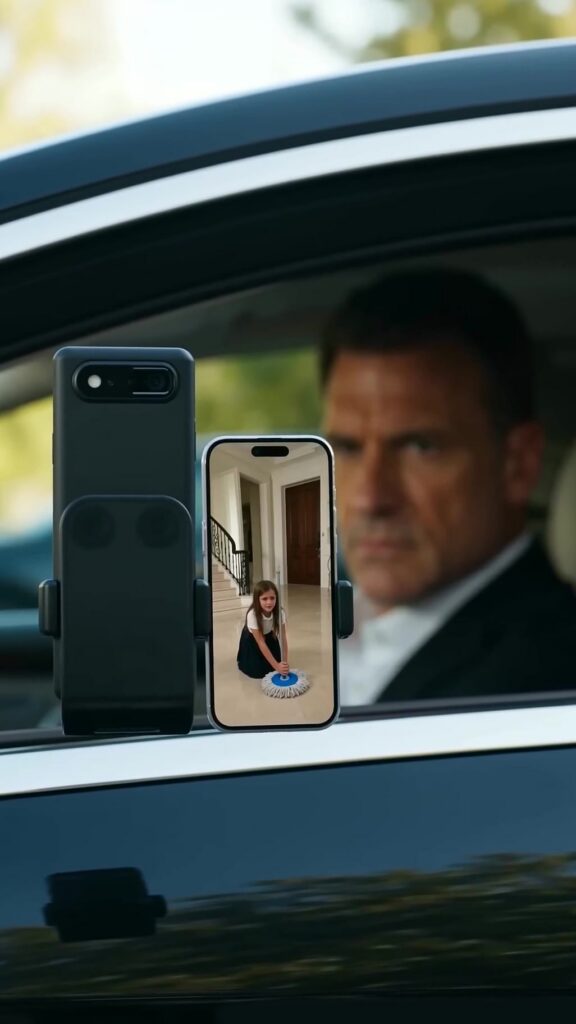
Outside, in the long driveway where the landscaping was so manicured it looked fake, Mark Hollis sat in his car with the engine off. He was still in his suit from the office, tie loosened, collar undone, the kind of end-of-day mess that made him look more human than usual. His phone was propped on the steering wheel, live footage filling the screen.
He had checked the cameras out of habit at first. A quick glance between calls. The nanny cam in the kitchen, the driveway feed, the hallway. He’d told himself it was about security. About peace of mind. About being the kind of father who didn’t miss things.
Then he heard Dara’s voice through the tiny speaker.
Again.
Then cry quieter.
Mark didn’t move. For a second he genuinely couldn’t. Like his body had forgotten how. The video showed his daughter on her knees on marble that cost more than his first car, scrubbing like a tiny prisoner. Her shoulders shook with the kind of crying that tries to be polite.
His grip tightened on the phone until his knuckles went pale. He’d hired Dara two months ago after the last housekeeper quit with a weird excuse about “not being the right fit.” Dara had seemed efficient. She’d smiled a lot during the interview. She’d said she loved kids. She’d said she understood “structure.”
Mark stared at the camera’s red blink in the corner of the feed. “I see everything,” he said, but the words came out more like he was reminding himself.
He slid the phone into his palm, opened the car door, and stepped out into the evening air. He didn’t slam the door; he didn’t need to. In his head, he could already hear the sound marble would make when he crossed it.
Inside, Dara kept chewing. She had one of those faces that looked relaxed when she was being cruel, like it cost her nothing. She watched Mia drag the mop back toward the bucket with the slow, careful movements of someone trying not to get yelled at for moving too loudly.
“There,” Mia said after another pass. She sniffed, hopeful for half a second, like maybe this time would be good enough.
Dara’s eyes flicked over the floor. “Nope.” She shrugged. “You’re leaving lines.”
Mia’s shoulders caved. “I can’t—”
“You can,” Dara said, and now there was a sweetness to it that made it worse. “You’re just being dramatic.”
The front door handle turned.
It wasn’t the usual quick, confident turn of someone coming home to relax. It was slow. Deliberate. Like whoever was on the other side wanted the sound to travel.
Dara froze mid-chew. Her eyes snapped to the door. “What was that?” she muttered, more to herself than anyone else, and for the first time since she’d sat down, she looked unsettled.
The door opened.
Mark stepped in without speaking. He didn’t take off his shoes. He didn’t hang up his coat because he wasn’t wearing one. He stood in the foyer as if the house had suddenly shrunk around him.
Mia’s head lifted. Her face was blotchy and wet, but her eyes brightened the second she recognized him. “Dad?”
Dara’s chip bag crinkled in her hand. “Mr. Hollis— I didn’t know you were—”
“Home?” Mark finished, and his voice was calm in a way that was almost frightening. He walked forward, and each step echoed. “Yeah. Funny thing.”
Dara stood up quickly, wiping her fingers on her pants. “I was just— We were practicing cleaning. She spilled—”
“She didn’t spill.” Mark looked past Dara and down at Mia’s hands. He crouched next to his daughter without asking permission from the room. He gently turned her palms up. The skin looked scraped, angry, like she’d been rubbing it against rough rope. “Did you make her do this?”
Mia opened her mouth, then shut it. Her eyes darted toward Dara, the way kids look when they’ve been taught that telling the truth has consequences.
Mark noticed. That tiny glance landed in his chest like a stone. He stood, slow, and faced Dara.
“There’s a camera right there,” he said, pointing up with two fingers. “It’s been recording the entire time.”
Dara’s smile appeared on instinct, like she could charm her way out of gravity. “Cameras? Oh, wow. I didn’t realize—”
Mark pulled out his phone and tapped it awake. The live feed popped up. The foyer, the beige chair, Dara’s hand in a chip bag, Mia on her knees. He turned the screen toward Dara like he was showing her a picture she’d asked to see.
Dara’s face changed. The smile didn’t just fade; it fell off. “That’s… that doesn’t show the context.”
“Context?” Mark repeated. He didn’t raise his voice. He didn’t have to. The word landed heavy. “Tell me the context where ‘cry quieter’ is acceptable.”
Dara swallowed. “Kids need discipline. You told me you wanted her to be responsible.”
Mark nodded once, slowly, like he was considering it. Then he said, “Responsible doesn’t mean afraid.” He looked down at Mia. “Sweetheart, go upstairs. Go to your room and wash your hands with warm water. Use the soft towel. The blue one.”
Mia hesitated, then stood. Her legs wobbled from kneeling on hard stone. When she passed Mark, she clung to his sleeve for half a second, just enough contact to prove he was real.
When she was halfway up the stairs, Mark spoke again, his eyes still on Dara. “You’re done here.”
Dara scoffed, trying to recover her swagger. “You can’t just—”
“I can,” Mark said. “And I am.” He walked to the side table by the door, picked up the small notepad where household staff wrote schedules, and tore off a page. He scribbled something, then held it out like a receipt. “This is your final pay plus an extra week. Not because you deserve it. Because I don’t want you coming back for anything.”
Dara didn’t take the paper. Her chin lifted. “You’re overreacting. She’s fine.”
Mark’s gaze sharpened. “If you ever say she’s fine again, we’re going to have a different kind of conversation.” He leaned slightly toward her, just enough to make her step back. “You know what you didn’t count on?”
Dara’s eyes flicked toward the camera, then away.
“You didn’t count on me watching,” Mark said. “Every second.”
The house felt quieter after that, like it was waiting for Dara to argue. But she didn’t. She grabbed her purse from the armchair with stiff movements, her pride trying to hold itself together in pieces. At the door, she paused like she wanted a last word, something sharp and victorious.
Mark opened the door wider for her. “Go.”
Dara stepped onto the porch, and the evening swallowed her up.
When the door clicked shut, Mark exhaled. It came out shaky, like he’d been holding his breath for weeks and only just realized it. He turned and looked up the stairs, where the camera’s red light kept blinking, steady and patient.
He walked to the base of the staircase and called softly, “Mia?”
Her little voice floated down from above. “Yeah?”
“I’m coming up,” he said. “And I’m not going anywhere.”
He took the steps two at a time, not caring about the noise anymore. Let the marble announce it. Let the whole house hear him, loud and clear, choosing his daughter over the silence he’d been paying for.
In the foyer, the mop lay where Mia had dropped it, still damp, still crooked. Mark paused on the landing and glanced back at it, then at the camera.
“Good,” he murmured, not to the camera, but to himself. “Keep blinking.”