The little girl had been crying long before Adrian Cole stopped his car, and it wasn’t the loud, messy kind that makes strangers hurry over. It was the kind you do when you’ve already decided no one is coming—when you’re trying to keep it quiet so the world won’t notice you’re breaking apart.
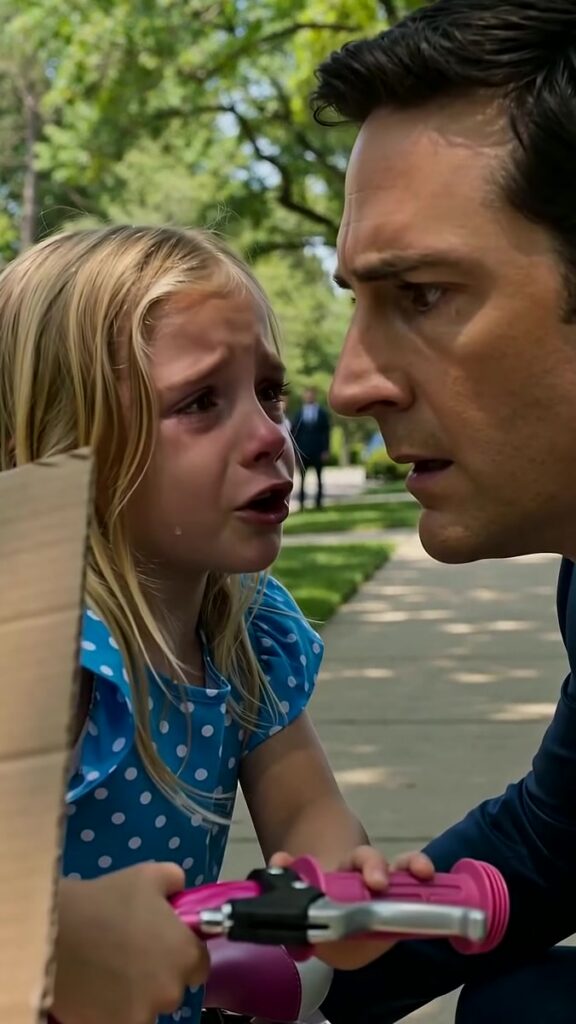
Adrian only meant to take the next left, head down, suit jacket folded on the passenger seat because June in the city was basically a practical joke. He was already late for a meeting he didn’t want to attend anyway—another round of smiling at men who treated people like line items. Then he saw her on the sidewalk, sunshine hitting her blue polka-dot dress, a too-big pink bike beside her with a hand-lettered FOR SALE sign wobbling off the handlebars.
It should’ve been a cute scene in a different universe. In this neighborhood, kids didn’t sell bikes on corners. They got new ones for birthdays, then another new one when they got bored of the first.
Adrian braked on instinct and rolled to the curb. He sat for half a second, watching her press her wrist to her face like she was trying to wipe the crying away before it showed. And then he was out of the car, shutting the door softly, moving slow like you do around skittish animals.
He crouched a few feet away. “Hey,” he said, making his voice smaller than it usually was. “You okay?”
The girl blinked hard, like her eyes hurt from doing their job too long. One hand clamped the bicycle grip as if the bike might float away without her. “Sir,” she said, breath trembling, “would you buy my bike?”
Adrian’s mouth opened, then shut. “Why would you sell it?”
Her lower lip quivered like it was thinking about running away. “My mom hasn’t eaten in days,” she said, fast, as if speed would make it less real. “So I’m selling my bike.”
The sentence hit him in the ribs. He’d grown up with a father who owned half a dozen buildings within a mile of where they stood. Hunger in this part of town was supposed to be theoretical. A concept you donated to, not a thing you could touch.
“Where’s your mom?” Adrian asked, keeping his eyes on her face and not on the sign, not on the pink bike with scuffed pedals like it had actually been loved.
The girl’s gaze flicked over his shoulder, not toward any house, not toward a driveway, but down the street.
Adrian followed her look with the smallest turn of his head.
A black SUV sat halfway down the block, too clean, too patient. Three men in dark suits leaned near it, pretending they weren’t watching. One of them wasn’t pretending very hard.
Adrian felt the old, familiar chill of being observed. He’d spent enough of his life around security teams to recognize the posture: the casual stance that was actually readiness.
He turned back to the girl. “Did you come here by yourself?”
She shook her head once, sharp. “She told me to sell it before they took her.”
The air seemed to change, thicker, like someone had lowered a ceiling.
“Who took her?” Adrian asked, and he hated how careful his voice sounded now.
The girl swallowed. Tears slid down her cheeks in slow lines. “She said… if I ever saw you… I should ask for Daniel.”
Adrian went still in a way he hadn’t been still in years.
Daniel.
Not a name people used around him. Not a name that existed in official conversations. His younger brother, the brother who had been pronounced dead after a fire at a warehouse none of them were allowed to visit, the brother their father had erased like a typo.
Adrian’s eyes dropped to the bike as if his mind needed something physical to hold onto. Tied beneath the sign was a thin ribbon bracelet, sun-faded, the stitching nearly white. Two initials were still readable if you knew how to look.
D.M.
Adrian’s throat tightened. Daniel had braided those bracelets when he was nineteen and romantic and reckless, looping them around anything he wanted to mark as important. Adrian remembered one tied to their mother’s rearview mirror. Remembered their father ripping it off and tossing it like trash.
The girl grabbed Adrian’s sleeve, sudden and desperate. “Please,” she whispered, “don’t let them see you with me.”
Adrian lifted his gaze to her face. The eyes. The little dip at the corner of her mouth when she tried to hold it together. He didn’t want to see it, but it was there anyway—familiar in a way that made his stomach drop.
One of the men near the SUV started walking toward them.
“Step away from her, sir,” the man called, loud enough to sound polite, sharp enough to cut.
Adrian didn’t move away. He rose smoothly, putting his body between the girl and the street without making it obvious. “She’s selling a bike,” Adrian said, casual like this was normal. “I’m buying it.”
The suited man closed the distance, eyes flicking over Adrian’s tailored shirt, the watch on his wrist, the car at the curb. Recognition flashed—tiny and unpleasant. “Mr. Cole,” the man said, tone shifting. “Didn’t realize it was you.”
“Yeah,” Adrian said. “Funny how that works. What’s your name?”
The man hesitated. “Harris.”
“Harris,” Adrian repeated, like he was tasting it. “Who do you work for?”
Harris’s smile was thin enough to be a blade. “Private client. Family matter.”
Adrian laughed once, dry. “Family matter,” he echoed. “That’s cute.”
The girl’s fingers were still tangled in Adrian’s sleeve, shaking. Adrian reached down and unhooked her hand gently, then took it himself—steady, deliberate. “What’s your name?” he asked her softly.
She hesitated, eyes darting to Harris. “Maya,” she whispered.
Adrian nodded. “Maya, I’m going to do something weird, okay? You’re going to get in my car. You’re going to buckle your seat belt. And you’re going to look at me the whole time like I’m the most boring man you’ve ever met.”
Maya sniffed. “Okay.”
Harris stepped forward. “Mr. Cole, I can’t allow—”
Adrian’s voice dropped, suddenly not casual at all. “You can’t allow what?” He leaned in just enough that only Harris would hear. “A little girl riding with someone whose last name is on half the deeds in this neighborhood? Try it.”
Harris’s jaw tightened. He glanced at the SUV. The other men were moving now, but slower, unsure. Adrian could see the calculation: risk versus reward. Headlines were always bad for “private clients.”
Adrian guided Maya toward his car. With his free hand, he pulled out his phone, thumb hovering. He didn’t dial 911. He hit a contact labeled simply: LENA.
It rang once.
“Adrian?” Lena’s voice came through, alert immediately.
“I need you,” Adrian said, eyes on Harris. “Now. And I need a location on Daniel. If he’s alive—if he’s anywhere—I need him before my father’s people do.”
There was a pause, the kind where a person swallows a lot of questions and chooses one. “Where are you?” Lena asked.
“North Briarwood,” Adrian said. “And I have a kid named Maya with me.”
Another pause, smaller. “Oh,” Lena said, understanding arriving like a door slamming. “Okay. Don’t hang up. I’m patching in.”
Adrian opened the passenger door for Maya. She climbed in, clutching the ribbon bracelet like it was a key. Adrian buckled her seat belt himself because his hands needed something to do besides shake.
He shut the door and turned back toward Harris, who had stopped two steps away, like an invisible line had been drawn. “Tell your client,” Adrian said, voice calm as glass, “that if he wants to have a conversation about family, he can call me directly. And if he wants to send men to scare children again, I’ll make it expensive.”
Harris’s eyes narrowed. “You don’t know what you’re stepping into.”
Adrian looked at the SUV, the men, the polished threat of them, and felt something old and hot wake up in his chest. “Actually,” he said, “I think I’m finally stepping out.”
He slid into the driver’s seat, started the engine, and pulled away from the curb without speeding—because panic was what predators expected. In the passenger seat, Maya stared straight ahead, tears still drying on her cheeks.
“Maya,” Adrian said gently as he drove, “when was the last time you saw your mom?”
She squeezed the bracelet so hard her knuckles blanched. “This morning,” she whispered. “She said to be brave and to find you. She said you’d remember Daniel, even if everyone else pretended not to.”
Adrian’s grip tightened on the steering wheel. “I do,” he said. His voice cracked on the truth. “I remember him.”
Outside, the city rolled on like nothing had changed. Inside the car, everything had.
And somewhere behind them, the black SUV eased off the curb, following at a distance that almost looked polite.
Adrian glanced at the rearview mirror, then at Maya. “Okay,” he said, making a promise to both of them, even if he wasn’t sure how he’d keep it yet. “We’re going to find your mom. And we’re going to find Daniel.”
Maya finally looked at him. “You’re sure?” she asked, like she’d been disappointed by adults so many times that certainty sounded suspicious.
Adrian swallowed. “No,” he admitted, honest. “But I’m not stopping.”