The little girl screamed like the flowers were alive when the planner crushed them under her heel.
It wasn’t a cute little yelp either. It was the kind of sound that makes grown-ups turn their heads and immediately feel guilty, even if they weren’t the ones who did it. The morning market had been humming—coins clinking, fishmongers yelling prices, someone somewhere testing a speaker too loud—and then the noise snapped in half.
On the golden-brown tiles of the aisle, petals scattered like somebody had burst a tiny sun. Yellow flecks against dust, bright enough to look fake. The girl dropped to her knees and started scooping them up with both hands, as if she could just put the bouquet back together by wanting it hard enough. Her fingers were already smudged with pollen and dirt. She kept grabbing for pieces that wouldn’t stay.
“Move your trash,” the woman said, like she was talking to a broken sign, not a child. She was dressed in a cream suit that probably had its own insurance policy, and her shoes—pointy heels with a shine like glass—had done the damage. She held a clipboard under one arm, the kind with a shiny metal clamp, and a phone in the other hand like she was in the middle of a call even though the screen was dark.
The girl’s face was blotchy, cheeks wet, hair braided too tight like someone had done it carefully and early. She clutched a ribbon in one fist, pink and thin, the kind you tie on a gift when you don’t have wrapping paper. “It’s for my mom,” she said, and the words came out jagged. She lifted the ribbon as if it could prove something. As if it could make the crushed flowers a mistake instead of a choice.
The planner—because that’s what everyone called her, even people who didn’t know her name—looked down like she was evaluating a stain. “Not with those flowers,” she said. “If you’re going to give something, at least give something decent.”
“She asked for yellow ones,” the girl insisted. Her voice cracked right down the middle. “She said yellow makes the room feel less… less like it’s trying to be sad.” She tried again to stack broken stems together, hands shaking so much the petals kept slipping away. “I promised.”
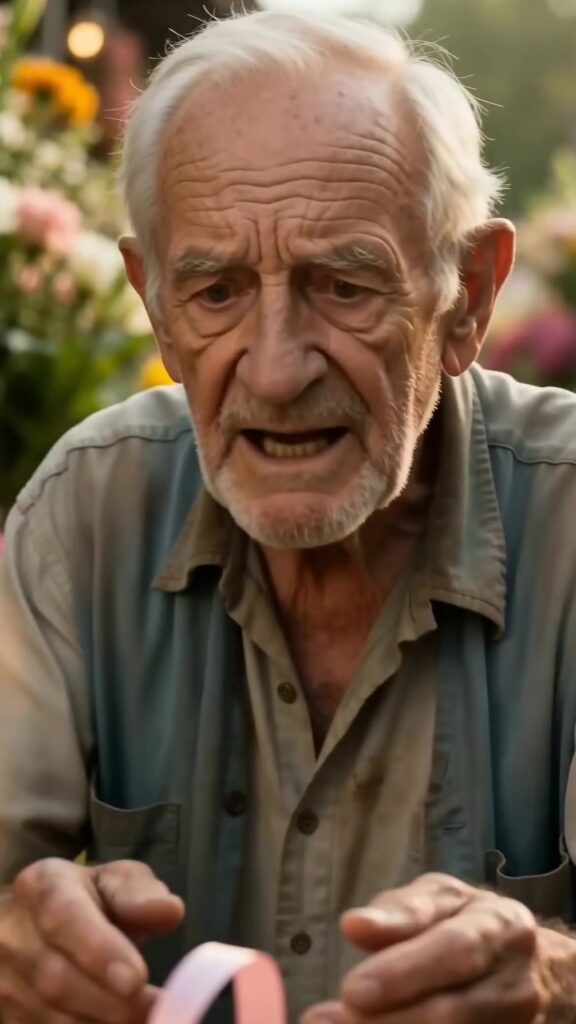
Across the stall, the old flower seller went still. His name was Halim, but most people just called him Uncle, the way you do when you’ve bought something from the same person for years and you’ve watched their hair go from black to silver. He had been trimming stems with a small knife, quick hands, steady hands, hands that smelled like green. Now the knife hovered in the air.
Halim had seen thousands of ribbons. Cheap ones, fancy ones, ribbons tied by bored boyfriends and nervous husbands and kids trying their best. But there was something about this pink strip—the way it had been looped, the way the knot was pulled tight like the ribbon itself was holding its breath. And on the inside edge, faint but clear, someone had pressed numbers into the fabric with a pen so hard it left an imprint: 7B-14. A room number. Not an address. Not a code. A room.
“Let me see that ribbon,” Halim said softly. He didn’t mean it like a demand. It came out like instinct.
The planner’s head snapped up. Her smile sharpened into something bright and unpleasant. “Don’t encourage her,” she said. “She’s blocking the aisle.”
But Halim had already stepped around a bucket of daisies. His knees creaked when he crouched, and he didn’t try to hide it. He held out his palm, open. The girl hesitated, then placed the ribbon in his hand like it was fragile. Halim turned it over and saw the pressed numbers again, and his throat tightened. He’d spent enough time visiting people in hospitals to know the look of those codes. He’d also spent enough time delivering bouquets to understand what people tried to say with flowers when they couldn’t say it out loud.
“That’s a hospital room,” he murmured, mostly to himself. “Seventh floor. Wing B.”
The girl’s shoulders shook harder. “She’s waiting,” she said. “She said she didn’t want visitors today, but she said I could come. She said I could bring sunshine.”
Halim started to ask her name, started to ask which hospital, started to ask the questions that adults ask when they’re trying to decide how much help they can afford to offer. But then he noticed the planner’s clipboard, and the way her fingers tightened around its edge. A corner of paper peeked out from under the metal clamp, folded like someone had tried to hide it in plain sight. When the breeze shifted, the fold lifted, just enough for Halim to catch a glimpse of the same code: 7B-14. Written in neat, impatient strokes.
The planner saw his eyes flick, and her hand moved fast. She slid the paper back under the clamp and tucked the clipboard against her body like a shield. “That’s none of your business,” she said, too quickly. “I’m here on a site walkthrough. This market is a hazard. Kids sitting in the aisle, broken stems everywhere—”
Halim didn’t stand up right away. He looked at the crushed flowers, then at the planner’s immaculate heel. He pictured the hospital corridor he’d walked last month, the way the air there always smelled like bleach and overcooked vegetables, the way people talked in whispers even when they weren’t sad yet. He pictured room 7B-14. He pictured a woman trying to pretend her room was not closing in on her.
“You’re going there too,” Halim said. He didn’t phrase it as a question. He held the ribbon up between two fingers. “Same room.”
For a second, the planner’s face slipped. Just a flash, gone almost as soon as it appeared—something like panic, or shame, or both. Then her expression smoothed back into professional marble. “I don’t know what you think you saw,” she said, voice clipped. “And even if I was, it wouldn’t matter. She doesn’t need… this.” She gestured at the mess on the floor like it was proof of incompetence. “She needs something appropriate.”
The girl blinked up at her. “Do you… do you know my mom?” she asked, like the idea was too big to pick up.
The planner didn’t answer. She stared at the ribbon, at the smudged ink numbers, and it was obvious she hadn’t known those numbers were pressed into the fabric. Like she’d written them somewhere safe and thought that meant she controlled them.
Halim stood, slowly, using his thighs the way old men do when they refuse help. “Here’s what’s going to happen,” he said, in the same tone he used when teenage boys tried to haggle like it was a sport. “You’re both going to stop acting like the flowers are the problem.”
The planner huffed, offended on principle. “Excuse me?”
Halim nodded toward his stall. “You,” he said to the girl, “tell me exactly how many yellow ones your mother asked for. Not what you could afford. Not what you thought was pretty. Exactly how many.”
The girl sniffed, rubbed her sleeve across her face, and whispered, “Twelve. She said a dozen looks like somebody planned it.”
Halim smiled, small and sad. “Twelve it is.” He reached into a bucket and selected blooms carefully—marigolds, small sunflowers, something with tiny golden stars—building a bouquet that looked like morning, like stubbornness, like a promise someone could hold. Then he reached under the counter and pulled out a fresh ribbon, same shade of pink, and he tied it with a knot that didn’t tremble.
He handed the bouquet to the girl first. “For your mother,” he said. “And for you, because you’re doing the hard part.”
The girl hugged it like it could keep her upright. “Thank you,” she breathed.
Halim turned to the planner and held out the old ribbon—the one with the pressed room number. “And for you,” he said, “this is your reminder to stop stepping on things you don’t understand.”
The planner’s jaw worked, as if she was chewing on words she didn’t want to swallow. Finally she took the ribbon, but her fingers didn’t look expensive anymore. They looked tired. Human. “I didn’t mean to—” she began, then cut herself off like apologies were a language she’d never learned properly. “I’m… her daughter too,” she said instead, the confession falling out in a rush. “From her first marriage.”
The girl’s eyes went wide. “You’re my sister?”
The planner flinched at the word, as if it pinched. “I didn’t know about you until last week,” she admitted. “I came here because I thought—” She glanced down the aisle, at the market, at the ordinary chaos of people buying ordinary things while the world kept moving. “I thought if I handled the logistics, if I scheduled the visits and the paperwork and the… arrangements, I wouldn’t have to feel anything.”
Halim nodded like that made perfect, painful sense. “Planners love control,” he said. “Hospitals don’t give it.”
The girl shifted closer, bouquet trembling a little in her arms. “She really wants yellow,” she said, offering the information like a bridge. “She said it makes the room less scary.”
The planner looked at the flowers, then at the crushed petals still on the floor like a bright warning. “I thought yellow was childish,” she said quietly. “I thought she’d want something… elegant.”
“She wants to see the sun,” Halim said. “People in beds always do.” He grabbed a broom and swept the broken petals into a neat pile, not because it erased what happened, but because leaving it there felt like letting the hurt win. Then he pointed with the broom handle toward the street where the taxis idled. “Go,” he told them. “Together. And when you get to 7B-14, don’t waste time arguing about what’s appropriate.”
The planner hesitated, then reached into her pocket and pulled out a crisp bill, held it out to Halim without meeting his eyes. He pushed it back with two fingers. “Pay me later,” he said. “In a way that matters.”
For once, the planner didn’t fight him. She nodded, swallowed, and then—awkward as someone putting on a coat that doesn’t fit—she placed a hand on the little girl’s shoulder. The girl didn’t pull away. She leaned in like she’d been carrying something heavy for too long.
As they walked off toward the taxis, the bouquet bounced with each step, yellow petals catching the light like tiny lanterns. The planner kept glancing at it, like she was learning a new color. And Halim watched them go, thinking about how strange it was that a room number could stitch people together, how a ribbon could tell the truth even when mouths wouldn’t, and how sometimes the only way to stop crushing flowers was to finally notice they were alive.