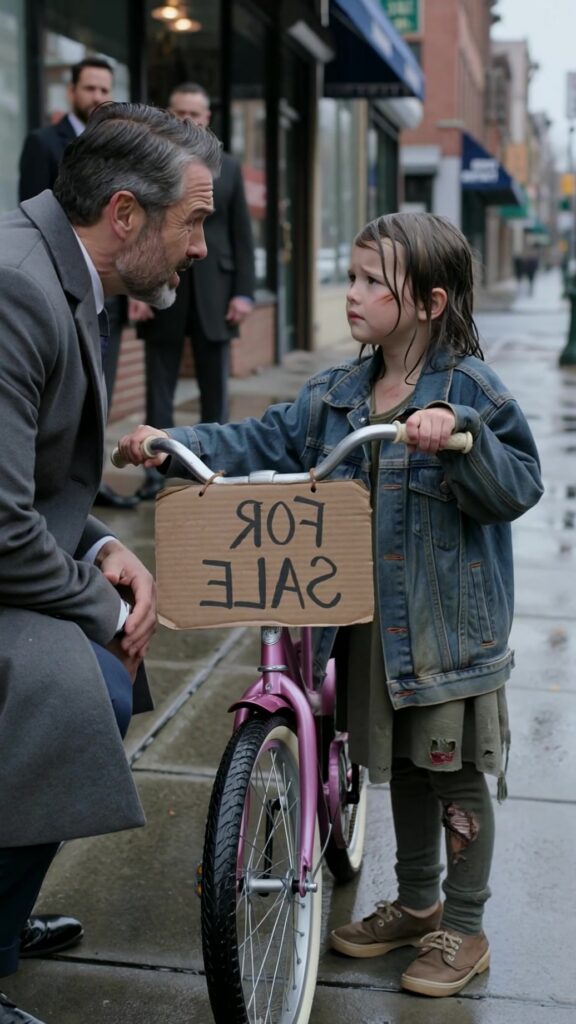
The first thing Martin noticed was that the bike was the wrong kind of wet. Rain had slicked it into a dull shine, but underneath that it was old—scuffed pedals, a chain that looked like it had chewed through a few childhood summers, and a bell that had stopped believing in joy. The frame was a faded pink that used to be loud. Now it just looked tired.
The second thing he noticed was the kid holding it like it was a barricade.
She couldn’t have been more than nine, maybe ten if you counted the stubborn way she stood with her chin up. Her bangs were glued to her forehead. Her sleeves were too long and dark with water. She’d made a cardboard sign and hung it on the handlebars with twine, but it drooped like a drowned flag.
“Excuse me, sir,” she said, voice steady in that practiced way kids get when they’ve repeated a sentence a thousand times in their head. “Would you buy my bike?”
Martin slowed under the awning of a closed bakery. The rain had gone from “annoying” to “punishing,” and the street was mostly empty except for a couple cars hissing by. He glanced at the sign. It did say FOR SALE in thick marker, letters bleeding at the edges.
He wasn’t the type to buy bikes off sidewalks. He was the type to go to work, do his job, buy groceries, try to remember to call his sister back. That was his whole personality. But something about the girl’s grip made him stop anyway.
He crouched a little so he wasn’t towering. “Hey,” he said gently. “Where’s your mom?”
The girl’s eyes flicked past him and then snapped back to his face. Her pupils looked huge in the gray light. “She’s… home.”
“And you’re out here selling your bike alone in this weather?”
Her lips pressed together, like she was trying to keep all the answers from spilling out at once. “My mom hasn’t eaten in days,” she said. “I didn’t have anything else left to sell. Just this.”
The words were calm, but the way she said “just this” made it sound like she was offering up a piece of her skeleton.
Martin felt something in his chest tilt, not quite pity, not quite alarm—more like the sudden awareness that the world could be cruel right on your block and you’d still be walking around thinking about your emails.
“Okay,” he said. “How much are you asking for it?”
Before she could answer, he became aware of movement behind her. Not fast, not obvious. Just… there. Four men clustered near the entrance of the laundromat, under its flickering neon sign. Dark suits. Dark umbrellas. Not the usual crowd for a place that smelled like detergent and loneliness.
They weren’t doing anything, which was almost worse. They were simply waiting, angled toward the girl like magnets.
Martin straightened a bit and asked, casual as he could make it, “Those guys with you?”
The girl’s shoulders tightened. “No.” She didn’t look at them. She didn’t have to. Her hands squeezed the rubber grips so hard her knuckles went pale.
Martin leaned in closer, pretending to examine the bike. The cardboard sign had more than the two big words on it. Under FOR SALE there were faint lines, places where the marker had dug deeper and then been rubbed at, like someone had tried to erase something in a hurry.
He tilted his head to catch it in the light. Beneath the smeared top line, another phrase peeked through, half-scratched, half-dissolved by rain.
It hadn’t originally been FOR SALE at all.
It had been FOR HER.
Martin’s stomach dropped like he’d missed a step on stairs.
The girl saw his eyes change. She barely moved her mouth when she spoke, like she was terrified the rain itself might carry the words to the wrong ears. “Please,” she whispered. “Buy it before they ask for the key.”
Martin blinked. “The key?”
Her gaze darted to his coat pocket, then to his hands, as if she wanted him to do something specific but couldn’t afford to explain. “Just… buy it,” she murmured. “And don’t let them know you heard me.”
Martin’s brain tried to assemble a normal explanation. Maybe the men were debt collectors. Maybe they were her relatives. Maybe this was some messed-up hustle.
But the sign—FOR HER—made it feel different. Like this wasn’t a sales pitch. It was a signal that had been repurposed at the last second.
He reached into his wallet, pulled out the cash he had—two twenties and a ten—and held it out. “Is fifty okay?” he asked, forcing his voice to stay light.
The girl’s eyes flashed with something like relief and then immediately with panic. “Yes,” she said too quickly. “Yes, thank you.”
Martin took the bike by the seat as if he’d just bought it and was now the proud owner of a sad pink relic. He slipped the money into her hand, but instead of letting her grab it, he folded her fingers around it, firm and quick.
Then, because he didn’t know what else to do, he did the dumbest, bravest thing his ordinary life had prepared him for: he stepped sideways so his body was between the girl and the men.
“You live nearby?” he asked loudly, like this was a normal conversation about a neighborhood deal.
The girl nodded once, tiny. “Two blocks.”
“Cool. Walk with me,” Martin said. “I need help carrying my new purchase. It’s… very heavy.”
Her mouth twitched, like she understood the joke but couldn’t afford to enjoy it. She took one step, then another, staying close to his elbow like she’d been trained to hide behind adults.
Behind them, one of the suited men peeled away from the group. Martin didn’t look back, but he felt it the way you feel thunder even before you hear it.
“Hey,” a voice called, polite and sharp. “Sir.”
Martin stopped under a streetlight that wasn’t doing much. He turned slowly, forcing his face into the blandest expression he could manage. “Yeah?”
The man approaching had a neat haircut and the kind of smile that never reached his eyes. “That bicycle,” he said, nodding toward the pink frame. “That belongs to someone else.”
Martin kept his grip on the seat. “Not anymore. I paid for it.”
“Did you?” The man’s gaze slid to the girl. “Sweetheart, you didn’t take anything else from the apartment, did you?”
The girl flinched like the word apartment was a slap. Her fingers curled around the folded bills so tight the paper crinkled.
Martin’s heart thudded. Apartment. Key. For her. He imagined a door somewhere, locked behind her, with someone inside who couldn’t come out. Someone the men wanted access to.
He smiled, thin and forced. “Look,” Martin said, shrugging like a guy annoyed by a minor inconvenience. “I don’t know anything about any apartment. I’m just a guy who overpaid for a bike because it’s raining and I felt generous.”
The suited man’s smile didn’t move. “We’re going to need the key,” he said, still polite, like he was ordering coffee.
The girl’s eyes widened. She stared at Martin’s pocket again, and it clicked: she thought he’d have it. She thought the key would transfer with the bike, like some awful fairy tale rule.
Martin had no key. But he did have something else: a phone, and the fact that they were on a public sidewalk, and that bullies hate witnesses.
He lifted his phone and aimed it loosely, as if checking the screen. “Sure,” he said, voice louder. “Also, I’m calling the police, just so we’re all on the same page.”
The suited man’s expression twitched—just a flicker, but there it was. The other three men shifted under the laundromat awning. None of them stepped into the open.
Martin put the phone to his ear and started talking, even though he hadn’t hit a number yet. “Hi,” he said, clearly, “I’m on Ninth and Maple. There are four men harassing a child in the rain. One is demanding a key. Yes, I’m sure.”
The girl’s breath hitched. She stared at him like he’d just done actual magic.
The suited man took a step back. “No need for that,” he said smoothly. “It’s a misunderstanding.”
“Great,” Martin replied, still performing into the phone. “Then you won’t mind waiting right there until someone shows up.”
For the first time, the man’s smile cracked. He turned his head slightly, a silent signal. The group near the entrance began to drift, not running, just melting into the rainy street like ink.
Martin kept talking into his phone until the men were far enough away that their dark shapes blended with parked cars and wet shadows. Only then did he lower it and finally dial for real, hands shaking a little.
When he ended the call, he looked down at the girl. “Okay,” he said softly. “Tell me about the key.”
She swallowed, then nodded toward the bike’s handlebar grips. “Inside,” she whispered. “The spare. I hid it. They kept asking, but I… I told them I lost it.”
Martin stared at the pink bike like it had suddenly become a vault. “For your mom’s place?”
Her eyes filled with tears that mixed with rain so you couldn’t tell which was which. “They said they’d come in whether she wanted it or not,” she said. “They said if I didn’t help, they’d take her away. So I wrote the sign to find someone kind. Someone with a face they wouldn’t mess with.”
Martin let out a slow breath. He gently peeled one grip back and felt it—metal, cold and small, taped to the inside like a secret. He didn’t pull it out yet. He just covered the spot again, protecting it with his hand.
“You did good,” he said. It sounded too small for what she’d done, but it was true. “Now we’re going to do the next part together.”
He offered his free hand. She took it, her fingers icy but determined. And the two of them started walking, the sad pink bicycle between them like a promise nobody was allowed to break.