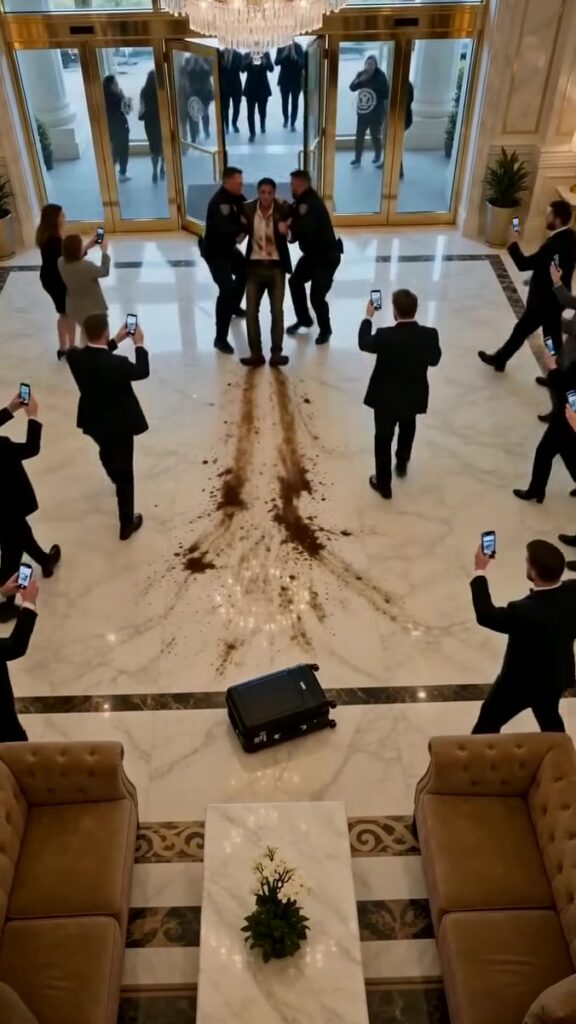
The lobby sparkled with wealth—crystal chandeliers scattering light like shattered ice, gilded columns reflecting champagne tones, quiet laughter floating above the marble as if it belonged there. It was the kind of room that taught people how to speak softly: money demanded reverence, and the Reverie Hotel had been built as a cathedral to it.
Bell staff glided in tailored navy. A pianist, half-hidden behind a vase of white orchids, turned sorrow into background music. Suitcases rolled in obedient lines; credit cards flashed; perfume veiled the air so thoroughly that even time seemed expensive.
Then the revolving door jolted as if struck by a fist.
A shout tore the hush apart—raw, animal, impossible to ignore. The glass doors flew open with a bang that made heads snap and a few flutes of sparkling wine tremble in manicured hands.
A man staggered inside.
He was filthy, soaked through with something sour and metallic, his hair clumped to his forehead as if he’d crawled out of a storm drain. His jacket might once have been black; now it was gray with grit, the sleeves torn. His shoes left damp crescents on the marble. But in his fist, held with a desperate, almost reverent grip, was a suitcase so immaculate it looked unreal—hard-shell, bone-white, the kind that traveled private jets and never touched a baggage carousel. There wasn’t a scratch on it. Not a smudge. It shone beneath the chandeliers as though it belonged more than he did.
The smell reached the concierge desk and spread outward in a wave. Guests recoiled, hands rising to noses, eyes narrowing with offended disbelief. Someone whispered, “Oh my God,” in the exact tone reserved for accidents that could be avoided if the world were properly managed. Another voice hissed, “How is he even allowed in here?”
The man didn’t look at them. Not once.
He walked straight to reception, his gait uneven, his breath coming in jagged pulls. The receptionist, Elise, was a woman polished to perfection—hair pinned without a stray strand, lipstick the color of dried roses, smile sharpened like a blade. She watched him approach as if she were watching an insect crawl across silk.
He slammed the suitcase onto the counter with a dull thud that drew a ripple of gasps. The pianist faltered, then resumed with a tentative chord, as though music might bandage the moment.
“Two hours,” the man said, voice hoarse. He swallowed hard, eyes fixed on the marble edge of the desk like it was a lifeline. “I’ll pay. Just give me a room.”
Elise stared at him, disgust tightening her features. “You think you can walk in here like… that,” she said, her gaze skimming the grime on his sleeves as if it might transfer through the air, “and purchase a room?”
“Please,” he rasped. “You don’t understand—”
“I understand perfectly.” Her tone sharpened. “Security. Now.”
Two guards appeared as if they’d been waiting behind the walls. They were broad-shouldered men in matching black suits, their earpieces like tiny leashes. One seized the man’s arm; the other grabbed his elbow. The man jerked, trying to hold himself upright, but exhaustion made him fold.
“Wait,” he said, voice cracking. “Just listen to me. I’m not—”
“We don’t need to listen to trash,” one guard muttered, loud enough for the nearest guests to hear. Laughter—small, relieved, cruel—fluttered from the seating area. Phones rose like periscopes, recording, hungry for spectacle.
They dragged him across the polished floor. His shoes squealed faintly, leaving a streak of dirty water. A woman in a pearl necklace leaned into her companion and whispered, “He looks dangerous.” A man in a cashmere coat said, “This is insane,” as if the building itself had failed him.
The filthy man twisted, eyes wild, a cornered animal—until his gaze landed on the suitcase still on the counter. Panic flashed across his face.
“No—don’t—!” he shouted, but the guards were already shoving him toward the doors.
Just before they pushed him outside, he threw his head back and screamed into the glittering air, “That suitcase is worth more than all of you!”
The doors slammed. The sound echoed, then died. The lobby’s breath returned in careful increments. The pianist smoothed the rupture with a flowing run of notes, and the chandeliers resumed their steady glitter as if nothing had happened.
At the desk, Elise exhaled with controlled disdain and adjusted the cuff of her blazer. “Throw it away later,” she said, nodding toward the suitcase as though it were contaminated.
Beside her stood Noah, a junior guest services clerk still young enough that his uniform didn’t sit on him like armor. He had been trained to smile, to apologize, to anticipate. He had not been trained for desperation.
He stared at the suitcase. It was too clean. Too deliberate. The filthy man’s hands had clutched it like an anchor, not a prop.
“What if…” Noah began, then stopped when Elise’s eyes snapped toward him. He tried again, softer. “What if he was telling the truth?”
Elise gave a thin laugh. “Truth doesn’t come in smelling like sewage, Noah.”
But Noah’s fingers had already curled around the handle. It was cold, solid, expensive. He expected the latch to resist. It didn’t. It opened with a precise, almost elegant click.
The lid lifted.
Noah’s world shifted.
Inside, stacked in perfect bricks and wrapped with bank bands, was cash—more than he’d ever seen outside of a movie. Not folded bills shoved into corners, not messy bundles, but an orderly grid of currency that seemed to radiate a quiet, terrifying intention.
He sucked in a breath so sharp it hurt. Elise leaned forward despite herself, disdain melting into an expression she couldn’t hide: alarm.
Beneath the top layer of cash lay a slim folder, sealed in clear plastic. Noah’s hands shook as he pulled it free. Inside were documents—passports, multiple, their covers different colors, their edges crisp. Names printed in bold. Faces that looked like they belonged to different lives.
Noah flipped one open and froze.
The name on the page didn’t just sound familiar—it landed in his memory like a hammer blow. He had seen it not long ago, flashing across news reports, whispered in elevators, discussed behind closed staff doors when management thought nobody listened. A name linked to collapsed corporations, vanished investors, and a trial that never happened because the man at the center had simply… disappeared.
Noah’s throat tightened. “Why does this name…?” he whispered, unable to finish. The photograph was of a man clean-shaven, composed, eyes calm and calculating. Nothing like the filthy figure dragged out moments earlier—except for the bone structure, the shape of the jaw, the set of the mouth that no dirt could fully erase.
Elise’s manicured hand shot out, snatching the passport from Noah as if to erase his touch. Her face had gone pale under her perfect makeup. She stared, lips parting, the lobby’s glitter suddenly harsh and merciless.
“Close it,” she hissed, then lowered her voice to a trembling whisper. “Close it right now.”
Noah didn’t move. His gaze dropped to the bottom of the suitcase, where something else lay beneath the documents: a small object wrapped in cloth, the outline angular and unmistakable. Not money. Not paper. Something with weight and intent.
Behind them, laughter rose again—guests returning to their curated conversations, already bored of the interruption. The hotel’s luxury reasserted itself like a spell. The chandeliers glittered. The marble shone. The air filled with perfume and denial.
Noah looked up at the glass doors. Through them, outside on the street, the filthy man stood unsteadily in the rain, his shoulders hunched. He didn’t leave. He stared back at the lobby with the expression of someone who had just thrown his last hope into a room full of strangers.
Noah understood, suddenly, what two hours meant. Not a booking. Not a request.
A deadline.
And in the Reverie Hotel—where everything was designed to look untouchable—something had just been placed on the counter that could crack the world open.
Elise swallowed, her eyes darting to the security guards now chatting near the entrance, oblivious. She leaned close to Noah, her voice barely audible. “If anyone asks,” she said, “this suitcase was never here.”
Noah’s hands hovered over the lid. Outside, the man lifted his head, and for a moment Noah saw not filth, but fear sharpened into purpose.
Noah closed the suitcase with a soft, final click—and the sound felt like a gun cocking in a room full of crystal.
Somewhere beyond the lobby’s walls, something was coming. And the Reverie, with all its gold reflections and quiet laughter, had just opened its doors to it.