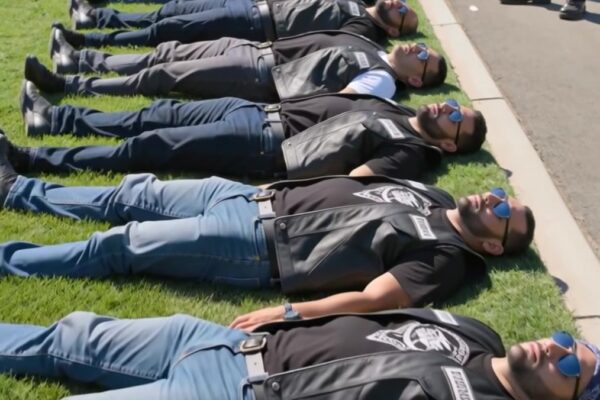
The men were laughing when the boy ran into the yard, the kind of big-belly, no-consequences laughter that made the air feel thicker. Somebody had said something about a state trooper and a donut shop, and it had landed just right. Behind them, motorcycles sat in a neat row like they were showing off—chrome, black paint, a few custom flames. The sky was low and gray, and the grass was wet enough to darken the toes of your boots.
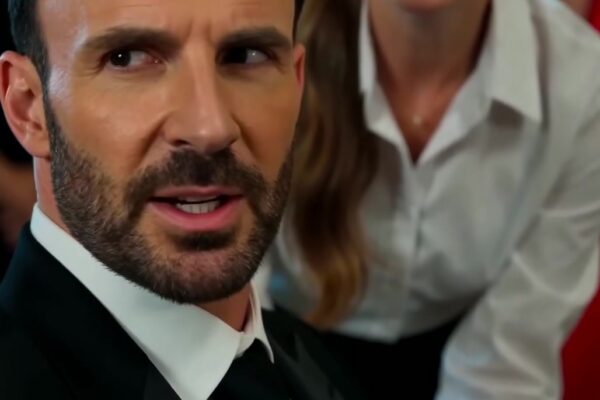
Rex stood near the picnic table with a paper plate in one hand and a half-burned cigarette in the other, looking like he belonged in the yard more than the yard belonged to the house. He was the biggest guy there by a mile, shoulders like a doorway, beard like a bramble patch. People called him Rex because he made decisions like he’d been crowned into them.
Then the kid appeared, sprinting through the open gate like he’d been fired out of it. He couldn’t have been more than six. A leather vest flapped around him like a cape stolen from a grown-up. His boots were too big, his legs too fast for them, and he clutched something to his chest with both hands like it was his heart.
He almost made it to the motorcycles. Almost made it to the men. And then his feet slid on the slick grass and he went down hard, knee-first, then hands, then face crumpling into a sob he’d been holding in for miles. The laughter in the yard snapped off like someone had flipped a switch. Even the wind seemed to hesitate.
The boy didn’t let go of what he’d been carrying. He hugged it against himself and cried like he couldn’t get enough air. When he finally looked up, his cheeks were smeared and his nose was running, but his hands were steady in one way that didn’t match the rest of him. He lifted the thing toward Rex like an offering.
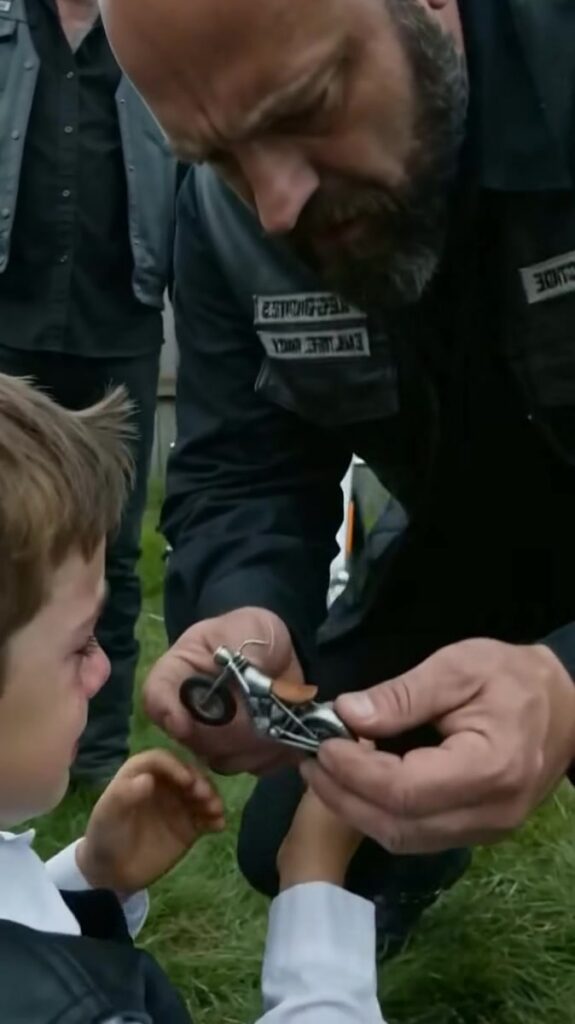
It was a toy motorcycle—handmade, not plastic, not store-bought. Metal frame. Wooden body. Tiny stitched seat. The kind of work you did when you cared too much to quit halfway. Rex took two steps forward before he realized he was moving. “Kid,” he said, voice rougher than he meant it to be. “You hurt?”
The boy shook his head fast, even though his knee was already turning red through his jeans. “Please,” he choked out. “Please buy it.”
Rex stared at him like he was hearing a foreign language. “Buy it?” He glanced back at the guys, but nobody was smirking anymore. Cigarettes hung forgotten. Someone’s beer bottle hovered near their mouth and never tipped. “What’s your name?” Rex asked.
“Noah.” The kid sniffed. “My dad made it. He said it’s… it’s good. He said bikers like these.” Noah’s voice wobbled between brave and broken. “My dad won’t wake up.”
That landed heavy. A couple men shifted, boots pressing wet grass down. Rex crouched so he wasn’t towering over the boy. “Where’s your dad, Noah?”
Noah pointed vaguely past the yard, toward the road, toward everything. “In our truck. He’s asleep. I tried shaking him. He’s not… he’s not doing it.” He gulped air like he’d been running for more than the length of the driveway. “I went to the neighbor but they’re gone. I saw the bikes and… I thought maybe you’d help. But my dad said I can’t ask for free stuff.”
Rex exhaled through his nose, slow. That was the kind of stubborn pride Rex recognized, the kind that got people hurt and also kept them alive. “Let me see the bike,” Rex said, holding out his hand.
Noah hesitated. His fingers tightened around the little motorcycle like it might be the last solid thing in his world. Then he placed it in Rex’s palm, gentle as handing over a baby bird.
Rex turned it over, inspecting the welds, the tiny bolts, the wheel alignment. It wasn’t just “good.” It was careful. Someone had built it with tired hands and a careful mind. Then he saw the mark.
Burned into the underside of the frame was a small symbol: a wolf head with a slash through one eye, done so fine you’d miss it if you blinked. Rex’s thumb stopped mid-stroke. His throat tightened, and for a second the yard disappeared and he was back in a different place—dusty garage, bare bulb, the sound of a punch landing, the word “traitor” thrown like a rock.
Only one person had ever used that mark.
Eli.
Not “Eli” the story people told at the clubhouse after midnight, the guy who supposedly stole cash and vanished like smoke. Eli the kid Rex used to split a sandwich with. Eli who laughed too loud and fixed things with cursed patience. Eli who, seven years ago, had stood in front of Rex with blood on his lip and said, “You’re gonna regret this,” and then left.
Rex looked at Noah differently. Same dark eyes. Same stubborn chin. Same way the lower lip trembled like it wanted to be tough but couldn’t always pull it off. Rex’s voice came out quieter than he intended. “Who’s your dad, Noah?”
Noah wiped his nose with the sleeve of the too-big vest. “He said his name was Dad,” he said, like Rex was being dumb on purpose. Then his expression crumpled again and he forced himself to keep going. “But when he talks to my mom on the phone, she calls him Elijah.”
The name hit Rex like a punch, clean and brutal. He felt his fingers tighten around the tiny motorcycle until he was afraid he’d crush it. Behind him, one of the guys—Mace, who never shut up—actually went silent enough that Rex could hear the metal ticking of a cooling engine.
Noah pointed at Rex’s back with a trembling finger. “He said if I saw the man with the wolf on his back, I’d know. He said you’d know me.”
Rex didn’t answer. He couldn’t. His brain was suddenly too full: Eli’s grin. Eli’s wrench hands. Eli’s voice saying, I didn’t take it. Rex’s own voice saying, Don’t come back. The club patch on his shoulder felt like it weighed fifty pounds.
Rex stood up fast enough his knees popped. “Tina,” he barked toward the house, and one of the older women on the porch snapped her head around. “Call 911. Now. Tell ’em possible overdose or… or something. Kid’s dad’s in a truck.”
Noah flinched at the volume. Rex softened immediately, crouching again so he wasn’t a storm cloud. “Hey,” he said, forcing his voice into something steady. “You did the right thing. You got help.”
Noah’s eyes widened. “You’ll buy it?” he whispered, holding his hands out like he expected Rex to give the toy back and walk away.
Rex swallowed the hard lump in his throat. “Yeah,” he said. “I’m buying it.” He dug into his pocket and pulled out his wallet with fingers that didn’t feel like his. He peeled off bills without counting. Twenty, fifty, another fifty. He pressed them into Noah’s small fist. “And you’re not selling it because you have to. You’re selling it because your dad made something worth paying for, got it?”
Noah stared at the cash like it might evaporate. “That’s too much,” he breathed, and the kid’s voice had that same stubborn honor Rex had hated and loved in his brother.
“It’s not,” Rex said. “Not even close.”
Sirens weren’t close yet, but somewhere far off, the world was already moving toward them. Rex held the little motorcycle like it was fragile history. He looked at the boy—his brother’s boy—and felt something inside him split open, the kind of break that finally lets light in.
“Noah,” Rex said, steadying himself. “We’re gonna go check on your dad together, okay? And no matter what happens next, you’re not walking through this alone.”
Noah blinked hard, tears spilling again, and nodded once. He reached out and grabbed a handful of Rex’s jacket like it was the only solid thing left in the yard. And for the first time in seven years, Rex let himself think the thought he’d been too proud to touch.
Maybe Eli hadn’t disappeared.
Maybe Rex had just pushed him off the map.
Rex lifted Noah into his arms like the kid weighed nothing, and as the men in the yard watched—silent, uneasy, respectful—Rex walked toward the road with a handmade toy motorcycle in one hand and a second chance in the other.