The mother was kneeling in the wet leaves, her black coat pressed against the ground, her face buried in her shaking hands. Rain had been falling for hours—fine, needling, indifferent—until the cemetery seemed stitched together from gray thread and mud. The air smelled of soil and rusted iron. A black umbrella lay on its side nearby like something dead.
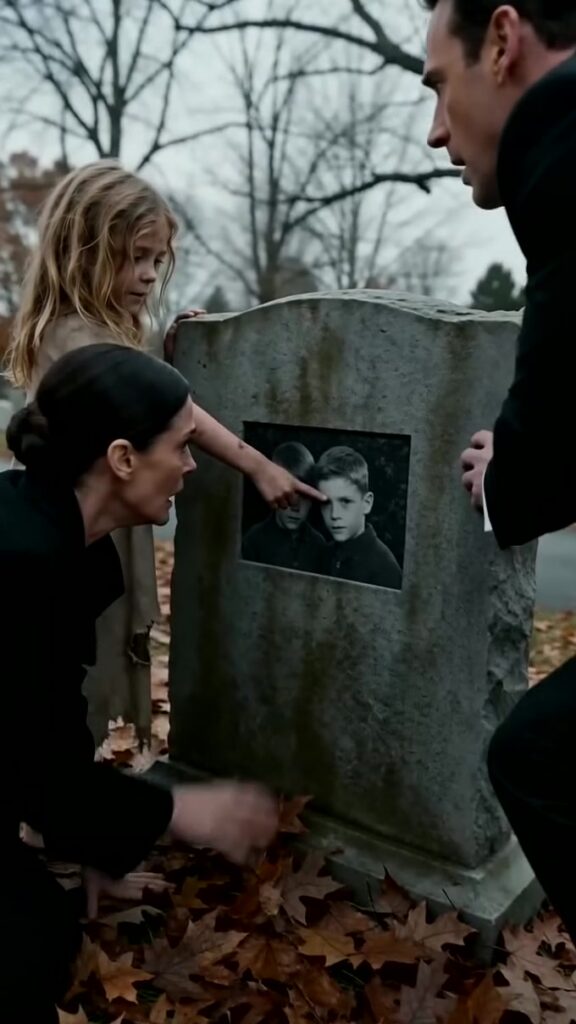
Beside her, the father stood as though his bones had forgotten how to hold him. He stared at the headstone until the carved letters blurred, until the little black-and-white portrait set into the granite became only two pale ovals in a fog of grief. Two boys stared out from that photograph, close together, hair neatly combed as if a hand had smoothed it just before the shutter snapped. In the picture they were still safe, still posed, still unaware of the word “after.”
They had been Daniel and Micah—twelve and nine, freckles and quick knees, the kind of boys who left the kitchen door swinging and came home with pockets full of treasure they couldn’t explain. A winter ago the house had been loud with their arguments, their laughter, their feet on the stairs. Then came the night of sirens and orange light across the windowpanes, and afterward came silence that did not behave like silence. It crowded. It pressed. It swallowed every room.
The mother lifted her head only to gulp at air, as if her lungs had forgotten their job. Her face was wet with rain and tears, the two indistinguishable. “I can’t do this,” she said to no one. The words fell into the leaves and disappeared.
“We have to,” the father answered, but his voice sounded like it belonged to someone older, someone with cracked hands and no future. He did not move toward her. He could not. If he bent down, he feared he would not get back up.
That was when the child appeared.
She stepped from the far side of the grave, as though she had been waiting behind the stone all along. Barefoot, in a torn smock that looked too thin for the weather, she moved without slipping on the wet ground. Her blonde hair clung to her cheeks in tangled ropes. Her feet were blackened by mud and cold. Yet she shivered less than the adults did.
She approached the headstone with the solemnness of someone walking into a church. Then she lifted one small finger and pointed at the embedded photograph.
“They’re not gone,” she said.
The mother’s sob stopped mid-breath. She blinked hard, thinking she had misheard. The father turned so fast his shoes scuffed a crescent in the soaked leaves.
“What did you say?” His voice cracked on the last word, the first true break he’d allowed himself since the funeral.
The girl did not flinch. Her finger remained steady, hovering close to the boys’ faces as if she could feel warmth through the stone. Her calm made the air seem colder. “They stay with me.”
The mother’s grief shifted, changing shape the way a shadow changes when a door opens. Fear slid underneath it. She crawled one step forward, leaves sticking to her sleeves. “Who?” she whispered, as if speaking louder might wake something cruel.
The girl tapped the photograph twice—once on Daniel’s face, once on Micah’s. “Both of them.”
The father straightened too quickly, crushing leaves under his heel. “Where?”
At last the girl lowered her hand and turned her head toward the cemetery gate, toward the road beyond where the rain made the asphalt shine like oil. “At the orphanage.”
The mother stopped breathing. The sound of the rain sharpened. The father’s throat worked as though swallowing glass. “Take us there,” he said.
The girl looked at them over her shoulder, her eyes startlingly clear for a child who looked like she’d been sleeping outdoors. “You have to walk,” she replied. “Cars don’t like the road.”
Before either parent could demand what that meant, she started toward the gate.
The father reached out on instinct, trying to catch her sleeve, to hold on to the only solid thing in a world that had turned to smoke. His fingers passed through empty air. Not through her—through where she had been a heartbeat ago. He stumbled, breath exploding from him.
“Did you—” The mother’s hands flew to her mouth. “Did you touch her?”
He stared at his own palm as if it had betrayed him. “I missed,” he lied, because the alternative sounded like madness.
The girl’s bare feet left no prints in the mud.
They followed anyway.
The cemetery gate groaned as it swung open, but the girl didn’t touch it. It moved as if pushed by the wind that couldn’t decide which way to blow. Outside, the road sloped down past hedges and sagging fences. The rain softened, becoming mist that hung at ankle height, and the world beyond the cemetery looked unmoored—streetlights hazy in daylight, telephone wires humming with a distant, metallic song.
The father kept pace beside the mother, though neither of them spoke. They could not afford to, as if words would pop whatever fragile bubble of possibility had formed. The girl walked ahead, occasionally glancing back to make sure they remained. When she did, her eyes held the quiet impatience of someone who had waited too long.
At the bottom of the hill, the orphanage stood behind a brick wall mottled with moss. Once it had been a convent; the pointed windows still wore their stone brows, and the iron gate still carried the ghost of a cross where someone had pried it off. The building’s entrance light flickered, though it was daytime. Somewhere inside, a bell chimed once—soft, accidental.
The girl stopped at the gate. “You can go in,” she said.
“What is your name?” the mother asked, her voice so small it seemed it might vanish.
The girl’s mouth twitched, not quite a smile. “I had one,” she said. “They changed it. They change a lot of things.”
The father gripped the iron bars, knuckles whitening. The metal was cold enough to hurt. “You said they’re with you,” he insisted. “Why? How?”
The girl turned her face upward, letting mist bead on her eyelashes. “Because they didn’t know where to go,” she said simply. “Because you kept calling them.”
The mother flinched as if struck. It was true. She had called them in her head so often that the sound of their names had become a second heartbeat. Daniel. Micah. Come back. Please. Just come back.
The girl leaned close to the bars, lowering her voice. “There are rooms inside that aren’t on the map,” she whispered. “There are children who don’t get counted. Sometimes, when people are missed hard enough, they slip through.”
“Are they—” The father couldn’t finish the question. Are they alive? Are they dead? Are they something else?
The girl’s gaze slid past them, toward the road they had come from, toward the cemetery hidden behind the hill. “They’re waiting,” she answered, and the words were heavy with a kind of warning.
She stepped back. The mist thickened around her ankles. For a moment she blurred, edges dissolving into the pale air, and the mother’s fear surged again, fierce and protective and desperate.
“Don’t go,” she pleaded, reaching through the bars. “Please—help us.”
The girl’s voice came from everywhere and nowhere. “I did.”
Then she was gone, leaving only the cold scent of wet earth and something faintly charred, like a memory of fire.
The father pressed his forehead against the iron gate. The mother’s hands shook as she found the latch. It was not locked. It opened with the smallest push, as if it had been expecting them all along.
Inside the courtyard, the orphanage windows watched like tired eyes. Somewhere within, a child laughed—one sharp, bright note that sliced through the fog of months. The mother froze at the sound. It was not Daniel’s laugh, not Micah’s, and yet it was close enough to hurt.
They crossed the courtyard, climbed the steps, and knocked.
No one answered, but the door eased inward anyway.
The hallway beyond smelled of soap and old wallpaper. The floorboards whispered under their weight. On the wall hung photographs in mismatched frames: rows of children in uniforms, each face carefully labeled in neat ink. The mother moved along them as if in a trance, fingers hovering close without touching. Then she stopped, a gasp tearing out of her.
Two empty spaces stared back at them—frames without photographs, labels without faces.
DANIEL HART.
MICAH HART.
The father’s knees buckled. He grabbed the banister, shaking his head violently, as if refusing could rewrite reality. “No,” he breathed. “No, no—”
From somewhere deeper inside the building, a low thump sounded, like a door closing. Then another. Footsteps, running—small feet on wood, coming closer.
The mother lifted her head, eyes wide and wild with hope and terror in equal measure. “Danny?” she called, voice breaking like thin ice. “Micah?”
The footsteps stopped at the end of the corridor, just beyond a corner where the light seemed to dim for no reason. A shadow fell across the wallpaper, tall and thin, too tall for a child.
And then, from behind that corner, two voices spoke at once—familiar, dear, impossibly close.
“Mom?”
The father made a sound that was half sob, half prayer. The mother stumbled forward, unable to stop herself, unable to decide whether she was running toward salvation or into the mouth of something that had learned their sons’ names.
The corridor held its breath as she reached the corner—and stepped into whatever waited beyond.