The music died before anyone realized why. It didn’t falter or fade the way a tired orchestra might; it vanished as if someone had reached into the air and snuffed out sound itself. One heartbeat the ballroom was a bright machine—bows drawing across strings, brass shining beneath chandeliers, laughter tumbling over laughter—then the note that should have followed simply never arrived.
The silence had weight. It pressed against eardrums and made people suddenly aware of their own breathing, of the slickness of champagne on their tongues, of the soft shuffle of shoes that had been hidden under the waltz. A violinist’s arm froze mid-stroke. A couple near the dais spun once more from momentum and stopped, embarrassed, as if they’d been caught dancing in an empty room.
At the entrance stood a small girl.
She was no one’s child—no clutching parent, no attendant, no harried nanny. Her dress was plain gray, too simple for the crystal-bright opulence around her. She had hair the color of ash, tied with a strip of black ribbon. She didn’t look frightened. She looked precise, like a message delivered in the shape of a person.
People smiled at first, as they did at anything out of place that wasn’t yet dangerous. An older woman laughed softly, thinking it a joke. A waiter stepped sideways to offer his tray, confused by the interruption. But the longer the silence held, the less the smiles made sense. The air near the doorway felt colder. Not draft-cold; something deliberate, like a door had opened somewhere inside the building that no one could see.
The girl began to walk.
Each step rang too loudly on the polished marble, the way footsteps sound in a church after the choir has stopped. She didn’t hurry. She moved with a confidence that made the crowd unconsciously part for her. No one reached out to guide her away. No one called a guard. Something in the room, unspoken and shared, whispered: let her pass.
At the center of the ballroom, beneath a chandelier heavy enough to be a weapon, stood Anton Varr, the patron of the evening and the man the city called untouchable. His tuxedo fit him like armor. He held his glass with a politician’s ease and wore a calm that had survived scandals, lawsuits, and rumors of men who’d offended him and never been seen again.
Beside him, Selene Varr—his wife in name if not in warmth—turned sharply. Her diamonds flashed when she moved, like teeth.
“This is not a place for children,” Selene snapped, her voice cutting through the quiet. There was something else under her sharpness: a tremor, almost pleading. “Go back where you came from.”
The girl didn’t glance at her. She continued forward until she stood a few steps from Anton, small enough that his shadow swallowed her. The crowd drew in. Even the chandeliers seemed to listen, their light steady and unforgiving.
Anton’s expression held. It tried to. His eyes dropped to the girl’s hands as she lifted one slowly, as if raising a vow.
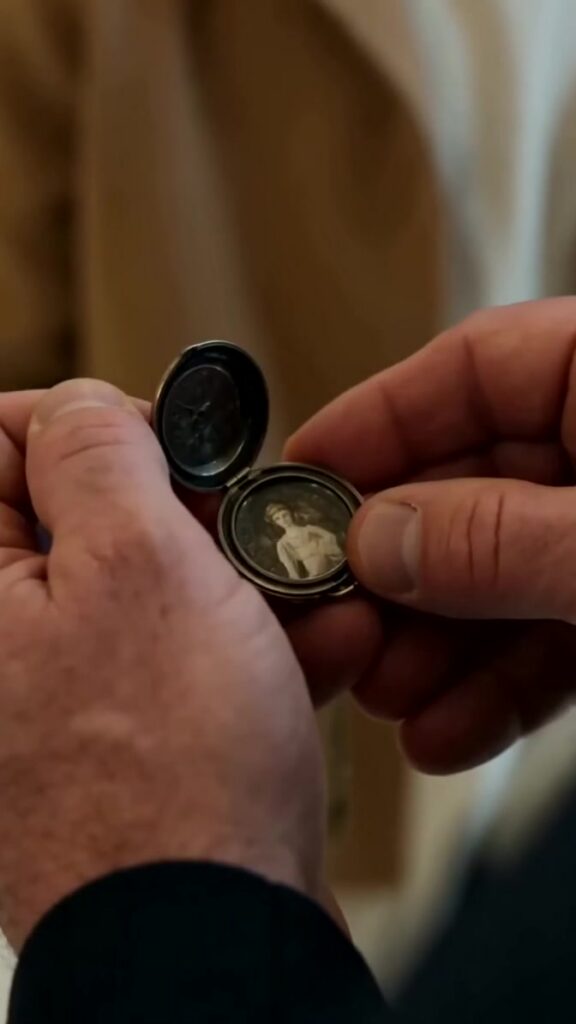
In her palm lay a locket.
It was old, oval, the kind that belonged to photographs and secrets. The metal was scratched as if it had been carried through years of rubbing and worry. A thin chain looped around her fingers. The hinge looked tired. The clasp, though, had a curious gleam—like it had been polished by touch a thousand times.
Anton’s breath caught in his throat. The tiny movement was the first crack in his composure, and everyone saw it.
His hand rose toward his chest on instinct, not thought. He slipped his fingers into the inside pocket of his jacket and pulled something free.
A matching locket.
The room seemed to tilt. The two lockets—one in the girl’s hand, one in his—were like halves of a single wound.
“That can’t be,” Anton whispered. The word fell into the silence and didn’t echo. “I—”
He held his locket up. The chain trembled between his fingers. For the first time in years, he looked ordinary, like a man who had mislaid a memory and found it staring back at him.
The girl opened hers with a patient click.
The hinge sighed, and something shifted in the air. Not light, not temperature—attention. People who’d been gripping glasses loosened their hands as if they’d forgotten why. A woman near the window pressed a fist to her mouth, eyes widening for no reason she could name.
Anton leaned forward, drawn as if by a thread wound around his ribs. Inside the locket was not a photograph.
It was a folded sliver of paper, too old to be white anymore, ink blurred at the edges but still legible. A name was written there in careful cursive, as if the writer had feared the letters might flee if not held firmly.
Anton’s face drained of color. His lips parted, and the strength that had built towers and crushed rivals simply slipped away. He made a sound that wasn’t a word, a broken exhale that carried decades.
Selene’s hand shot out and clamped around his forearm. Her nails dug in through the cloth, not to steady him but to anchor herself. “Stop,” she hissed, too quiet for politeness, too fierce for calm. Her eyes were on the girl’s locket like it was a blade. “Put that away.”
The girl looked up at Anton, not at Selene. Her gaze was pale and steady. “My mom told me to find you,” she said.
The simplicity of it made the room colder. People shifted, the way they did when confronted with a truth they didn’t want to know how to hold. Somewhere, a dropped fork clinked against a plate and sounded like a bell.
Anton swallowed. His voice, when it came, didn’t belong to the man who had made speeches and signed contracts with a smile. “What’s your mother’s name?” he asked, and the question had the shape of dread.
The girl answered.
The name was soft and ordinary—two syllables that should have meant nothing in a room filled with wealth and power. Yet the moment it was spoken, the chandeliers seemed to dim by a fraction. Several guests blinked as if struck by sudden dust. A man near the orchestra staggered back, gripping the edge of a chair, his face twisted in confusion that quickly became fear.
Selene went pale in a way that made her lipstick look like blood. “No,” she breathed, and the word shook. “That name is—”
Erased, Anton finished silently, because everyone in the city knew certain names were never said. Not because they were sacred, but because they had been removed. From newspapers. From invitations. From charity plaques. From the mouth of anyone who wished to keep their life uncomplicated. The city was good at forgetting what it was told to forget.
Anton stumbled back a step, his shoes skidding faintly on marble. He stared at the name inside the locket as if the ink had crawled there by itself. His own locket felt heavier in his hand, suddenly not an heirloom but evidence.
“Where is she?” he managed, each word scraped raw. “Tell me where she is.”
The girl closed the locket carefully, like shutting the lid on a fire. “She’s not allowed to come,” she said. “They said she didn’t exist.”
Anton’s eyes lifted to Selene, and what lived there now wasn’t confusion. It was recognition. A memory, hauled up from the bottom of a dark lake: a young woman with paint on her fingertips, laughing as she fastened a locket around his neck; a promise whispered under a bridge; a night when he’d chosen ambition over love and told himself it was necessary.
Selene’s throat worked. Her gaze flicked toward the doors as if calculating distances, exits, witnesses. “This is a trick,” she said, louder now, forcing the words into the room like a command. “Security—”
But no guard moved. Not because they hadn’t heard, but because they couldn’t. The girl’s presence made authority feel irrelevant, like trying to shout over a storm by insisting the weather obey.
Anton took a step toward the child and lowered himself slightly, as if afraid to loom. “How did you get in?” he asked, but his voice broke on the question, because he already knew the answer that mattered was not about doors.
The girl’s gaze shifted at last, past Anton, past Selene, to the orchestra. The musicians sat with instruments in their laps, hands trembling. Their sheet music fluttered though there was no breeze.
“The music stopped when I came,” she said, almost conversationally. “It doesn’t like lies.”
A shiver ran through the room, collective and involuntary. Anton’s mouth went dry. He looked around at the faces staring back—wealthy donors, council members, people who’d applauded him an hour ago—and understood with sick clarity that the silence was not accidental. It was judgment.
The girl held out her locket again, offering it as one might offer a key. “Mom said you’d know what to do if you remembered,” she said. “She said you’d hear it when the world went quiet.”
Anton’s fingers closed around the chain, and for a moment the two of them held the same object, child and titan bound by a thin line of metal and history. His eyes glistened, not from sentiment, but from the brutal pain of a door in his mind swinging open.
Somewhere deep in the building, a faint note tried to form—one single violin string trembling without a bow. It didn’t become music. It became a warning, a promise that sound would not return until the truth did.
Anton looked at Selene, and his voice, when he spoke, was the first real thing he’d said all night. “You didn’t erase her,” he said quietly. “You erased me.”
Selene’s lips parted, but no words came. The crowd leaned forward, hungry and afraid, because they could feel the shape of scandal becoming the shape of reckoning.
The girl slipped her hand into Anton’s, small fingers cold as river stones. “Come,” she said, and the command was gentle. “She’s been waiting a long time.”
Anton rose, still holding the locket, and the ballroom watched him choose between the life he had built and the name he had helped bury. The chandeliers shone steadily above them, uncaring. The orchestra sat motionless, instruments silent.
And as Anton took his first step away from the dais, the silence followed—heavy, alive—until the world decided whether it deserved to hear music again.