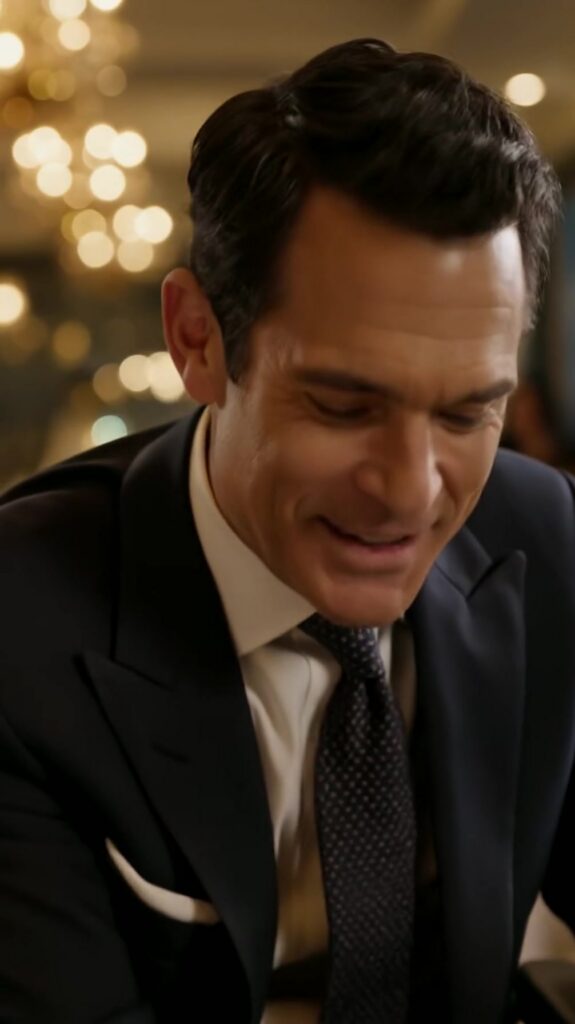
The night was flawless—too flawless, like a painting varnished until the brushstrokes were gone.
From the street, the Orpheum Conservatory looked like a jewel box propped open for the city to admire: tall windows lit from within, curtains the color of claret, and a spill of warm gold across wet pavement. Inside, the gala moved with the smooth inevitability of money. Crystal chimed against crystal. Laughter arrived on schedule and left without leaving fingerprints. Even the string quartet sounded expensive, each note polished as if it had been appraised before it was played.
People who had everything wandered through it all with the bored grace of those who expected the world to behave. They spoke about acquisition as if it were weather. They spoke about philanthropy as if it were a kind of alibi. Their smiles were impeccable, their eyes restless, hunting for novelty the way a predator hunts for weakness.
Lucian Voss sat near the center of the room, positioned so no one could miss him. He had always been a man who arranged sightlines. Tonight he wore a charcoal suit that made his pallor look intentional, and his right hand rested lightly on the carved handle of his cane as if it were an accessory rather than a fact.
His leg—the one the headlines called “tragically injured”—was hidden beneath tailored fabric, but the room remembered. People remembered in the way they remembered the names of storms: with distance and a certain satisfaction that it happened to someone else.
He endured the well-wishers with the practiced patience of a man who knew admiration could be harvested. A board member bent low, murmured about courage. A senator’s wife touched Lucian’s sleeve as if proximity to his suffering might improve her. Lucian smiled until his cheek began to ache.
Then the doors at the far end opened, and something slight and dark slipped through.
The boy wasn’t announced. No one trailed him. No name preceded him like a drumroll. He wore a jacket that had been cleaned too many times to be new, and his hair was still damp, as if he’d come in from rain no one else had noticed. He moved without hesitation, but not with the swagger of a gate-crasher. It was something worse: purpose.
For a moment, the crowd didn’t see him. Their attention had been trained to ignore anything that did not reflect them back. But the boy continued forward, threading between waiters balancing champagne and guests balancing reputations, and the sheer certainty of his trajectory began to snag eyes.
A waiter took a step to intercept, then stopped. A woman in diamonds turned as if tugged by an invisible string. One by one, heads followed the boy like sunflowers turning toward a shadow.
He walked straight through the heart of the gala and stopped in front of Lucian Voss.
Lucian’s first reaction was irritation—not fear, not curiosity, only the annoyance of interruption. The night had been arranged like a performance; the boy had wandered onstage without permission. Lucian lifted his gaze and saw, at close range, that the boy’s eyes were neither hopeful nor hungry. They were steady, the way a compass needle is steady.
“Sir,” the boy said.
The word was polite. The tone was not submissive.
Lucian exhaled, a small sigh practiced for exactly this kind of disturbance. “Yes?”
“I can fix your leg.”
A ripple of amusement skimmed nearby tables. A few guests smirked into their flutes. Someone laughed softly, as if at a joke too minor to own. Lucian felt the attention shift and, instinctively, leaned into it. He could turn this into charm.
He tilted his head, letting a smile sharpen. “Oh really? How long will that take?”
“A few seconds.”
That answer was so flat, so unperformed, it stole the room’s laughter halfway through. People leaned closer, entertained by the absurdity and the audacity. Lucian found himself enjoying the spotlight again, the chance to show how generous he could be to nonsense.
“I’ll give you a million,” Lucian said, loud enough for those around him to hear, “if you can do that.”
The boy did not react. Not a blink of greed. Not a flicker of triumph. He stepped closer, just inside the boundary Lucian’s staff normally defended, and said one word.
“Count.”
Lucian felt it land in his chest like a pebble dropped into deep water. He couldn’t have explained why. It was a child’s game. A magician’s trick. And yet the skin on his forearms tightened.
“This is absurd—” Lucian began.
“One,” the boy said.
Lucian’s mouth closed. His heartbeat became suddenly loud in his ears, as if the quartet had gone silent. The boy’s voice was calm, but it had an authority Lucian couldn’t refuse, like an old promise remembered by the bones.
“Two,” the boy said. “Stand up.”
Lucian’s hand tightened on his cane. For years, standing had been a negotiation—pain, balance, shame. His body knew the script. His body knew how to fail.
And then his leg responded as if it had never learned failure at all.
His foot planted. His knee unbent. His weight rose. No jolt. No flare of agony. The world didn’t lurch. He stood—straight, steady, effortlessly aligned—while his mind scrambled to catch up.
The room’s sound vanished as if someone had shut a door on it. The quartet’s bowing seemed to freeze midair. Conversations died in people’s throats. Even the air felt altered, too still to breathe.
Lucian stared down at his own legs, at the impossible symmetry of them beneath expensive wool. He lifted his gaze slowly, because sudden movements felt dangerous now, as if the miracle might shatter.
“…How?” he managed.
The boy looked at him as if the question were late. “You don’t remember?” he asked quietly.
A chill opened along Lucian’s spine. Memory came in fragments at first: a different night, years ago, without gold light and string music—only headlights on wet asphalt. A smell of burnt rubber. A scream that might have been his. The sound of metal tearing. He had tried very hard to bury that night beneath success, beneath interviews, beneath donations with his name etched into stone.
“Remember what?” Lucian asked, and his voice had dropped into something rougher than his gala-politeness.
The boy reached into his pocket. His fingers emerged holding something small that did not belong among champagne and crystal. He placed it gently on the table beside Lucian’s untouched dessert spoon.
It was a silver charm in the shape of a tiny key, dulled with age, the chain broken clean through. It was not valuable. It wasn’t even fashionable. But it hit Lucian like a blow because he knew exactly where it had last been: on a girl’s necklace, swinging as she laughed beside him in a car that smelled of summer. A girl he had promised to protect. A girl whose name he refused to speak now, because names made the past real.
Lucian’s breath stopped. His hands began to tremble, betraying him in front of everyone.
“You left it behind,” the boy said, his voice still level, still unadmiring. “On the road. When you crawled out and didn’t look back.”
Lucian looked from the charm to the boy’s face. The boy’s features were not identical to anyone Lucian remembered, and yet something in the set of his mouth, in the shape of his stare, unlatched an image Lucian had kept locked away: a hospital waiting room. A man with red-rimmed eyes and a crushed cap in his hands. A plea. Lucian had signed papers. Lucian had paid money. Lucian had made the story neat.
“Who are you?” Lucian whispered.
The boy’s gaze did not waver. “The part you thought you could bury,” he said. “The person you drove away from. The son of the woman you didn’t stay for.”
The room around them held its breath, though Lucian barely registered it. His flawless night, his perfect architecture of noise and light, had cracked open to show rot beneath the marble.
Lucian tried to speak, but his throat refused him. He could feel the charm’s coldness from where it lay, radiating accusation.
“Why… why do this?” Lucian finally forced out. “Why heal me?”
The boy leaned in slightly, close enough that Lucian could see a faint scar at the boy’s temple, pale against darker skin, like an old lightning strike. “Because you needed to stand,” he said. “Not for applause. Not for pity. For what comes next.”
Lucian swallowed hard. “What comes next?”
The boy’s eyes flicked over Lucian’s shoulder, toward the tall windows where the city waited beyond the glow. “You’re going to walk out of here,” he said. “On your own legs. In front of everyone. And you’re going to tell the truth.”
Lucian shook his head once, a small, frantic denial. “No one would believe—”
“They already do,” the boy interrupted, and Lucian realized the room was staring at him, not with amusement now but with that hungry attention that always came when something real bled into luxury. Phones had appeared in hands like knives. Faces were lit with disbelief and anticipation.
The boy tapped the broken chain lightly, a gesture so delicate it felt cruel. “You can buy silence,” he said. “You can’t buy what you owe.”
Lucian’s mind raced, searching for negotiation, for a lever, for the familiar path of control. “What do you want?” he asked, voice cracking. “Money? A foundation? A settlement?”
The boy straightened, and for the first time his expression shifted—not into anger, but into something harder, a sorrow that had been sharpened into a blade. “I want you to remember her,” he said. “Out loud.”
Lucian closed his eyes. In the darkness behind his lids, the girl’s face surfaced—laughing, then terrified, then still. He had amputated that memory to keep living. The boy had stitched it back on.
When Lucian opened his eyes, the flawless night looked different. The golden lights seemed harsh, exposing. The music had resumed somewhere, but it sounded far away, irrelevant. The crowd’s elegance was suddenly just a costume.
Lucian stood without his cane now. His leg held him steady, as if the body had been reset to a time before the crash. But steadiness was not safety. It was simply the ability to face what he’d avoided.
The boy waited, unmoving, as if he had all the time in the world. As if he had been waiting years already.
Lucian reached for the small silver key and curled his fingers around it. It cut into his palm. The pain was real, and he welcomed it.
The night had been flawless. Until the boy arrived and made it impossible to keep pretending that perfection was the same as innocence.
Lucian took one step forward—an ordinary human step, the kind he had mourned—and felt the room tilt toward him. In that first step was a confession, a surrender, a beginning of punishment that no money could soften.
Behind him, the boy’s voice came again, quiet as a verdict. “Walk,” he said. “And don’t leave it behind this time.”