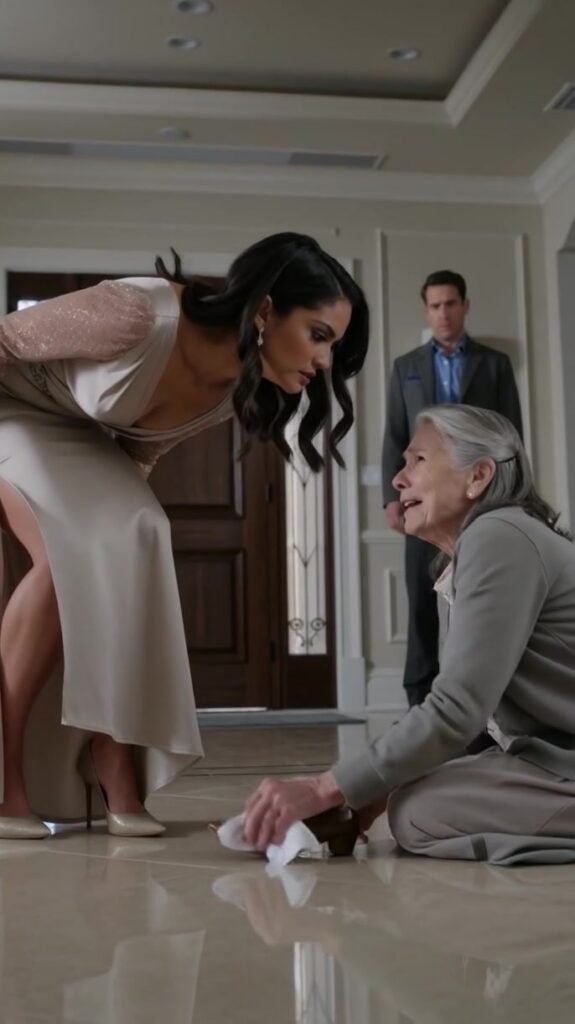
The old woman’s hands were trembling so badly that she could barely hold the shoe. It wasn’t the weight of it—nothing so simple. It was the moment itself, sharp as glass, pressing down on her shoulders until her bones felt hollow. On the polished marble of the foyer, Eleanor Whitlock knelt as if the house had suddenly turned into a church that demanded penance, and she was the only sinner left.
The shoe was a pale, glossy thing, a heel so thin it looked like it could pierce skin. Eleanor dabbed at it with the edge of her cardigan sleeve. Her tears, which should have been private, fell in bright drops that smudged the shine. She tried to wipe those away too, frantic, humiliated—trying to undo the evidence of her own heartbreak.
Above her, Calla stood in a tailored cream dress, her posture as straight as a threat. One foot was bare, the other planted like a claim upon the floor. The bare foot flexed once, impatient. Calla’s mouth held a practiced curve that might have passed for a smile in photographs, but in the flesh it was colder, sharpened by the knowledge that everyone in the room was watching.
“Careful,” Calla said, voice clipped and bright. “That shoe costs more than everything you own.”
Eleanor’s throat tightened. She could taste the copper of her own pride being crushed. She wanted to stand, to refuse, to tell this young woman that she had once hosted fundraisers in this foyer, had soothed fevers on these stair landings, had held the front door open for neighbors during storms. Instead, she kept wiping because her son was there.
Julian stood near the staircase, his hands half-lifted as if he’d started to reach for her and then remembered he didn’t know how. He looked pale, as though he’d swallowed ash. His gaze flicked between Eleanor’s bowed head and Calla’s straight spine and then skittered away again, landing on the chandelier like it might offer answers.
“Louder,” Calla said, leaning forward as if she were listening for a confession. “I want to hear you ask permission to stay in my house.”
The words sank into Eleanor’s chest and cracked something old. She drew in a breath that came out broken, half sob and half laugh. “I lived here,” she whispered. “Before you even knew his name.”
Calla’s laugh rang once, clean and cruel. “Not anymore.”
She stepped closer. Eleanor smelled expensive perfume—powdery and sharp, like flowers left too long in a vase. Calla’s voice dropped, each syllable deliberate, as if she were writing the future into the air. “Once I marry your son, everything here becomes mine. The furniture. The land. The keys. Even the room you sleep in.”
Eleanor looked up, her face streaked, her eyes bright with a pleading she hated herself for. “Say something,” she breathed to Julian. “Please.”
Julian’s mouth opened. Nothing came out. His silence landed harder than a slap. Eleanor felt it travel through her, cold and final, like a door closing.
Calla’s smile widened, fed by that quiet. “See?” she murmured. “Even he knows where this is going.”
Then the front door opened.
The sound wasn’t loud, but it cut through the room with the authority of a gavel. A man stepped in—stern face, dark overcoat, a folder tucked under one arm. He paused as if he’d walked into the wrong address and found a private drama staged at the exact moment of its most vicious line.
His eyes moved from Eleanor on her knees to Calla towering above her and then to Julian, frozen on the stairs like an ornament left out too long. The man adjusted his grip on the folder, and the stamped seals caught the chandelier light.
“Well,” he said slowly, the word loaded with discomfort, “this is awkward.”
Calla straightened as though she had been interrupted mid-victory. “Who are you, and what are you doing here?”
“Harland Pryce,” the man replied, stepping forward with professional caution. “Property officer for the county, acting on an executed transfer.”
Julian’s brow furrowed. “A transfer? What transfer?”
Harland looked down at his documents, then up again. His gaze rested on Eleanor, and something in his expression tightened—sympathy, maybe, or simple human disgust at the tableau. “The deed transfer finalized this morning,” he said. “Recorded at 9:12 a.m.”
Calla let out a thin laugh, dismissive. “That’s impossible. Julian and I—”
“The property now belongs entirely to her,” Harland said, nodding toward Eleanor.
For a second, no one moved. Eleanor’s hands stopped trembling, not because she was calm, but because her body didn’t know what to do with the word entirely. Julian’s head snapped toward her, his face blank with shock. Calla’s mouth fell open as if the air itself had betrayed her.
“What?” Calla demanded, the polished edge of her voice beginning to splinter.
Harland flipped to another page, the paper whispering in the sudden silence. “Mrs. Whitlock’s name was restored to sole ownership per an agreement signed last month,” he said. “A transfer initiated by Mr. Julian Whitlock.”
Julian staggered down one step, then another. “I didn’t—” he began, then faltered. His eyes went to Eleanor, and something old and boyish flashed there: guilt, panic, the memory of someone else cleaning up his messes.
Eleanor’s knees ached on the marble, but she felt oddly suspended above her own pain. “Julian,” she said softly. “What did you sign?”
Julian swallowed. “Calla said… she said it was a routine update,” he whispered, his voice cracking under the weight of his own stupidity. “She said it was to protect us. Tax issues. Paperwork.”
Calla’s face tightened, her cheeks flushing. “Don’t you dare,” she hissed at him, then swung back toward Harland. “This is fraudulent. I want to see those papers. Give them to me.”
Harland held the folder a fraction closer to his chest. “You’re not a party to this transfer,” he said. “And there is more.”
He drew out one last document, the kind of sheet people feared: formal, precise, unfeeling. “Mrs. Whitlock also filed a notice this morning,” he continued. “Effective immediately, she is revoking any permission for non-owners to occupy the premises.”
Calla blinked once, slow, as if her mind refused to process the phrase non-owners. Julian’s breath hitched. Eleanor’s chest rose and fell, each inhale a battle with disbelief.
“Meaning,” Harland said, and now his voice held a firmer edge, “Mrs. Whitlock may legally ask you to leave. Today. Right now.”
Calla’s composure finally cracked. “You can’t throw me out,” she said, the words thin and frantic. “This is my future. Julian promised—”
Julian looked as if he might be sick. His eyes moved from Calla to his mother and back again, and in that flicker Eleanor saw the war inside him: the craving to be chosen by the woman he thought was his salvation, and the shame of seeing what that choice had turned him into.
Eleanor pushed the shoe gently toward Calla’s bare foot, then let go. It clacked softly against the marble and rolled an inch, stopping like a question.
Slowly, with the care of someone standing after a long illness, Eleanor rose. Her knees protested, her hands still shook, but she was upright. She wiped her face with the same sleeve she’d used on the heel and faced Calla at full height, not tall, not imposing—just present.
“I have spent decades believing this house was built of wood and stone,” Eleanor said, her voice raw but steady. “I see now it was built of permission. I gave it. I can take it back.”
Calla’s eyes flashed, and for an instant Eleanor saw what lived beneath the polished exterior: calculation, hunger, contempt. “You’re making a mistake,” Calla spat. “He’ll resent you. He’ll blame you for ruining his life.”
Eleanor turned to Julian. The silence between them was an old wound, reopened. “I didn’t ruin your life,” she said. “I carried it. I held it up when you were too weak to. But I will not kneel in my own home to prove I deserve air.”
Julian’s eyes filled, his throat working. “Mom…”
Harland cleared his throat gently, as if offering Eleanor a lifeline of procedure. “Mrs. Whitlock,” he said, “do you wish to exercise the notice?”
Eleanor looked at Calla, then at the shoe on the floor, then at the staircase where she had once watched her son take his first steps. The air felt different now, as if the house itself had been holding its breath and was finally allowed to exhale.
“Yes,” Eleanor said.
Calla’s face went white. “Julian,” she whispered, reaching toward him like a drowning person reaching for a raft. “Tell her. Tell her no.”
Julian’s hands trembled as badly as Eleanor’s had, but his arms stayed at his sides. His eyes dropped to the marble where his mother’s tears had fallen and dried into faint, dull spots. When he spoke, his voice was small. “Calla… you shouldn’t have done that.”
Calla stared at him, incredulous, then turned sharply toward the door, gathering the fragments of her pride as if they were expensive fabric. Her bare foot slid into the heel without elegance. She walked out with a stiff back and shaking shoulders, the click of the shoe echoing like a countdown.
When the door shut, the silence that followed wasn’t empty. It was heavy, full of consequences. Harland offered the folder to Eleanor with both hands, respectful now. Eleanor took it, feeling the crisp edges of paper under her fingers, proof that words could be turned into walls and keys and freedom.
Julian stepped closer, stopping a few feet away as though there were an invisible line he didn’t deserve to cross. “I didn’t know,” he said, and the lie in it wasn’t deliberate—he truly hadn’t known what he’d been allowing.
Eleanor held his gaze. “You knew,” she replied quietly. “You just thought it would hurt less if you pretended not to.”
She took one slow breath, then another. The trembling didn’t stop, but it changed. It wasn’t fear anymore. It was the body relearning what it meant to stand after being forced to kneel.
“This house is mine,” Eleanor said, not as a boast, but as a boundary. “And so is my dignity.”
Julian’s shoulders sagged, and for the first time that day, he looked at his mother not as a fixture in the background of his life, but as a person—wounded, yes, and still standing.
Eleanor turned toward the staircase, toward the rooms she had once believed she might lose. Each step she took away from the foyer felt like a reclaiming. Behind her, Julian remained where he was, finally forced to understand that the most expensive thing in the world was not Calla’s shoe—it was the cost of silence.