The park looked harmless at first glance. The kind of place that shows up on postcards and makes you believe in good timing: a slow breeze, trees showing off in gold and rust, and a path dusted with leaves like someone had been deliberately romantic about it. I was only there because Mira liked the bench by the pond. She said it was “quiet enough to hear the water think.”
I sat on that bench the way a man sits when he’s trying to keep his life from spilling out—back straight, jaw locked, one arm wrapped around my daughter’s shoulders like I could physically keep the world from touching her. Ellie leaned into me, small and careful. Dark sunglasses covered her eyes even though the sun was weak. Her white cane rested against the bench, angled the way the therapist taught her. She didn’t talk much anymore. She didn’t fidget like she used to. She was there, but also… not there, like a candle someone had decided to snuff and keep for decoration.
People walked past and gave us that look. You know the one: pity mixed with relief that it wasn’t their kid. I tried to be grateful for their distance. I was holding onto routine like it was a rope. Park. Bench. Pond. Duck that always limped. It was the only stretch of the week where I could pretend I was just a dad with a kid and not a man measuring medications in milligrams and counting how many hours his wife had slept.
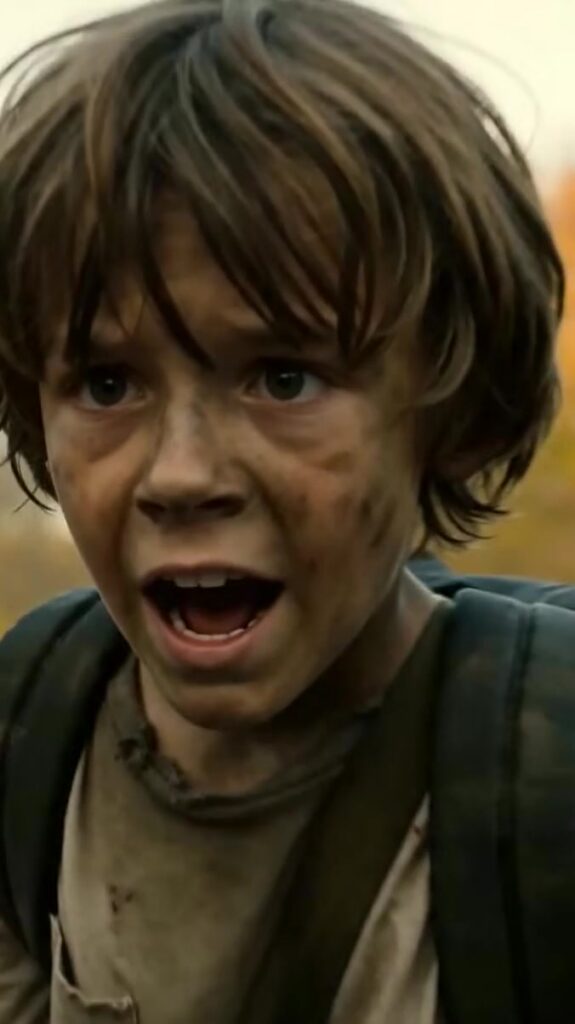
Then a boy came barreling down the path like the ground was on fire behind him. He was all elbows and panic, clothes ripped and dirty, backpack gaping open with a corner of something shiny—foil?—peeking out. He nearly slid on the leaves and caught himself by grabbing my sleeve with a grip that didn’t belong to someone his age. He smelled like rain and old smoke, and his eyes were so alert it made my stomach drop.
“Your kid isn’t blind,” he blurted, words tumbling over each other. “She’s faking it. Or somebody’s making it look like—”
My first impulse was rage. The pure, clean kind that shows up when a stranger touches your life with dirty hands. “Get off me,” I snapped, yanking my arm back. “What the hell is wrong with you?”
The boy didn’t move away. He looked past me, at Ellie, and his face did something strange—like fear and certainty had agreed to share a room. “I saw her,” he said, voice dropping as if the trees were listening. “By your house. She looked right at me. Not like… not like blind people look. Like she saw me.”
Ellie stayed still, lips pressed into a careful line. Her sunglasses reflected the pond, the sky, and my own tense face. I started to say something sharp, something final, because people say awful things about your family when they’re bored. But then a single leaf detached from above us and drifted down, slow as a thought. It floated in front of Ellie’s face, wobbling side to side like it was unsure where to land.
Ellie’s head turned. Not much—just a clean, natural pivot that followed the leaf’s dance. Instinctive. Automatic. It lasted maybe half a second. But it was too smooth to be a guess. Her hand shot out and steadied the cane when it began to slide, fingers landing exactly where it needed to be. The movement was quick and practiced, like someone who knew precisely what she was doing.
The world went quiet in that way it does when your brain is trying to protect you from what it already knows.
I stared at Ellie’s sunglasses as if I could see through them by force. My pulse hammered in my ears. “Ellie,” I said, too softly, as if volume might make it real. “Sweetheart… did you—”
She didn’t answer. She didn’t need to. Her shoulders tightened against my arm, a tiny flinch, and that did more damage than words could have. It was the flinch of someone who’s been coached to stay still, to stay convincing.
The boy took a step back, like he’d finally realized what he’d kicked over. “I sleep in the culvert by the trail,” he said quickly, voice shaking. “Near your street. I’m not stalking you, okay? I just… I’m there. I see stuff. People don’t look down when they walk past.” He swallowed hard and glanced over his shoulder. “Your wife leaves early. Sometimes she comes home with bags from that health store on Maple. The one that smells like incense.”
My mouth went dry. Mira’s health phase had started after Ellie’s “accident.” That was what we called it. The doctors never agreed on a clean explanation—stress, trauma, functional vision loss, migraines, all these terms that sounded like smoke. Mira latched onto supplements and tinctures and podcasts hosted by men who sounded like they sold vitamins out of their trunks. She said she was “supporting Ellie’s nervous system.” She said the medical system didn’t want us well. I’d argued, then stopped, then started doubting myself. Because when your kid goes quiet, you’ll believe anything that promises to bring her back.
“She puts something in Ellie’s food,” the boy said. “I saw her. In the garage. Mixing powder into a smoothie. Ellie didn’t want it. Your wife smiled like… like she was giving a dog a pill.”
I felt my stomach twist, the way it does when you see a crack in a wall and realize it’s been there for months. “Why are you telling me this?” I asked, though the answer didn’t matter.
The boy’s eyes flicked to Ellie again. “Because she looked at me,” he said simply. “And she looked scared. Like she wanted me to notice.” He reached into his half-open backpack and pulled out a crumpled wrapper—silver with green letters, the kind of thing you’d never notice in a trash can. “This was in your bin,” he added. “I thought it was food. It wasn’t. It made my tongue numb.”
My hand hovered, then took it. The wrapper smelled faintly sweet, like fake vanilla. My brain spun up a hundred rationalizations and then tore them down. It wasn’t proof. It was nothing. It was everything.
A jogger appeared between the trees on the far path, moving at that steady, controlled pace Mira used when she wanted to look like someone who had it together. Her ponytail bounced lightly. Her cheeks were pink with the sort of effort that was mostly for show. For a second she was just a woman in leggings, blending into the Sunday crowd.
Then she lifted a hand and waved at us, smile bright and practiced, and the park stopped feeling harmless. It felt staged.
Ellie went rigid beside me. Her fingers tightened on the cane like it was a handle to a door only she could open. The boy shifted, ready to bolt. Mira’s eyes locked onto him first—fast, sharp—and then back to me, like she was doing mental math.
“Hey,” she called, voice cheerful, too cheerful. “I found you.”
I stood up slowly, Ellie still tucked close, my heart thudding so hard I could taste it. I didn’t know yet what I was going to do—confront her, run, play along until I could get Ellie safe. I only knew the bench was no longer a bench. It was a line I couldn’t sit on anymore.
Mira’s smile didn’t change as she approached, but her eyes did. They slid to Ellie’s sunglasses, then to the boy, then to the wrapper in my hand. For the first time, I noticed something I’d never wanted to name: she wasn’t worried about Ellie. She was worried about me knowing.
The wind moved through the trees like nothing in the world could go wrong there. And I realized that was the scariest part. The park wasn’t dangerous. People were.
Mira stepped into the circle of fallen leaves at our feet, and her voice softened, honey-thick. “What’s going on?” she asked. “Who is this?”
Ellie’s chin tipped up a fraction, just enough that I knew she could see the outline of her mother approaching. Behind the sunglasses, her eyes—my daughter’s eyes—were awake. And in the grip of her small hand on my sleeve, I felt a message clearer than any sentence.
Don’t let her take me back.
I took a slow breath, tightened my hold on Ellie, and looked straight at the woman I’d built my life around. “Mira,” I said, keeping my voice even because I didn’t trust it otherwise, “we need to talk about what you’ve been feeding our daughter.”
Her smile held for one more beat, like a mask refusing to fall. Then it cracked, just slightly, and I saw the thing underneath—cold, annoyed, calculating. She glanced around at the families and dogs and golden leaves, then back to me, as if checking whether the scenery would protect her.
“Not here,” she said, still sweet, still careful. “You’re tired. Let’s go home.”
The boy backed away, eyes wide. Mira noticed and took a step toward him, too quick to be casual. Something in my chest snapped into place. I shifted between them without thinking.
“No,” I said, and for the first time in a long time, the word came out solid. “We’re not going home. Not yet.”
Somewhere behind us, a duck splashed, the pond continuing its ordinary business. Leaves kept falling, soft as lies. And in the middle of that beautiful, harmless park, everything that mattered finally broke open.