The rain outside the Aurora Grand Hotel fell like shattered glass against the skyline, but inside, everything was designed to feel untouchable. The lobby shone with gold-veined marble that mirrored every heel and cufflink. Crystal chandeliers hung overhead like captured lightning, bright enough to make midnight look embarrassed. A pianist somewhere behind a wall played notes so soft they sounded more like manners than music.
Men with watches that could pay off mortgages spoke in low tones over champagne they lifted only to prove they could. Women in gowns the color of expensive secrets moved like they belonged to the building, like the building had been built around them. Security glided at the edges—tall silhouettes in black that never quite turned their heads, as if their gaze alone could bruise the air.
At the reception desk, Sloane Mercer kept her smile sharp and her voice softer than a threat. She had been trained in a particular kind of kindness: the kind that denied without appearing to. It was the hotel’s finest offering, after the suites and the silence.
The revolving doors turned. The storm pressed itself into the lobby as if testing the glass, and for a moment everyone noticed the weather because it offended the aesthetic. Then something smaller slipped in with it.
A boy. Barefoot. No older than five, maybe younger—age was hard to tell when someone looked like the rain had been chewing on him. His hair clung in dark strings to his forehead. His shirt had once been pale; now it was a map of wet and cold. He stood on the marble like a dropped item, not a person.
Sloane’s fingers tightened around her pen. Her smile didn’t change, but her eyes narrowed with the reflex of someone guarding a sanctuary. “You’re not allowed here,” she said, not loud enough to make a scene, just loud enough to make the boy feel the boundary.
The child swallowed. His lips were cracked, trembling. “I just need food,” he whispered, like apologizing for being hungry.
A server paused nearby with a silver tray: salmon arranged like petals, bread that smelled of butter and heat, fruit polished to unnatural perfection. Sloane took the tray with two hands, her movements steady as if she were receiving an award. She lowered it to the boy’s height.
For one second, his eyes lit with something so raw it made the chandeliers look theatrical. He reached out—hesitant, as if he expected the food to bite him.
Sloane slid the tray away before his fingers could touch. “Wrong place,” she said, and her tone hardened into a fact.
A laugh came from somewhere near the bar, a short burst quickly hidden behind a cough. A couple of guests pretended to check their phones, as if shame might be contagious. The lobby returned to its preferred temperature: cool, curated, clean.
Across the room, near a wall of glass that framed the city like an exhibit, a man stood alone. His coat was black, tailored, and severe enough to look like it had been cut from the night itself. He wasn’t surrounded by an entourage, which somehow made him more dangerous. People didn’t look at him directly. They orbited around the space he occupied as if gravity had shifted and no one wanted to test the pull.
His name was never spoken in the lobby, not because it was unknown, but because it carried weight. Elias Vane had the kind of fortune that made policy bend and headlines soften. The Aurora Grand wasn’t simply his preferred hotel; it was one of his assets, a jewel among quieter acquisitions.
He watched the boy with an attention that felt wrong, too focused, too still. His eyes followed the child’s shaking hands, the way he hugged himself to keep his body from falling apart.
The boy looked from the tray to Sloane’s polished nails, then to the guests who had become suddenly fascinated by anything else. Something in him folded. He turned, a tiny figure aiming for the revolving doors as if the storm might be kinder than this brightness.
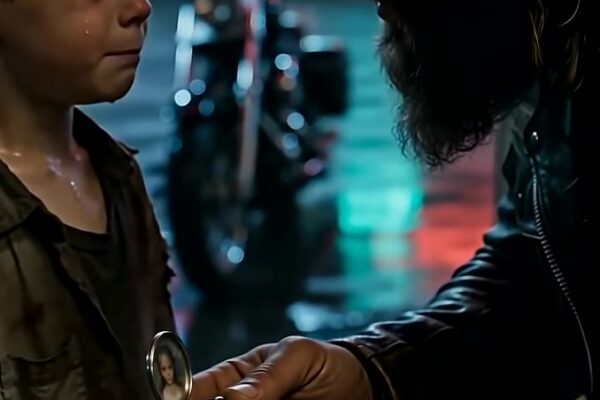
That was when his shirt shifted. A chain, thin and silver, slid free from his collar. The locket at the end swung once and dropped onto the marble with a soft clink, delicate as a teardrop hitting stone.
The sound wasn’t loud. It didn’t need to be. It landed in the lobby like a gunshot that no one could admit to hearing.
Elias moved. Not with deliberation, but with the violence of instinct. He crossed the floor in a few strides, coat flaring behind him. Before anyone could decide whether to intervene, his hand closed around the locket, quick as a magician, careful as a priest.
The boy froze, eyes wide, unsure whether to run or plead. Security shifted—just a fraction—as if receiving a silent command to hold the world in place.
Elias opened the locket. The hinge resisted, then gave, and there it was: a small, faded photograph behind cloudy glass. A woman’s face, half-smile, hair swept back, eyes bright with a familiar defiance. Time had dulled the ink, but it hadn’t dulled recognition.
The color drained from Elias’s face so fast it looked like someone had turned a dial. His breath caught. The lobby, with all its music and money, seemed to thin around him. For a moment, he wasn’t a man who owned buildings; he was a man being struck by a memory.
“No,” he whispered, and the word sounded like it had been torn out. “This can’t be real.”
The boy edged back, clutching his arms, frightened now by the rich man’s sudden fracture. “Mama said you’d know it,” he said, voice small and absolute, like repeating a rule.
Elias’s fingers trembled, the locket shaking in his grasp. He stared at the picture as if it might change, then slowly, painfully, he lifted his gaze to the child’s face.
In the boy’s eyes was the same blue-gray storm as the woman’s. In the line of his cheek, the same stubborn shape Elias had once seen in a mirror before he learned to soften himself into a brand. The resemblance wasn’t a coincidence; it was an accusation.
He took one step closer. Then another. People began to notice the silence, the way even the piano had stopped, as if the building itself were listening.
Elias lowered himself until he was level with the child, knees bending on marble that had never known humility. His voice broke, not into a whisper, but into something worse—honest sound. “What did your mother say my name was?”
The boy’s chin quivered. He looked past Elias, toward the glass doors where the storm waited, as if expecting his mother to appear and correct him. Then he looked back, and in that gaze was a kind of weary courage no child should have to learn.
“She said,” the boy murmured, “that if I ever got lost, I should find Mr. Vane. She said… Elias. She said you used to call her Lila, even when everybody else called her Ms. Hart.”
The name hit Elias like a fist. Lila. Not a socialite, not a headline, not a rumor—the woman he had once loved in a life he’d buried under contracts and vows and security codes. The woman who had vanished without a trace the night he chose to marry money over a future that scared him.
Elias’s eyes blurred. He didn’t wipe them. He reached out as if afraid the boy might evaporate, then stopped just short, letting the child decide whether touch was allowed. “Where is she?” he asked, voice hoarse. “Is she—”
The boy’s mouth tightened. “She’s sleeping,” he said carefully, using the word adults used when they wanted children to stop asking. “She couldn’t come. She told me to bring the locket. She said it would make you listen.”
Elias’s jaw clenched so hard a muscle jumped in his cheek. He stood abruptly, turning toward Sloane, and the air in the lobby changed with him—charged, volatile, no longer polite. “Get him a room,” he said, each syllable a command. “Now.”
Sloane blinked, startled into humanity. “Mr. Vane, I—”
“A room,” Elias repeated, and the shadows of security straightened. “And call a doctor. Then call my legal counsel. And have my car brought around.”
The guests watched openly now, their curiosity finally outweighing their discretion. Whispers rippled like the rain outside. The Aurora Grand, built to feel untouchable, had been touched—by a barefoot child and a photograph the richest man in the room couldn’t buy his way out of.
Elias looked down at the boy again, and his voice softened into something terrifying in its gentleness. “What’s your name?”
The boy hesitated, then answered as if handing over the last thing he owned. “Noah.”
Elias swallowed. He closed the locket carefully and placed it back into Noah’s small palm, curling the child’s fingers around it. “All right, Noah,” he said, and the promise in his tone made the marble feel fragile. “You’re not going back into that storm. Not tonight. Not ever, if I can help it.”
Outside, the rain continued to shatter against the skyline. Inside, the chandelier light no longer looked like frozen storms. It looked, suddenly, like something that could melt.