The restaurant glowed like a place where nothing ugly was allowed to exist. Light spilled from golden chandeliers the way honey pours—slow, deliberate, impossible to rush. The marble floors reflected every heel, every hem, every polished laugh as if even sound had been scrubbed and waxed. A piano murmured in the corner, soft enough to be ignored, perfect enough to be trusted. Men in dark suits and women in bright silence performed the ritual of being admired.
Mara moved through it with a tray balanced on her palm and a calm she had practiced in smaller, louder places. Here, even the air seemed expensive. She kept her spine straight, her smile restrained, her eyes lowered—because this room asked to be handled the way one handles a weapon. All grace, no sudden movements.
At table twelve, Dominic Valera leaned back in his chair like the world had been built around him. His wife, Celeste, sat opposite, glittering in a dress that looked cut from moonlight. Between them sat a single candle and an invisible history. Mara knew his face from old newspapers folded in her mother’s hands: a man who had made money the way storms make damage—quietly at first, then all at once.
She approached with the entrées, careful not to let her fingers tremble. The plates were heavy, porcelain edged in gold. The scent of truffle and wine lifted toward the ceiling, toward the chandeliers, toward the lie this place told itself: nothing ugly, nothing raw, nothing that could stain.
Celeste’s eyes found Mara’s, and the room tightened. It wasn’t jealousy exactly. It was possession, the kind that flares when a stranger touches what you’ve named yours. Mara placed the first plate down. She was reaching for the second when Celeste rose, swift as a blade leaving its sheath.
The slap cracked across the air—sharp, cold, final. It didn’t sound like skin against skin. It sounded like a verdict.
Mara’s tray tilted. Glass and silver collapsed into each other, and the dishes fell in a bright, violent chorus. Wine spread across the marble like a fresh wound. The piano stumbled into silence. A hundred conversations died mid-breath.
No one moved. No one spoke. The room held itself in suspension, each guest trying to decide whether witnessing was participation.
“Stay away from my husband!” Celeste snapped, but her voice wasn’t steady. It shook with something deeper than anger, something hungry and frightened.
Mara’s cheek burned as if someone had pressed a coin from the hearth into her skin. She didn’t lift a hand. She didn’t protest. She looked at the broken glass, the spilled wine, the ruin she had been trained to apologize for, and for a moment she felt the old reflex rising—bend, gather, vanish.
Instead she straightened.
Slowly, deliberately, she reached into the pocket of her apron. In the stillness, the small movement was obscene. A woman beside the wine rack put a hand to her throat. A man at the bar stopped halfway through a sip.
“I didn’t come for him,” Mara said. Her voice cracked like a thin pane of ice. “I came to give him something.”
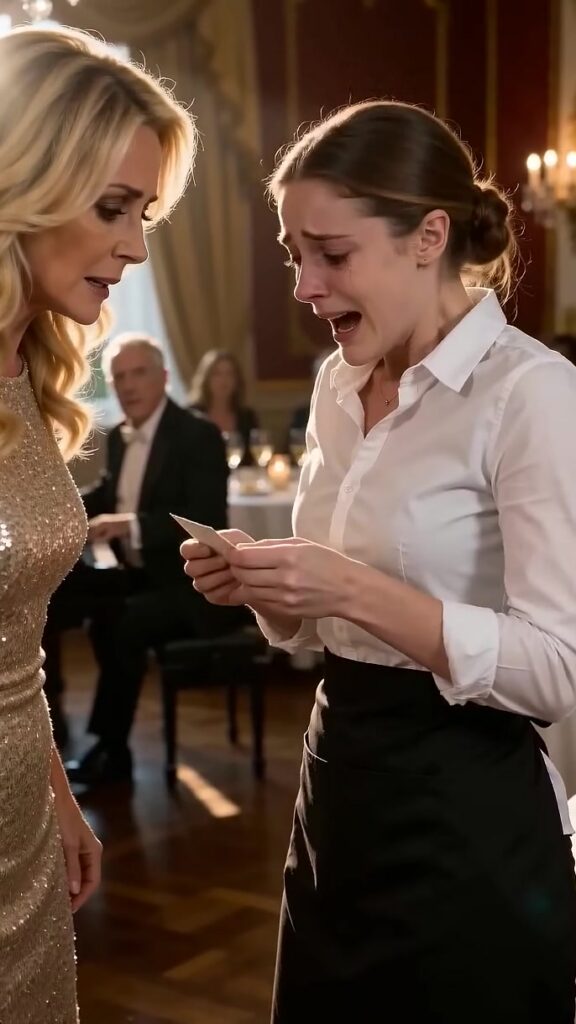
Her fingers closed around a photograph—creased, worn at the corners, as if it had lived in someone’s fist through long nights. She held it out toward Dominic, not as an offering, but as a summons.
Dominic’s jaw hardened. He reached for the photo with the impatience of someone used to controlling the narrative. “Enough,” he said, too loud. The word hit the room like a command.
Then he looked at what he’d taken.
Color drained from him so fast it was as if the photo had stolen it. His mouth opened slightly. His eyes lost their practiced calm and turned wild with recognition—then terror, plain and unmasked.
It was a baby, swaddled in a blanket with a stitched border, the threadwork simple and unmistakable: tiny flowers in faded blue. The infant’s face was small and furious, eyes squeezed shut, as if the world had already offended them. The background was dim—somewhere not meant for photographs at all.
Dominic’s fingers tightened on the paper until the edges bowed. He stared as if the image were breathing.
The pianist stood up so abruptly the bench scraped the floor. His hands hovered over the keys, trembling. His face had turned ashen. “I remember that night,” he whispered, not to anyone in particular. The words crawled through the room.
People shifted, and the air changed. It grew heavy, as if the chandeliers had dropped lower. The restaurant’s glow no longer looked warm. It looked like a spotlight.
Mara stepped forward. Tears collected on her lower lashes, stubborn, refusing to fall until she allowed them. “My mother told me,” she said, and her breath came in short, controlled pulls, “that if you ever tried to forget us… I had to bring you the truth.”
Dominic looked up from the photograph to Mara’s face, and something in him broke open. He looked again—really looked—past the uniform, past the bruise blooming on her cheek, past the role he’d assigned her in his mind.
The room saw it too, like a curtain pulled back: the shape of her mouth, the line of her cheekbones, the dark, unflinching eyes that matched the ones in old society photos of Dominic Valera and his first wife. The resemblance wasn’t vague. It was a mirror held at an unforgiving angle.
“She has Elena’s face,” the pianist said, voice shaking. He pressed a hand to his chest as if his heart were trying to escape. “Holy God—she has Elena’s face.”
Dominic’s breath stuttered. Elena. The name itself felt like a ghost in the room, a draft through a closed door. Elena had been spoken of in past tense, in tasteful murmurs, in condolences. Elena had died, people said, after losing their child. A tragedy wrapped neatly and stored away, like everything else ugly.
Celeste’s lips parted. For the first time, her perfection faltered. She whispered, “That’s impossible,” but the words floated weakly, unanchored.
Mara didn’t look at her. She looked only at Dominic, as if Celeste were just another expensive chair in the room. “You buried us,” Mara said softly. “Not just in the ground. In the story you told everyone.”
Dominic’s voice came out hoarse. “You—” He swallowed. His eyes were wet, but his fear remained. “How did you get that?”
“My mother kept it hidden,” Mara said. “She kept everything hidden. She raised me far from here, far from your name. She taught me what to remember and what to never, ever forgive.” Her tears finally fell, one after another, tracing clean lines through the powder on her skin. “She told me the blanket was the proof. The one thing you couldn’t rewrite.”
The pianist took a step forward, shaking his head. “They brought the bundle in,” he said to the room, voice gaining strength the way confession sometimes does. “I was playing that night. I saw the mud on the shoes. I saw the blanket. Dominic—your hands were… there was dirt under your nails—” He stopped, gagging on the memory.
Dominic’s shoulders hunched as if the chandeliers had become weights. “Stop,” he said, but his authority sounded like a costume slipping.
Mara’s hands curled into fists at her sides. “I didn’t come here for answers,” she said, and the sentence landed like another kind of slap—quiet, merciless. She leaned in just enough that Dominic could see the anger behind her tears. “I came for what you took from us.”
His eyes searched her face, frantic, as if he could find the right expression to make this disappear. “You don’t understand,” he whispered. “You don’t know what they would have done. What they threatened. Elena—”
“Don’t say her name like it’s a prayer,” Mara cut in. “You made her into a story people could swallow. A beautiful tragedy. No mess. No blame.” She gestured around them at the glowing room, the frozen diners, the marble, the gold. “This is what you built to keep the truth from touching you.”
Celeste made a sound—half scoff, half sob. “Dominic,” she said, pleading now, a crack running through her composure. “Tell me this isn’t real.”
Dominic didn’t look at her. His gaze stayed on Mara, and the terror in him shifted into something older, more shameful. “What do you want?” he asked.
Mara exhaled, shaking. “I want my mother’s name cleared,” she said. “I want the grave you paid for to be opened. I want the records—hospital, police, all of it—handed over. I want every lie you bought to be returned to the people you sold it to.”
She lifted her bruised cheek into the light, letting the room see what ugliness looked like when it was denied its humanity. “And I want you to look at me,” she said, voice rising, “and admit out loud what you did.”
For a long moment, the restaurant stayed trapped between its glow and its shadow. Then Dominic’s shoulders sagged, and in that small collapse, the room’s illusion cracked. The chandelier light seemed harsher now, less like honey and more like fire.
Dominic’s fingers loosened on the photograph. He stared at the baby wrapped in the forbidden blanket, then at the waitress with Elena’s face and Elena’s eyes. “I buried the wrong thing,” he whispered. “I buried the truth.”
Mara didn’t smile. She didn’t soften. She only nodded once, as if a door had finally unlatched. “Good,” she said. “Now we begin.”