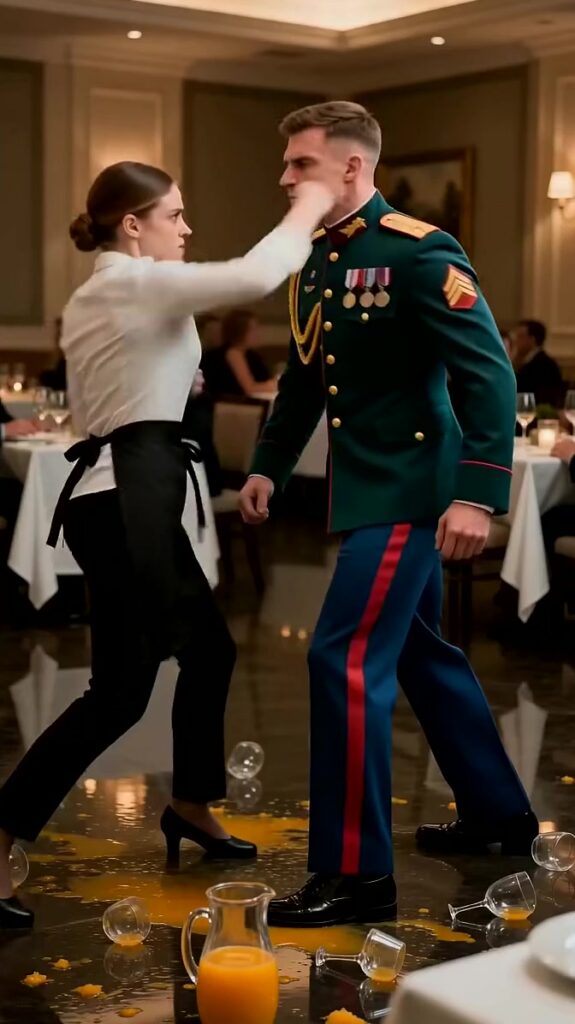
The restaurant had been quiet just seconds earlier. The kind of quiet that cost money—soft piano drifting from hidden speakers, silverware set in obedient symmetry, voices trained to the polite register of people who believed loudness was a sin. Candlelight slid along crystal stems and made small halos on the white linen. Even the air seemed filtered, scented with roasted garlic and lemon peel, as if a door to the outside world had been sealed and bolted.
Mara moved through it like she belonged to it and like she didn’t. She wore the same black apron as the other servers, but her steps were different—measured, precise, never wasted. She carried a tray with a practiced wrist, balanced as if it were an extension of her forearm. The table numbers were memorized, the dietary restrictions noted, the timing of the courses almost musical. She smiled when she needed to and kept her eyes soft. That softness was a choice, not a default.
Near the center of the room, a man in formal military dress sat with his back straight and his medals arranged like a statement. He was younger than most of the officers Mara had seen on the news, but his expression carried the confidence of someone used to rooms rearranging around him. His companions—two men in tailored suits—laughed too loudly at his remarks, as if to demonstrate they understood their place in the orbit.
Mara approached with a pitcher of orange juice and a fresh round of water glasses. She heard the officer’s chair scrape as he stood abruptly, and she adjusted instinctively, angling her shoulder to pass behind him. But he stepped back at the same time, careless, not glancing, as though the space behind him was guaranteed empty.
The collision was small—barely a tap—yet it was enough. The tray tilted. The first glass slid, then another, then gravity took command. Water arced in a bright ribbon. The pitcher knocked her wrist. Orange juice fanned across the front of his uniform in a wet, sun-colored splash, soaking the fabric at his chest and darkening the crisp lines that had taken someone’s careful hands to press.
For a single breath, the restaurant stopped. A fork hovered halfway to a mouth. A laughter died mid-note. Even the piano seemed to shrink into a quieter key. The officer stared down at himself, stunned at first, as if the laws of respect had just been broken and he was waiting for reality to apologize.
Mara’s throat tightened. She set the tray down too quickly, metal kissing table edge with a faint clang. “I’m sorry,” she began, reaching for napkins, words tumbling with the practiced urgency of service-industry remorse. “Sir, I didn’t—”
He looked up, and whatever surprise had been there turned into something sharper. Rage, yes—but more than that. It was humiliation turned outward, a need to make someone else carry the weight of his discomfort. “Watch where you’re going,” he snapped, voice cutting through the linen-and-candle atmosphere like a blade. His companions sat back, eyes bright with anticipation, as if witnessing a show they’d paid for.
Mara froze with the napkins in her hand. She was aware, suddenly and completely, of the room’s attention. The way strangers’ eyes could become a jury in seconds. “I can clean it,” she said, quietly, trying to keep her voice level. “Let me—”
The officer stepped close enough that she could smell cologne and the metallic tang of anger. “Do you know what this uniform represents?” he demanded, loud enough that the tables closest to them flinched.
Before Mara could answer—before anyone could—his hand moved. A quick, dismissive motion, like swatting a nuisance. The sound of skin against skin cracked through the room. Mara’s head turned with the impact, her cheek blooming hot. A gasp rose from somewhere near the bar and died, strangled by disbelief.
Mara’s fingers loosened. Napkins fell like small, white birds to the floor. Her hand came up to her face, and for a moment her eyes looked empty, not with weakness but with a sudden, dangerous distance, as if she had stepped away from herself to assess a situation. Tears gathered, not in a spill, but in a bright, controlled line at the rim of her lashes.
The officer’s chest heaved. He seemed almost pleased at the hush he’d summoned. His arm lifted again, not fully, but enough to say he could do it twice. Around the room, chairs shifted. Someone started to stand. The manager, pale and trapped behind the host stand, took a step and then stopped, as if his feet had met a wall of protocol.
Mara lowered her hand. The tears stayed, but they stopped being plea and became heat. She adjusted her stance—an inch of foot placement, a subtle bend in the knee. Not a server’s posture. Something older and more deliberate, a balance found in harder rooms than this one.
The officer reached for her again. Mara moved first.
Her fingers closed around his wrist with a crisp certainty that surprised even her. It wasn’t strength alone; it was timing. She turned his hand just enough to stop the strike, just enough to make his elbow betray him. His eyes widened as control slid away. Mara’s other hand drove forward, not wild, not vengeful—precise. Knuckles met jaw. The officer’s head snapped sideways, a grunt escaping him as his body tried to decide whether to fall or fight.
He chose wrong. Mara stepped in, caught the front of his soaked uniform, and pivoted. Her hip became a fulcrum. The motion was clean, almost graceful, the kind of movement that belonged in a training hall, not under chandeliers. He went over her shoulder and hit the polished floor with a sound that made the candle flames shiver. A nearby table rattled; cutlery jumped; a glass toppled and rolled, spinning out a thin ring of sound.
People scattered back. A woman pressed both hands to her mouth. One of the officer’s companions rose halfway, then stopped, calculating the cost of involvement. The officer tried to scramble up, but Mara followed him down, pinning his arm with a lock that flattened him. She controlled his wrist like it was a lever attached to pain, and she held him there with the same quiet focus she used to balance trays.
Her face hovered close to his, breath coming fast but steadying. “No,” she said, voice low enough that the words felt like they sank into the floorboards. “You don’t get to do that. Not here. Not anywhere.”
The officer’s mouth opened, perhaps for a threat, perhaps for a plea. He couldn’t find one. His eyes darted around, seeking rescue in the stunned ring of diners and waitstaff. He found only witnesses.
Then, from a table near the back where the light was dimmer, an elderly man pushed his chair away and stood. He moved with slow care, but his gaze was sharp as a knife’s edge. He stared at Mara as if he were looking through years, through uniforms and haircuts and the performance of normal life, to something he recognized beneath.
“That grip,” he said, voice unsteady with shock. “That turn—” He swallowed, his hands trembling at his sides. “Captain?”
The word dropped into the restaurant like a second broken glass.
Mara didn’t look away from the officer immediately. She maintained the hold until she felt the fight drain out of him, until the heat of his anger cooled into fear and confusion. Only then did she lift her eyes toward the old man. In the candlelight, the scar near her hairline—usually hidden by careful styling—caught the glow, a pale line like a secret.
Her expression didn’t soften, but it shifted. Something shuttered opened just a fraction. “Don’t,” she said, not as a command but as a warning laced with fatigue. “Not here.”
The old man took one step forward. “We thought you were dead,” he whispered, and it sounded like a prayer and an accusation at the same time.
Mara finally released the officer’s wrist. She stood, straightened her apron with a small, habitual tug, and looked around at the room of strangers who now held her story in their widened eyes. The manager made a strangled sound, caught between calling security and calling an ambulance and calling the police, and Mara could see every calculation scrambling behind his expression.
She leaned down once more, close enough that only the officer could hear. “You’re going to stay on that floor until I walk away,” she murmured. “And when you remember this night, you’ll remember what it felt like to be powerless. Let it teach you something.”
She stepped back and turned toward the back of the restaurant where the elderly man stood like a ghost with a name on his tongue. Outside the tall windows, the city continued, indifferent and loud, but inside, the hush had changed. It was no longer purchased calm. It was the silence that comes after truth breaks through varnish.
Mara walked toward the old man, each step measured, as if crossing a line she’d drawn long ago. “If you say it,” she said, her voice barely carrying, “if you call me that, you’ll bring every door I’ve kept closed crashing open.”
The old man’s eyes glistened. “Maybe they should,” he replied, and behind him, the restaurant’s warm light trembled on glass and silver like the world was holding its breath for whatever came next.