The restaurant looked like something out of a dream—like it had been assembled from the kind of memories people borrow when they’re trying to feel better about their lives. It sat on a cliff above the sea, all creamy stone and archways, with a terrace that floated out over the water like a promise. White linen draped every table. Candles glowed inside little glass cylinders so the wind couldn’t bully them. The sunset painted everything gold, and the ocean below kept time with a slow, lazy hush.
I was there because of my friend Nina, who had texted me, Wear something that makes you look expensive. I’m making a point tonight. Nina’s points were always sharp. Usually aimed at people who deserved it. This time the target was a man named Grant Havelock—local celebrity, venture-capital prince, owner of three restaurants and the kind of face that looked like it had been carved by someone who hated softness. Nina had pitched a project to his foundation and been invited to “discuss it,” which in Grant-speak meant “let me decide if you’re worth noticing.”
The maître d’ moved like a swan with a clipboard. Waiters slid between tables like they were on rails. Somewhere a violin and a guitar were being gentle about it, keeping the music in that safe zone where it adds charm but never demands attention.
Grant sat across from Nina, his jacket still on like the air itself owed him respect. He didn’t look at the menu so much as hover over it, bored, as if food was a formality that interrupted negotiations. Nina kept her smile strapped in place, the way you keep a lid on something that might boil over if you breathe wrong.
“We’re not a charity,” Grant said, cutting a piece of bread like it had personally disappointed him. “I don’t fund feelings. I fund outcomes.”
“Outcomes require people,” Nina replied. “People require a little humanity.”
He gave her a thin look. “Then earn it.”
It was one of those evenings where everything shimmered on the surface—crystal glasses catching the last light, laughter floating around in bubbles, somebody celebrating an anniversary at a table near the railing. Perfection like a painted backdrop.
Then it broke.
Grant’s fist came down on the table hard enough that the candles jumped in their sleeves. The sound cracked through the terrace—wood against wood, a sudden ugly punctuation.
“THEN EARN IT!” he barked, louder now, as if the whole restaurant needed to understand the rules.
Conversations choked off. Forks paused midair. Heads turned in that synchronized way crowds have when drama appears, hungry and cautious at the same time. Nina’s smile vanished. Her shoulders tightened, but she didn’t flinch. She’d been broke before. She’d been disrespected before. She knew the difference between someone testing you and someone enjoying the test.
That’s when I noticed the boy.
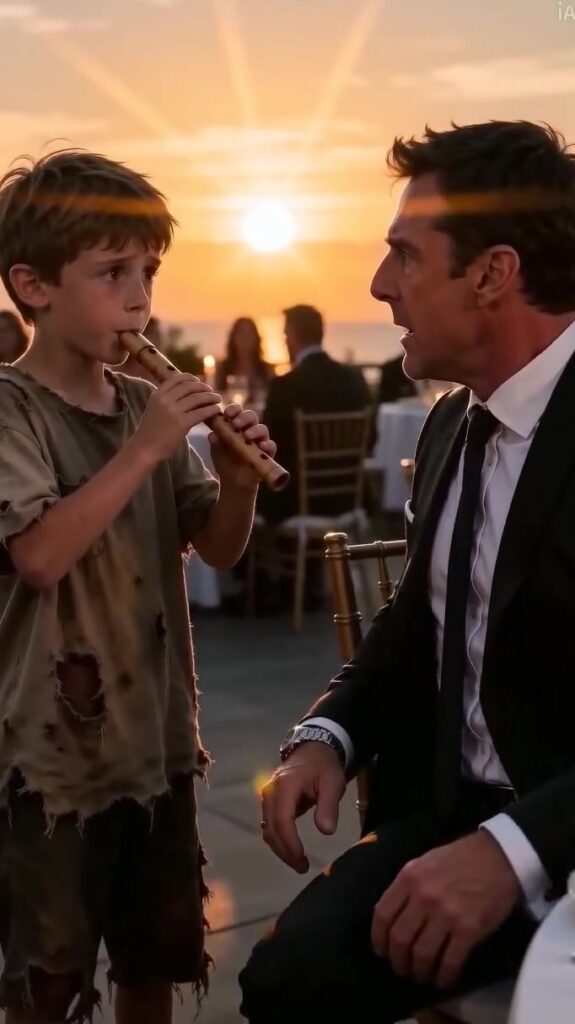
He was standing in the aisle between tables, barefoot on the expensive stone. He couldn’t have been more than ten, maybe eleven. His clothes were thin and worn, the kind of hoodie that had lost its original color. His hair stuck up in clumps like he’d run his hands through it too many times. In his hands he held a wooden flute, simple and scuffed, as if it had been dropped and picked up and dropped again.
He looked at Grant, not at the room, like the room didn’t matter. Like only this man mattered.
“My mom…” the boy said. His voice was small, but the silence made it huge. “She’s dying.”
Someone at a nearby table inhaled sharply. A couple shifted like maybe they’d stand, but no one did. The waiters froze in place, unsure if this was a security issue or a moral one.
Grant didn’t soften. He didn’t even pretend to. He flicked his gaze over the boy like he was a spilled drink.
“Then don’t waste my time,” he said. Cold. Clean. Final.
Nina made a sound—half protest, half disbelief—but it died in her throat. I could see her calculating whether speaking up would help the kid or just make Grant double down. The terrible thing about power is how it makes everyone do math.
The boy didn’t argue. He didn’t beg. He didn’t even look around for support, which somehow made it worse. Like he’d learned early that adults liked to watch tragedy but not touch it.
He lifted the flute to his mouth.
The first note came out shaky, a little breathy, like a bird testing its wings. The next note steadied, and then the melody began to assemble itself—simple, looping, threaded with something that made my skin tighten. It didn’t match the restaurant. It didn’t match the candles or the linen or the expensive perfume drifting on the breeze.
It was too honest.
The song moved like a story told without words. It rose and fell with a kind of stubborn hope, and underneath it there was grief, the way the sea has depth even when the surface looks calm. The boy’s fingers were quick and sure despite the cheap instrument. He played like he couldn’t afford to be timid.
People stopped pretending not to stare. A woman near the railing wiped at her eyes and looked annoyed at herself for doing it. Someone at the bar lowered their phone like the recording suddenly felt disrespectful.
Grant’s expression stayed hard at first—irritated, distant, a man determined not to be moved by something he hadn’t chosen.
Then something shifted.
It was subtle, the way ice changes before it breaks. His jaw unclenched. His breathing slowed. His eyes narrowed as if the sound had reached into him and pulled on a thread he’d forgotten was there.
“No…” he murmured, not to anyone in particular. His voice sounded smaller than it had minutes ago. “That song…”
Nina glanced at me, eyebrows raised, like she was watching a door crack open in a wall she’d assumed was solid.
The boy kept playing. The melody curled tighter, repeating itself, but each repetition landed deeper, like footsteps approaching in a hallway.
Grant leaned forward. His hands, which had looked so confident wrapped around a wine glass, now rested flat on the table, fingers splayed as if he needed to hold himself down. His eyes shone with something that wasn’t anger. Recognition, yes—but also fear, the kind you feel when the past shows up uninvited.
The final note hung in the air and then let go.
Silence rushed back in, but it was heavier now, weighted with all the things nobody was saying. Even the ocean seemed to hush.
The boy lowered the flute and looked straight at Grant. His face was calm in that eerie way kids can be when they’ve spent too much time around hospitals.
“You remember it,” he said. It wasn’t a question in the usual sense. More like a key fitting a lock. “Don’t you?”
Grant swallowed. His throat bobbed. “Where did you learn that?”
The boy reached into his pocket and pulled out a photograph so worn it looked soft. The edges were bent. The image was faded, but you could still make out a young woman smiling, hair messy from wind, holding a baby against her chest. Beside her was a man—cleaner, younger, less armored—his arm half around her like he couldn’t decide if he deserved to touch happiness.
The boy held the photo out. His hand trembled only once, and then steadied, like he refused to let his body betray him.
Grant stared at it as if it might bite.
He hesitated.
Then he took it.
The moment his fingers touched the paper, they started to shake, fine and uncontrollable, like the tremor had been waiting for permission. He stared at the image, and the color drained from his face in waves. It was like watching someone’s certainty get unplugged.
“Where did you get this?” Grant asked, but the words weren’t sharp anymore. They were broken around the edges.
The boy didn’t look away. “She kept it in her wallet,” he said. “She said you left us.”
A collective breath went through the terrace. You could almost hear people rearranging their assumptions, struggling to align this barefoot kid with the polished man who owned half the town’s idea of luxury.
Grant’s eyes flicked up, then back down. Slowly—almost fearfully—he turned the photograph over.
Something had been written there in faded ink, careful handwriting that had survived being folded and unfolded a thousand times.
Grant’s eyes widened as he read it. His lips parted as if his body forgot how to make words.
The sunset, which had been warm and generous, suddenly felt far away. The candles still flickered, but they looked weaker now, like their light couldn’t compete with what had just stepped into the open.
Grant swayed slightly in his chair, like the ground beneath him had changed without warning.
And then, for a second, it felt like the whole perfect restaurant went dark—not literally, but in the way a room does when a secret finally blocks out the light.
The boy’s voice cut through it, quiet and steady as the flute had been. “I didn’t come for your money,” he said. “I came because she asked me to find you before she can’t talk anymore.”
Grant stared at him, the photograph clenched in his hand like evidence and punishment at once.
Nina reached across the table and set her palm on the linen—an anchor, not a demand. Nobody moved. Nobody dared to turn away. The dream had cracked wide open, and underneath it was something real, waiting to be answered.