The rooftop glittered like nothing bad could ever happen there—like the universe had signed a contract promising soft music, expensive perfume, and only the kind of drama that ended with a laugh and a second glass of champagne.
It was one of those terraces that didn’t feel real unless you were the one footing the bill: a waterfall wall that didn’t actually cool anything, heat lamps that looked like sculpture, and marble floors polished so hard they mirrored the candlelight. The city stretched out beyond the railing, all glitter and motion, every window a tiny square of someone else’s life.
Marina hated rooftops. She’d hated them since she was seventeen and stood on one in a cheap dress that smelled like smoke, staring down at a street that didn’t care if she existed. But tonight she’d agreed to come anyway, because Leo’s small hand had curled around her finger when she said, “We don’t have to go,” and he’d whispered, “I want to see the lights.”
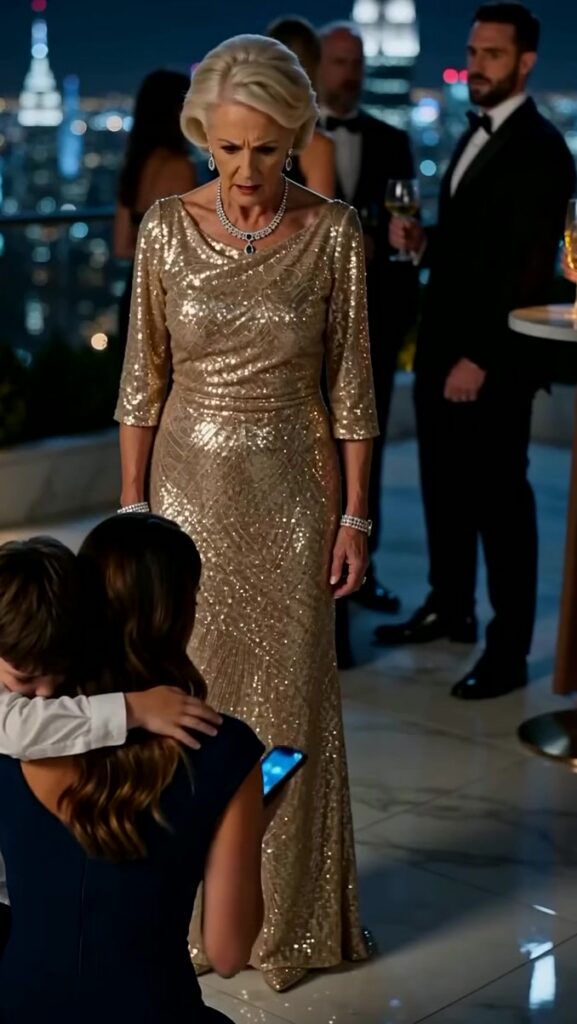
Now Leo was pressed to her shoulder so tightly she could feel his ribs and the fast drum of his breath. His white shirt was wrinkled and smeared at the collar where he’d buried his face. Marina’s navy dress had been chosen to disappear, to be polite, to look like a woman invited as an accessory rather than a threat. She was on her knees, because she’d fallen there without deciding to, as if her body had recognized the moment before her mind did.
Aurelia Vance stood in front of them like the last word in a sentence. Gold gown, blond hair shaped into perfect waves, diamonds at her throat and wrists that caught every stray flicker of candlelight and turned it into something sharp. She didn’t look angry so much as offended by the idea that other people were allowed to have needs in her vicinity.
“Take him and leave,” Aurelia said. Her voice cut clean through the rooftop murmur, through the jazz trio, through the clink of glasses. She said it the way people told waiters the soup was cold.
Leo flinched so hard Marina’s arm instinctively tightened. He didn’t look up. He just pressed closer, like if he could get under her skin he’d be safe.
Marina swallowed. Her throat burned. “Please,” she said, and she hated how small it sounded. She wasn’t pleading for herself. She’d stopped doing that years ago. She was pleading for the eight-year-old boy who’d learned the difference between “family” and “important family” long before he’d learned long division.
Aurelia didn’t even blink. “I don’t care. You’re finished.”
The party didn’t stop. It never did. It just shifted. People rotated their bodies the way sunflowers turn toward light, pretending their curiosity was an accident. Whispering traveled in a neat ripple: that’s her, that’s the kid, no way, can you believe, I heard, I heard.
Marina felt the humiliation like heat. Public, complete, deliberate. Aurelia could have handled it privately, but Aurelia didn’t do private when she could do performance.
For one brief second Marina’s face crumpled, the tears coming fast and hot. She tasted salt and something metallic. She told herself to breathe, to stand, to be civil, to take Leo away before his memory of tonight calcified into something permanent.
Then she heard Leo’s voice, muffled against her shoulder. “Marina… don’t let her take me.”
Something in her clicked into place. Not rage exactly. More like a door closing. Panic drained out as if someone had pulled a plug. Marina lowered her eyes and inhaled once—slow, full. The music sounded farther away. The wind lifted a corner of her hair and she didn’t flinch.
When she looked up again, the tears were still there, because tears were physical and she wasn’t a robot. But the fear was gone.
“You just made the worst mistake of your life,” Marina said quietly.
Aurelia frowned, startled by the tone more than the words. “What did you say?”
Marina’s hand slid into her clutch. Not a designer bag. A simple black rectangle she’d bought two years ago because it fit documents without bending them. Inside was a phone, matte black, no glittering case, no charms. The kind of phone people carried when they were done being underestimated.
Conversation around them thinned to a hush. Even the jazz trio softened, as if the saxophone itself was trying not to intrude.
Marina brought the phone to her ear without looking away from Aurelia. “Close every store,” she said. “Five minutes.”
There was a pause. Not confusion—confirmation. A beat of gears turning.
Aurelia’s mouth opened slightly. “What?” She said it like a woman who had never once in her life been asked to share oxygen.
Marina rose slowly, Leo still tucked against her side. He clung at first, then, sensing something unfamiliar—stability—he loosened his grip just enough to peek over her shoulder. His eyes were red-rimmed and glossy. He stared at Aurelia as if trying to decide whether she was real.
Marina’s voice stayed low, controlled, almost gentle. “And freeze her access.”
Aurelia’s face went pale in a way no makeup could fix. Around them, a few guests sucked in breath. Someone set a glass down too hard; it made a nervous clink that sounded like a bell in a church.
From the phone came a clear voice—male, precise, respectful. “Yes, ma’am. Your company is—”
Marina cut in softly. “I know what it is.” She didn’t need the name said out loud. She didn’t need the satisfaction of watching Aurelia recognize the brand, the hierarchy, the very boring reality of paperwork. “Do it.”
Aurelia recovered just enough to sneer. “This is—this is a tantrum. You think you can intimidate me with some—some retail chain?” She laughed once, brittle. “I have lawyers. I have—”
“You have my patience,” Marina said. “Had, technically.”
That made Aurelia blink. Not from insult. From the strange sensation of being corrected.
Marina glanced down at Leo. “Hey,” she murmured. “Do you remember what I told you about numbers?”
Leo sniffed. “That… that they’re honest?”
“That’s right,” Marina said. “And contracts are numbers wearing suits.”
She looked back up. “Aurelia, you love parties because you can curate the room. You can decide who’s important by where they stand and who they talk to. That’s why you did this out here, under the lights.” Marina’s gaze swept over the watching guests, the lifted glasses, the pretending. “So everyone would understand the rules.”
Aurelia’s nostrils flared. “The rules are simple. You don’t belong.”
Marina nodded as if she’d just received a weather report. “You’re right. I don’t belong in your family. I never did.” She held up the phone slightly, not as a weapon but as evidence. “But your family belongs to my company. Your family’s wealth belongs to it too, at least the parts that have been quietly mortgaged against future earnings.”
Aurelia’s lips parted. The diamonds at her throat glittered like teeth. “That’s impossible.”
“It was,” Marina said. “Until your son got bored and signed things he didn’t read.”
That landed. Not as scandal, but as physics. A force. A truth with weight.
Someone behind Aurelia whispered, “Her son…?” Another voice: “Wait, Marina… Marina Ross?” As if the name had been hiding in plain sight until now, and people were suddenly remembering headlines they’d skimmed and forgotten. The woman who’d built a logistics empire from nothing. The woman who’d bought half the city’s delivery infrastructure during the pandemic. The woman who never attended parties because she was always working.
Aurelia’s eyes flicked—just once—toward her own clutch, where her phone was. Marina didn’t miss it.
“Go ahead,” Marina said. “Try.”
Aurelia snatched her phone out and tapped. Her fingers were fast, practiced. Then her face went stiff as the screen refused her. Again. Nothing. Her jaw clenched so hard Marina could see the muscles jump.
Marina’s phone buzzed lightly. She listened for a second. “Mm,” she said. “All locations closed. Online checkout disabled. Corporate cards locked. Personal cards flagged.” She tilted her head. “And, per your preference for public displays, the system sent a notification to your executive assistant. It’ll be waiting when you land from your little charity gala in Zurich next week.”
Aurelia’s voice came out thin. “You can’t do this.”
“I can,” Marina said. “And I did.”
Leo looked up at Marina with the cautious awe of a kid realizing the adult beside him might actually be able to stop the bad thing. “Are we… are we in trouble?” he whispered.
Marina’s expression softened, just for him. “No,” she said. “We’re leaving. That’s all.”
She turned her body slightly, angling Leo away from the crowd, away from Aurelia’s gaze. “Tonight was supposed to be about you seeing the lights,” she murmured. “We can still do that, okay? Somewhere that doesn’t smell like other people’s opinions.”
Aurelia stepped forward, suddenly frantic. “You can’t take him. He’s a Vance.”
Marina stopped and looked back. Her calm didn’t waver. “He’s a child,” she said. “He’s not a last name.”
The city wind picked up, tugging at Aurelia’s gown, at the napkins on trays, at the illusion that this rooftop was a safe, sparkling world suspended above consequences. Somewhere below, a siren wailed and faded, and life continued in all its messy, uninvited ways.
Marina reached into her clutch again and pulled out a folded paper—not dramatic, not fancy. She held it out. “Temporary guardianship,” she said. “Signed by your son six months ago when he was sober and trying to be decent. Filed properly. Approved. He didn’t tell you because he was afraid of you.” She paused. “Honestly, I get it.”
Aurelia stared as if the paper might bite. Her mouth moved, but no sound came.
Marina didn’t wait for permission. She didn’t wait for applause. She took Leo’s hand in hers—small, warm, real—and walked toward the elevator doors at the edge of the terrace.
As they went, she heard the party breathe again, the whispers shifting from glee to discomfort, because nothing made people more uneasy than watching power change hands without bloodshed.
In the mirrored elevator, Leo wiped his face with his sleeve. “Marina?”
“Yeah, buddy?”
He hesitated. “Are you… mad?”
Marina watched their reflections. Her mascara had smudged slightly under her eyes, making her look less like a CEO and more like a woman who’d been on her knees on marble. “I’m not mad at you,” she said. “I’m mad at the idea that anyone thought you were disposable.”
Leo nodded slowly, as if filing that away somewhere important. “The rooftop looked… pretty,” he said. “Like nothing bad could happen.”
Marina pressed the lobby button. The elevator began to descend, smooth as a lie. “That’s how rooftops work,” she said. “They’re high enough that people think they’re above consequences.” She squeezed his hand. “But we’re not going to live up there. We’re going to live where things are real.”
The city lights rose in the mirrored doors as they descended, turning into a river of brightness. For the first time that night, Leo leaned into her side without fear, just tired trust.
Above them, the rooftop glittered on, stubbornly beautiful, trying to pretend it hadn’t just witnessed something irreversible. And maybe it hadn’t. Maybe rooftops couldn’t remember. But Marina could. Leo could.
And in that remembering was something sturdier than marble.