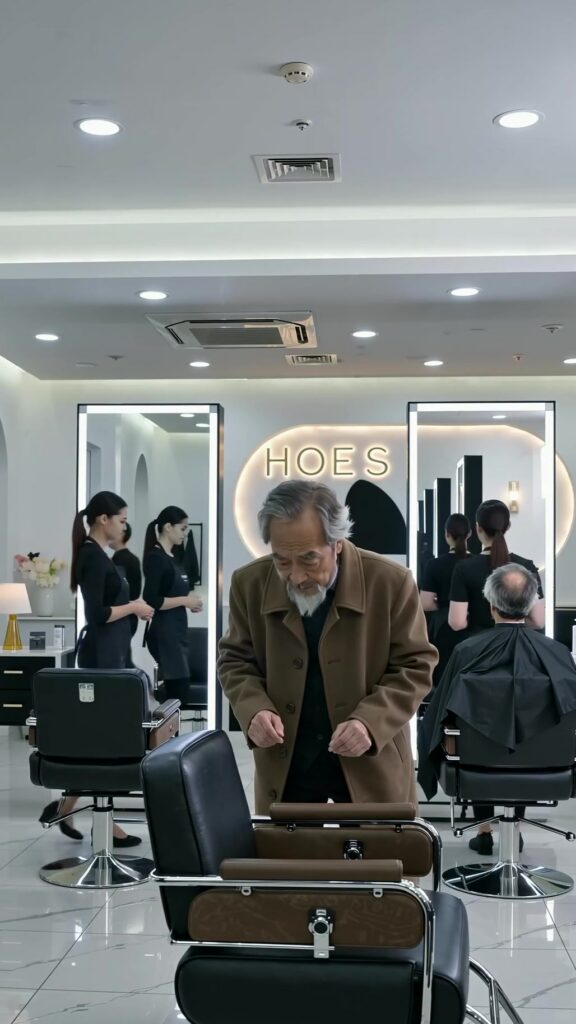
The salon gleamed with artificial perfection. Not the warm, lived-in kind you find in a neighborhood barbershop with cracked leather chairs and a bowl of mints that tastes like 2006. This was the other kind: white lights that never forgave, mirrors polished until they looked like portals, chrome stations lined up like an army, and that faint chemical-floral scent that clung to your clothes as if it wanted to come home with you.
Even the silence felt curated. It wasn’t peaceful. It was the quiet of a museum where you were afraid to breathe too loudly, because the room might decide you didn’t belong.
The receptionist sat behind a glossy counter that looked like it had never met a fingerprint. Her hair was a clean blond sweep, her eyeliner sharp enough to cut, and her smile didn’t reach her eyes. She scrolled on her phone with the bored grace of someone who had never needed anything from anybody.
A coin struck the counter.
Sharp. Wrong. Like a swear word in a prayer.
A crumpled dollar drifted down beside it, tired and apologetic.
Heads turned. The hum of blow-dryers seemed to lean in. In the mirrors, people’s eyes flicked up and away as if looking too long might be contagious.
An old man stood at the counter, shoulders pulled in like he was bracing for weather. His coat had seen better decades; his shoes looked like they’d walked miles on decisions. His hands trembled when he tried to flatten the dollar, but his eyes were steady—steady in a way that made you realize shaking hands didn’t always mean fear. Sometimes it meant hunger. Or cold. Or the price of holding yourself together for too long.
“Please,” he said, voice low enough to be private, but the room heard it anyway. “I need a haircut to get a job.”
The receptionist didn’t bother to soften her face. She glanced at the money like it was lint on her sleeve. “That’s one dollar,” she said, in the same tone someone might use to read a parking sign. “It’s fifty.”
A couple of stylists exchanged looks. One did that tiny laugh people do when they want to be cruel without being accountable for it. Someone else turned back to their client, pretending this was just background entertainment.
The old man swallowed. His throat moved hard. “I can pay later,” he tried. “After I— after I start.”
The receptionist leaned forward. Her perfume reached him before her words did. “Leave.”
The word didn’t echo; it landed. Heavy. Final. Like a door being shut that you couldn’t reopen, even if you knocked until your knuckles split.
The quiet that followed wasn’t kindness. It was the kind of silence that watches a bad thing happen and doesn’t risk getting involved. A few people glanced at their own reflections instead, checking if their discomfort showed.
Then a chair squeaked back.
“I’ll do it.”
A man stepped forward from the line of stations. Early thirties, simple black uniform, no flashy accessories, no ego in his posture. His hair was neat but not styled to announce itself. He had the kind of face that looked like it could keep a secret, the kind you trusted with a story before you realized you were telling it.
He wasn’t loud. He didn’t perform the moment. He simply walked up as if it was the most normal thing in the world to offer help.
“Come with me,” he said to the old man, and placed a hand on his shoulder—not possessive, not pitying, just steady. An anchor. Permission to exist.
The receptionist opened her mouth like she might argue, but something in the stylist’s calm made the room feel suddenly smaller. She closed it again, lips tightening into a line that looked expensive and useless.
The old man blinked, surprised in a way that hurt to see, like he’d forgotten kindness could still be a real object in the world. “Are you sure?” he asked.
“Yeah,” the stylist said. “Let’s get you sorted.”
They walked together to the chair. No rush. No spectacle. The stylist adjusted the chair height with a gentle click and wrapped the cape around the old man like it mattered. Like the old man mattered. He tucked the tissue strip around the neck with the same care he’d give someone wearing a tailored suit.
In the mirror, the old man stared at his own face as if meeting it after a long absence. His hair was a frayed halo of gray, uneven, too long at the sides. It had the look of someone who’d been busy surviving instead of grooming.
The stylist combed through slowly. “What kind of job are you going for?” he asked, as if this was any ordinary appointment.
The old man’s lips quivered. He cleared his throat. “Security,” he said. “Nights. I used to do maintenance at a hotel… before my back went. Then things…” He didn’t finish the sentence. Some stories don’t need an ending spoken aloud to be understood.
“Security’s solid,” the stylist said. “Clean cut helps. But what helps more is you showing up.”
He began to cut. The scissors whispered with crisp, controlled snips. Hair fell in soft gray feathers onto the cape. With every few movements, the stylist paused, checked the line, moved around the chair like he was sculpting something worth looking at.
As the hair lifted away, the old man’s face changed. Not younger, exactly. Just clearer. His cheekbones appeared. His jawline tightened. The exhaustion stayed, but it stopped being the only thing people would see first.
Somewhere behind them, a client shifted uncomfortably. A stylist pretended to fuss with a drawer. The receptionist tapped her nails against the counter, watching with a sour kind of interest she couldn’t hide.
Halfway through, the old man exhaled—one long breath—as if he’d been holding it since he walked in. “Thank you,” he whispered. “You didn’t have to.”
“I know,” the stylist said, smiling gently. “That’s why I did.”
The old man’s eyes glistened, but he didn’t let tears fall. He sat straighter, like dignity was a muscle and he was remembering how to use it. “I have a surprise for you,” he said softly.
The stylist chuckled once, light and kind. “You don’t have to—”
But the old man was already reaching into his coat. Slowly. Carefully. Like he was handling something fragile or sacred.
He pulled out a card.
It wasn’t a plastic membership card or a beat-up business card. It was metal. Gold. Thick enough to make a sound when it hit the stylist’s palm. It caught the harsh white lights and threw them back like it owned the room.
The stylist’s smile faded as he turned it over. There was a logo embossed in the corner: the salon’s name, but in an older design, the kind you’d only see framed on a wall in an office nobody visited. Under it, a title stamped with quiet authority.
OWNER.
The stylist’s breath caught. His eyes darted to the mirror, to the receptionist, to the rows of perfect chairs, as if the room had just shifted on its axis. “You… own this place?” he managed.
The old man met his gaze in the reflection. Those steady eyes again. “Used to,” he said. “On paper, anyway. I haven’t been in for a long time.”
The stylist looked stunned, like he’d found a trapdoor under his feet. “Why— why come in like this?”
The old man’s mouth lifted into something that wasn’t quite a smile, more like a tired truth. “Because I wanted to see it,” he said. “Not the marble floors. Not the chandeliers. The people. The way they treat someone who can’t offer them anything.”
Behind the counter, the receptionist straightened. Her face drained of color in neat, controlled stages. “Sir—” she began, voice suddenly sweet in the way syrup tries to pretend it isn’t sticky.
The old man didn’t look at her. “I didn’t come to make a scene,” he said. “I came because I needed to remember what I built. I sold my shares years ago when my wife got sick. Signed away my name, my office, all of it. I thought I was leaving it in good hands.”
He paused, and the stylist saw the tremor in his hands again—not weakness, but effort. “Turns out,” the old man continued, “I left behind a beautiful shell.”
The stylist swallowed. “I’m just… I’m just a barber,” he said quietly.
“No,” the old man said, and his voice held a strange warmth now, like the lights had finally changed color. “You’re the first person in this room who treated me like a human being.”
The stylist set the gold card down gently on the station as if it might burn. “I didn’t do it for a reward,” he said.
“Good,” the old man replied. “That’s the only reason it counts.”
He reached into his coat again, and this time he didn’t pull out money. He pulled out an envelope, worn at the edges, like it had been carried around for a while. He slid it across the counter, not to the receptionist, but to the stylist.
“What’s this?” the stylist asked, wary.
“A job,” the old man said. “Not behind a chair, if you don’t want. I need someone to help me take this place back to what it was supposed to be. A salon should make people feel better than when they walked in. Not smaller.”
The receptionist took a step forward. “He can’t just—”
The old man finally looked at her, and the room seemed to shrink under the weight of his calm. “He can,” he said, nodding once toward the stylist, “because he already did. He made someone feel welcome. That’s the whole business, isn’t it? Hair is just what you use to get there.”
The stylist stared at the envelope. Inside, a key card and a folded document peeked out—an invitation to meet, a handwritten note, something official enough to be real. He looked back to the old man in the mirror, and for the first time, he saw more than worn fabric and tired shoes. He saw someone who had once made decisions that shaped rooms like this, and who was now making one more.
“I still need a job,” the old man added, almost sheepishly, as if remembering his original request. “The security thing? That’s not a lie. I hate sitting still. But I also need to know… if what I believed in is still here.”
The stylist’s throat tightened. He picked up the comb again, because finishing mattered. “Let me get you presentable for that interview,” he said, voice steady.
He trimmed the last uneven edge, brushed the loose hairs from the old man’s neck, and revealed a face that looked ready to be taken seriously. When he spun the chair, the old man blinked at himself like he was seeing possibility again.
The salon was still gleaming. The lights were still merciless. The mirrors still showed everything. But in one reflection—just one—the judgment had cracked, and something human had slipped through.
At the counter, the old man gathered his coin and his crumpled dollar anyway. He smoothed the bill with slow care. “For the tip jar,” he said, and placed it near the register with a quiet dignity that made the gesture feel like a lesson.
Then he turned to the stylist. “Name?”
“Eli,” the stylist said.
The old man nodded, committing it to memory like it mattered. “Eli,” he repeated. “See you tomorrow. And… thank you.”
As the old man walked toward the door, the room parted for him without realizing it. People watched him go, not quite sure what they’d witnessed—charity, drama, a test, a warning. The receptionist stood frozen behind her perfect counter, staring at the gold card as if it had turned the air thin.
Eli stayed by his chair, scissors in hand, and looked at his own reflection. For once, it didn’t feel like judgment staring back.
It felt like a choice.