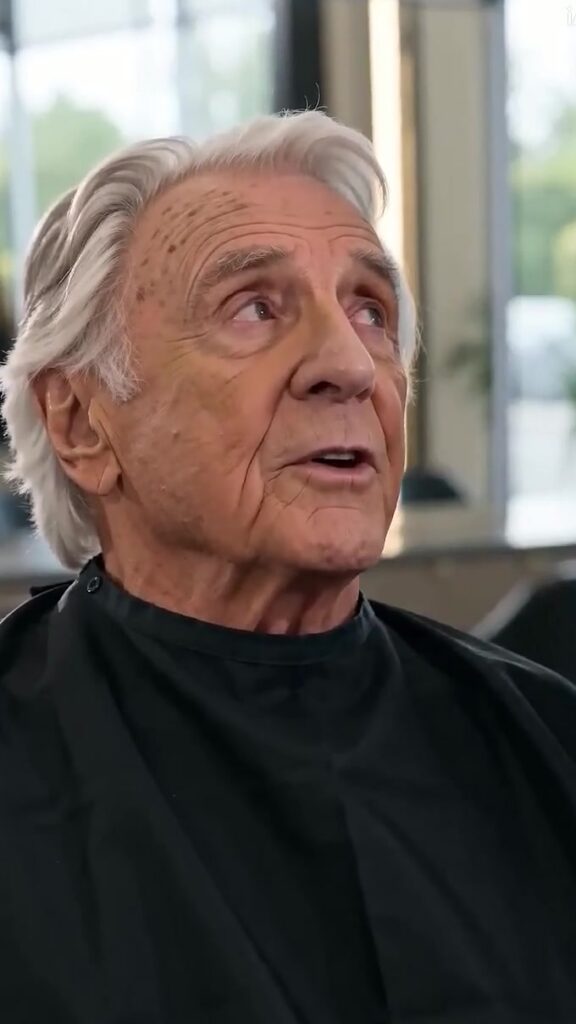
The salon gleamed with perfection, the kind of perfection that looked expensive even when no one was looking. Light poured from recessed panels in the ceiling, clean and white, washing every surface until the whole place seemed scrubbed of fingerprints and doubt. Mirrors stretched from counter to counter like silent judges. The black chairs lined up in obedient rows, their leather so polished it reflected the ceiling like still water.
It was a room built for transformations, but it didn’t feel like change lived here. It felt like control did. The stylists moved with measured speed, scissors flashing, blow-dryers humming, laughter carefully portioned. A tray of iced water sat untouched on the marble counter. Even the air smelled arranged—citrus and lavender and money.
Gabriel kept his station immaculate, more out of habit than devotion. He’d been here six months, long enough to learn the salon’s rules: no late clients, no bargaining, no exceptions. The owner—Mr. Harrow, a name spoken with a hush—was said to inspect the place without warning, like weather that could ruin you. Gabriel watched customers the way a sailor watched clouds, trying to anticipate the storm.
The afternoon drifted toward evening when the first sound landed wrong. A small, hard clack against stone.
Heads turned as a coin skittered across the counter and stopped near the tip jar. A crumpled dollar bill followed, fluttering like a tired leaf. For a moment, the salon’s hum stumbled.
An old man stood at the reception desk as if he’d been placed there by accident. His coat hung too large, sleeves frayed to softness, buttons mismatched. His hands trembled with the stubborn rhythm of cold or age. But his eyes were steady—unfashionably steady—like someone who had learned patience the hard way and never unlearned it.
“I’m sorry,” he said, voice low enough to be private, and somehow the room heard it anyway. “I need to look… presentable. There’s a job interview tomorrow. A haircut might help.”
Serena, the receptionist, didn’t shift her posture. Her hair was a glossy sweep of blonde, her makeup precise. Her smile appeared exactly where it was trained to appear, but it carried no warmth. “A men’s cut is fifty,” she said. Her eyes flicked to the coin and the dollar like they were lint.
The old man’s shoulders sank a fraction. He nodded as if he’d expected the answer, as if he’d rehearsed being refused. “This is what I have right now,” he murmured. “I can pay the rest later. I can come back. I just—”
Serena’s smile tightened, polished into something sharp. “We don’t do later. We do payment.” She leaned forward, voice dropping into a tone that made it feel like the rule existed to protect the room from him. “You need to leave.”
The word didn’t echo. It fell. Heavy. Like a lock clicking shut.
A few stylists let out a small sound—half amusement, half relief that the attention wasn’t on them. A customer pretending to scroll on her phone didn’t scroll at all. Another stared at her own reflection as though it might explain what was happening.
Gabriel felt his chest constrict, that familiar pressure between fear and anger. The salon’s perfection suddenly looked fragile, as if it required cruelty to stay spotless. He glanced at Serena, then at the old man’s hands hovering over the counter, unsure whether to pick up his coin or leave it behind like proof of humiliation.
“I’ll do it,” Gabriel heard himself say.
The room turned. Serena’s eyes widened a millimeter, just enough to show she understood the risk. “Gabe,” she warned softly, not a plea but a reminder. Policies. Inspections. The invisible weight of Mr. Harrow’s name.
Gabriel stepped around the desk anyway. He didn’t look at the other stylists. If he looked, he might see the question: Are you trying to be a hero, or are you trying to get fired? He walked to the old man and placed a hand—light, respectful—on his shoulder.
“Come with me,” Gabriel said, as if this were the most normal thing in the world.
The old man blinked, surprised by the touch more than the offer. Then his mouth trembled, not with age this time but with something that wanted to be gratitude and was afraid it might be a trick. “Thank you,” he whispered. He gathered his coin and bill, then paused. “Should I—”
“Keep it,” Gabriel said. “You’ll need it more than the register will.” He guided him toward an empty chair at the far end, away from the reception desk’s bright authority.
The cape rustled like a flag surrendering when Gabriel draped it around the old man’s shoulders. He didn’t hurry. He didn’t pretend the man wasn’t thin or that his coat hadn’t smelled faintly of rain and sidewalks. He fastened the neck strip carefully, as if the details mattered because the person did.
In the mirror, the old man studied his own face with a kind of wary distance, like he hadn’t met himself in a while. His hair was uneven, longer on one side, silver threaded with grime. His jaw looked stronger than his posture suggested. Gabriel saw, beneath the fatigue, the bones of someone who had once stood tall.
“How would you like it?” Gabriel asked.
“Neat,” the old man said. “Not fancy. Just… honest.” He swallowed. “Something that says I’m still worth hiring.”
Gabriel’s throat tightened. He combed gently through the hair, separating tangles with patient strokes. The salon’s silence grew strange, not hostile, but attentive. People kept pretending they weren’t listening, and listening anyway.
When Gabriel began to cut, the sound of scissors was crisp, almost ceremonial. Snip by snip, the old man’s face emerged from its shaggy hiding place. His cheekbones became visible. His eyes, already steady, now looked sharper, more awake. With each careful pass of the clippers, Gabriel felt the room’s perfection shift from sterile to something else—something that had breath.
The old man exhaled, long and trembling, and for the first time his shoulders loosened. “You didn’t have to,” he murmured.
“Yes,” Gabriel said quietly, surprising himself. “I did.”
A faint, almost invisible smile moved across the old man’s mouth. He stared at his reflection as if memorizing proof that he could still be someone. Then he spoke again, softer than before, like he was afraid to break the moment. “I have something for you.”
Gabriel kept his hands steady. “You don’t owe me anything.”
“Not owe,” the old man corrected. “Offer.”
He reached into the inner pocket of his worn coat, slow and deliberate. The movement drew attention in the room, a ripple of unease. Serena’s posture stiffened as if anticipating trouble. A stylist near the shampoo sinks took one step closer, then stopped.
The old man pulled out a card—not paper, but metal. It caught the overhead lights and threw them back in a muted glow. Gold, heavy-looking, etched with a minimalist emblem: a hawk in flight, wings spread wide. Along the bottom was a name pressed into the metal with clean authority: E. HARROW.
Gabriel took it without understanding why his fingers suddenly felt numb. He turned it over. A simple sentence was engraved on the back, small but sharp: If you find this, you found me.
His breath caught. He looked from the card to the old man’s face, and something in the man’s eyes—something calm, watchful, heartbreakingly patient—clicked into place like a lock recognizing its key.
“Mr. Harrow?” Gabriel whispered.
The old man’s gaze held his, steady as stone. “Elias,” he said. “Just Elias, right now.”
Across the salon, Serena’s perfect smile finally cracked. One of the smirking stylists went pale. The room’s immaculate order trembled on its foundation, because suddenly every polished mirror reflected not beauty, but judgment.
Elias Harrow tilted his head, examining Gabriel as though the haircut had been the smaller test. “You touched my shoulder like I was human,” he said softly. “You cut my hair like I belonged here. You gave me back my dignity before you knew it could cost you.”
Gabriel’s heart hammered. “I thought you were—”
“Someone you could dismiss,” Elias finished, not unkindly. “That’s the point.” He glanced toward the reception desk. “This place gleams. But I’ve been wondering for a long time what it hides.”
Gabriel swallowed. “I’m sorry if I broke a rule.”
Elias’s eyes sharpened. “No,” he said. “You broke the wrong rule.” He looked at Gabriel’s hands, still holding scissors. “Keep those steady. Finish.”
Gabriel did, trimming the last edges with care, shaping the back clean, wiping stray hair from the old man’s collar. When he spun the chair toward the mirror for the final reveal, the man staring back looked older than the salon, older than its trends, and somehow newly alive.
Elias stood, removing the cape with a slow dignity, and the room held its breath. He set the gold card on the counter where everyone could see it, then placed the coin and the crumpled dollar beside it like a dare.
“Tomorrow morning,” he said, voice calm enough to slice glass, “we open this salon again. The lights will still be bright. The mirrors will still be clean. But we will no longer sell perfection like it’s a weapon.” He looked directly at Serena. “And we will never again measure a person’s worth by what they can lay on a counter.”
Silence stretched, thick and inevitable. In that silence, Gabriel understood the true drama of the room: not the reveal of ownership, not the threat of firing, but the sudden exposure of everyone’s choices reflected back at them in flawless glass.
Elias turned to Gabriel last. His steady eyes softened. “Bring your hands to work tomorrow,” he said. “And bring your heart too. If this place is going to shine, it will be because of that.”
Then he tucked his worn coat around himself and walked out into the evening, leaving behind a salon that still gleamed—only now, for the first time, it didn’t look perfect. It looked honest.