The salon gleamed like it had been polished by people who weren’t allowed to have bad days. Gold accents ran along the mirrors in thin, confident lines. The chairs looked like they belonged in a luxury car showroom. Even the air smelled expensive—citrus and something woody, like money had a cologne.
Inside, everything moved at a soft, practiced pace. Stylists glided. Clients murmured. Machines hummed with the steady purr of technology that promised perfection if you could afford it. Every surface reflected somebody else’s good life back at them.
Jay worked the front half of the floor, the “junior” stations along the window where you could see the street and, if you were unlucky, your old high school crush walking by while your hair was half foiled. He’d been there six months. He still got the eyebrow raises when he suggested things like “maybe we don’t need to upsell the scalp treatment to someone who clearly just wants a trim.”
Most days, Jay kept his head down, did clean work, and tried to ignore the salon politics: the way the receptionist, Marla, could make a customer feel like royalty or like gum on her heel depending on what handbag they carried; the way senior stylists talked about clients the moment they left; the way everyone pretended it was “just business.”
The bell over the door chimed, tiny and sweet, and the whole room shifted the way a body shifts when it senses a draft.
An old man stepped inside. He didn’t look dramatic, exactly. He looked… tired. Like someone who’d been doing the same uphill walk for years and had finally accepted the incline as normal.
His coat was clean but worn at the edges. The fabric had that softened, over-loved look—washed a hundred times, held together by habit. His shoes were the kind you could tell had met a lot of sidewalks. Not ripped, not filthy, just old. Honest old.
Conversations didn’t stop. They just changed frequency, like a radio station sliding a notch. Laughter turned quieter. A couple of people stared without meaning to, then pretended they hadn’t. One woman in a glossy blowout glanced at him, then at her reflection, like she needed reassurance she was still in the right place.
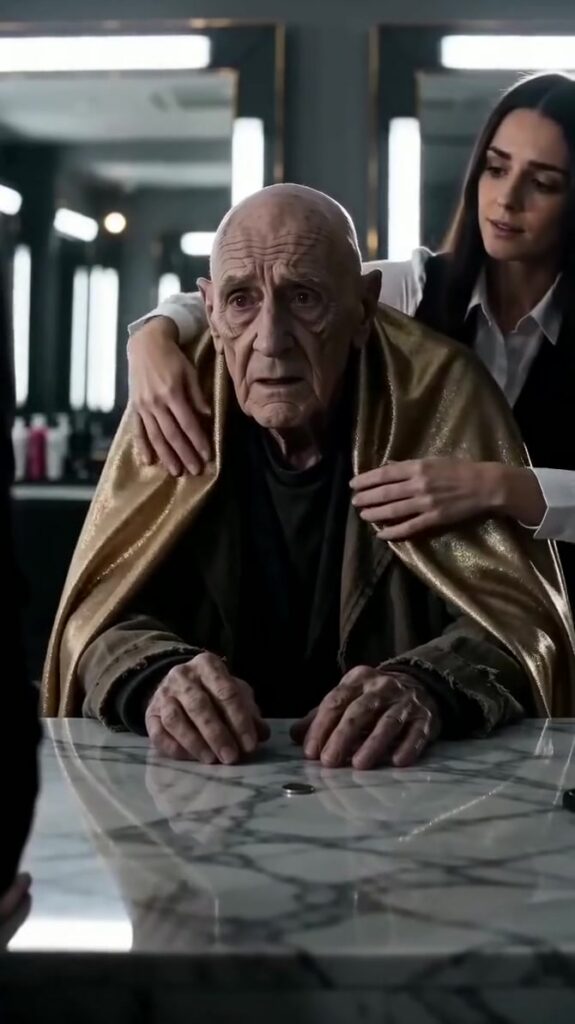
The man walked to the counter with careful steps, as if the marble floor might bite. He opened his hand over the desk.
A single coin dropped.
CLACK.
The sound was small, but it landed like a gavel. The hum of the machines suddenly felt louder. Even the music—some mellow playlist the salon insisted was “curated”—seemed to shrink away.
“Please,” the old man said. His voice was soft but clear, the way people sound when they’ve had to ask for help more times than they wanted. “I need a haircut. I have a job interview.”
Marla’s smile didn’t even make an attempt. Her face stayed arranged in that polished customer-service shape, but her eyes sharpened like she was reading a receipt she didn’t agree with.
“That’s one dollar,” she said, flat as the countertop. “Our cuts start at fifty.”
The old man swallowed. You could see his throat move, see him bracing like he’d already guessed how this would go.
“I can pay after,” he said. “Just… I need a chance. I’ll come back right after. I promise.”
Marla leaned forward a fraction, just enough to make the power dynamic obvious. “No money, no service. That’s not personal. It’s policy.” Then, because she couldn’t resist, she added, “There’s a discount place two blocks down.”
A quiet chuckle slipped from somewhere behind the man—one of the stylists near the color bar, probably. It wasn’t loud, but it wasn’t hidden either. The old man’s shoulders dropped. His eyes flicked toward the door like a person mentally measuring how far they could go before they had to feel embarrassed again.
Jay’s hands were busy wiping down his station, but his stomach tightened. He’d seen plenty of rude customers, plenty of drama, plenty of “I’m late and it’s your fault” tantrums. This felt different. This felt like the salon was showing its teeth.
The old man’s fingers curled around the edge of the counter. For a second, Jay thought he might say something sharp back. Instead, he just nodded, tiny and defeated, as if agreeing with gravity.
Jay surprised himself by speaking before he’d fully decided to. “I’ll do it.”
Every head didn’t turn, because salons are too cool for that, but the room definitely listened.
Marla scoffed. “Jay, don’t be stupid. You’ll get in trouble. And for what? He can’t pay.”
Jay walked up anyway, heart thudding. “It’s fine. I’ve got an opening. Come on, sir.”
The old man blinked like he’d misheard. “You would?”
“Yeah,” Jay said, trying to make it sound normal. “It’s just hair.”
Marla’s voice sharpened. “You’re not authorized to comp services.”
Jay kept his eyes on the man. “Then I’m not comping. I’m doing my job. I’m cutting hair.” He lowered his voice slightly, not to hide, but to soften. “Let’s get you cleaned up for that interview.”
The old man followed him toward the back like someone walking into a warm room after being outside too long. When Jay draped the cape around his shoulders, the man exhaled, slow, as if he’d been holding his breath since the door opened.
Up close, Jay noticed details that didn’t match the “poor old guy” story everyone had already written in their heads. The man’s hands were rough, yes, but his nails were trimmed. His posture was tired, but not sloppy—more like someone who carried responsibilities, not just years. And his eyes… his eyes were alert. Kind, but sharp in a quiet way.
“What kind of job interview?” Jay asked while combing out the tangled ends. He spoke casually, the way stylists do when they’re trying to make you feel human and not like a project.
“Consulting,” the old man said after a pause. “Maybe management. I’m… trying to get back into things.”
Jay raised his eyebrows. “Consulting, huh? Nice.”
“If they’ll have me,” the man replied. Then his voice dropped into something smaller. “Thank you. I know I don’t look like… I know.”
Jay kept snipping, focusing on clean lines. “You don’t owe me anything,” he said, because that was what he believed you said in moments like this. “Everyone deserves to look like themselves on a good day.”
The old man’s mouth twitched, almost a smile. “Oh,” he murmured. “But I do.”
Jay paused. “What?”
The man’s hands disappeared into the inside pocket of his worn coat. For a second, Jay’s brain flashed through dumb possibilities—did he have a check? Was he pulling out a crumpled wad of cash? Was he going to hand Jay a sentimental trinket?
Instead, he produced a card. It was sleek and heavy-looking, matte black with a thin gold edge that caught the light like a secret. There was no visible logo from where Jay stood, just a subtle embossed pattern that looked like a crest when the angle shifted.
The room changed temperature. Jay felt it before he saw it: the way nearby voices faltered. The way Marla’s perfume suddenly seemed too loud. The way one of the senior stylists stopped mid-spray.
The old man held the card between two fingers, not showing off, just offering it like a fact.
“I don’t carry cash much anymore,” he said mildly. “Bad habit, I know. But I can settle this. And I’d like to speak with whoever runs this place.”
Marla’s eyes landed on the card, and the color in her face rearranged itself. Her polished expression cracked just enough for Jay to see panic underneath it.
“Sir,” she said, suddenly sweet, suddenly upright. “Of course. We—we can absolutely accommodate—”
The old man looked at her the same way you’d look at a door that didn’t open the first time. Patient, but not impressed. Then he looked at Jay in the mirror.
“Finish the cut,” he said. “You have good hands.”
Jay swallowed and nodded, scissors steady again, even though his thoughts were sprinting. The card wasn’t just a payment method. It was a key. The kind of key that didn’t open doors so much as remind people who built them.
Behind them, the salon whispered status like it always had—gold, laughter, machines—but now it sounded different. Not like a promise. More like a test. And Jay had a strange feeling the old man hadn’t come in by accident at all.
When Jay angled the chair and began shaping the back neatly, the old man leaned forward just enough to speak so only Jay could hear.
“That interview,” he murmured, “is for you too. You just didn’t know it yet.”