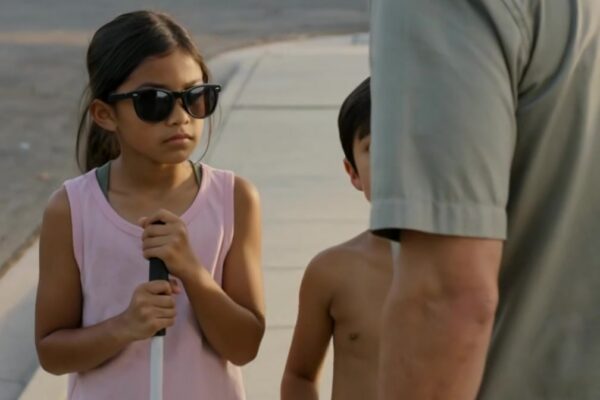
The street was a careful thing—trimmed hedges, polished cobblestones, and light that seemed to land gently on every surface. The kind of place where even the wind moved politely. In the late afternoon, the sun turned the row of mansions into honeyed stone and gilded the parked cars until they looked like trophies. A few nannies pushed prams with the soft patience of routine. A gardener clipped roses as if time couldn’t touch them. Nothing broke the spell.
Then a scream tore through the golden calm like a blade through silk.
“DON’T TAKE IT!”
It rang too sharp, too human. Birds exploded from the plane trees, flinging their shadows across the pavement. A passing car braked hard enough to make its tires whisper against stone. At the curb, a man in a tailored suit froze mid-motion, his hand wrapped around a cardboard sign he’d started to tear.
He was wealthy in the quiet, indisputable way: shoes without scuffs, a watch that didn’t announce itself because it didn’t need to, a coat cut to hide the body under it like a secret. Two security men flanked him—earpieces, stiff posture, eyes already measuring threats.
Between them and the curb stood a child with a bicycle.
The bike was small, pink once, now worn toward a dusty rose. Its tassels were frayed. The handlebars were spotted with rust like freckles. The little girl clung to it as if it were a railing on a sinking ship. Her fingers, tiny and white-knuckled, dug into the metal. Her whole body shook as though she were holding back more than tears.
“My dad gave me that bike,” she cried, and the words broke in her throat, “before he disappeared!”
The world around them seemed to choke on the sentence. The gardener stopped clipping. One of the nannies went still, hand hovering over a stroller handle. Even the passing car idled as if uncertain whether it had the right to keep moving.
The man’s expression—stern, rehearsed, in control—slid off his face like a mask knocked loose. Something raw took its place. His grip slackened on the torn cardboard, and for a moment he stared at the bicycle as if it had rolled out of a memory rather than a side street.
“Disappeared?” he repeated, so quietly it barely existed.
One guard leaned in, voice low. “Sir, we should go.”
But the man didn’t step away. His eyes moved to the girl’s face with an intensity that did not belong in any street, wealthy or poor. Her cheeks were wet, dirt caught in the tracks of tears. She couldn’t be more than seven. Eight, if grief had made her older.
She nodded fiercely, as if nodding could keep her from falling apart. “He said he’d come back,” she said, “but he never did. Mom stopped eating… she just cries now. I thought if I sell it… maybe I can help.”
Her voice dissolved into sobbing, and she pressed her forehead against the bicycle’s basket where a faded sticker of a cartoon rabbit still clung stubbornly to the wire.
The man staggered half a step back, as if hit. His throat worked. The street, immaculate and untroubled a moment ago, suddenly felt too bright, like a stage light exposing the seams of a set.
He crouched, slower this time, bringing himself down to her level. “What,” he said, and his voice trembled despite the effort to steel it, “was your father’s name?”
The guards stiffened. The nearest one scanned the sidewalk, clearly deciding whether this was a con, a trap, or a public relations disaster. The second guard’s hand hovered near his jacket as if comforted by the possibility of force.
The little girl sniffed hard. Her gaze flicked to the man’s face as if weighing whether it was safe to give him anything. Then she whispered the name.
It was a simple name. Ordinary enough to belong to a teacher, a mechanic, a man who fixed broken fences. But it struck the suited man like a gunshot.
All the color drained from him. His eyes widened, not in surprise but in recognition—recognition welded to fear. The air seemed to thin, and for a terrifying second he looked as young as the child, trapped inside a moment he’d once sworn would never catch him again.
“That’s not possible,” he whispered. He glanced at the bike again, at the rust and the fraying tassels, and his hand lifted as if to touch it. He stopped inches away, fingers suspended, because touching it might make the past solid.
“Sir,” one guard urged, sharper now. “We really need to leave.”
The man ignored him. His eyes searched the girl’s features—brow, nose, the shape of her mouth—like a man reading a text he didn’t want to understand. The longer he looked, the more his certainty curdled. He swallowed. “Where do you live?” he asked, and it came out too rough.
“Over there,” she hiccuped, pointing a trembling finger toward the edge of the neighborhood, where the manicured streets began to fray into older buildings and narrower lanes. “By the laundromat. Mom says I shouldn’t come here but—people here have money.” She said it like an accusation against the world.
The man closed his eyes for a heartbeat. When he opened them, something in him had shifted from shock into a grim, dreadful resolve. He reached into his coat and drew out a leather wallet. His hand shook as he slid bills free—too many for a bicycle, too many for a child. He held them out.
She recoiled as if the money were hot. “No,” she said, voice thin with pride and panic. “I’m not begging. I’m selling.”
He stared at her, and a strange sound escaped him—half laugh, half fracture. “Stubborn,” he murmured, and the word had the texture of familiarity. He nodded once, almost to himself. “All right.” He looked at the torn cardboard sign at his feet and realized what it was: the girl had written a price and a plea, probably in careful block letters, and he had reached to rip it away because it had no place here. Because need was untidy. Because suffering ruined property values.
He picked up the torn sign, hands suddenly gentle, and set the pieces together as if he could undo his first instinct. Then, very carefully, he laid the bills on top of it. “This is the price,” he said hoarsely. “And extra for… repairs.”
“But then I won’t have my bike,” she whispered, and the sentence held more than a child’s attachment—it held the last thread connecting her to someone missing.
He stared at her, jaw working. For a moment, it looked as if he might break completely. Instead he forced his voice steady. “You won’t sell it,” he said, as if issuing a decree to the universe. “You’ll keep it.”
She blinked, confused. “But—”
“I’m not taking it,” he cut in, and there was iron under the tremor. “No one is.”
The guards exchanged glances again, the kind that said this had veered into territory they couldn’t control. One of them murmured, “Sir, the board meeting—”
“Cancel it,” the man said, and the words came so fast they startled even him. He looked at the girl as if she were both key and lock. “What’s your name?”
She hesitated. “Mara.”
Mara. The name landed in his chest like a stone. He repeated it softly, as if tasting it for truth. Then his gaze slid to the inside of the bicycle basket, to a small cloth tied around the wire. A charm. A little bundle, tied in a knot. Something a father might have fastened there for luck, for safety, for a promise.
He reached toward it and, this time, didn’t stop. His fingers brushed the cloth, and a memory cracked open—an alleyway, a rushed goodbye, a man pressing a bundle into his palm and saying, You don’t know what they’ll do, you don’t know what you’re part of. The suited man’s breath hitched. He felt suddenly, violently, that the calm street was only a painted surface over something deep and dark.
“Mara,” he said, and his voice was not a stranger’s anymore, “I need to talk to your mother.”
Her eyes widened in alarm. “Why?”
He looked down at the bicycle, at the charm, at the rusted handlebars that had carried a child through days of absence. Then he looked back at her, and in his eyes was the terrible weight of a man who had spent years burying a name and had just watched it climb out of the ground.
“Because,” he said, and each word felt like a confession dragged into daylight, “I knew your father.”
The street held its breath again. The wealthy man rose, not with the smoothness of privilege, but with the stiff urgency of someone walking into a reckoning. He nodded at the guards, and this time they moved, not to usher him away, but to form a tense, protective shape around the child as if the world itself had become dangerous.
Mara tightened her grip on the handlebars, eyes shining with terror and a fragile, desperate hope. “Do you know where he went?” she asked, and the question was so small it could have fit in the palm of her hand.
The man’s mouth opened. No answer came out. Only the truth, unspoken, pulsed behind his teeth: that disappearance wasn’t always an accident; that sometimes it was a decision made by powerful men in quiet rooms; that he had once signed papers without reading them closely enough; that he had slept beside a clean conscience because it was easier than digging.
He bent again, close enough that only she could hear. “I don’t know,” he said, and the honesty cut him. “But I know who made it happen.”
Mara’s face went pale. “Who?”
He glanced up at the row of mansions, at the perfect windows reflecting sun like shields. Somewhere behind those walls were people who would smile at charity galas and speak of safety and order. People who would call a missing man an unfortunate statistic and sleep well.
He swallowed hard. “Someone who lives on a street just like this,” he whispered.
And then, with the scream still echoing in the air like a warning, he took the first step toward the end of his carefully managed life.