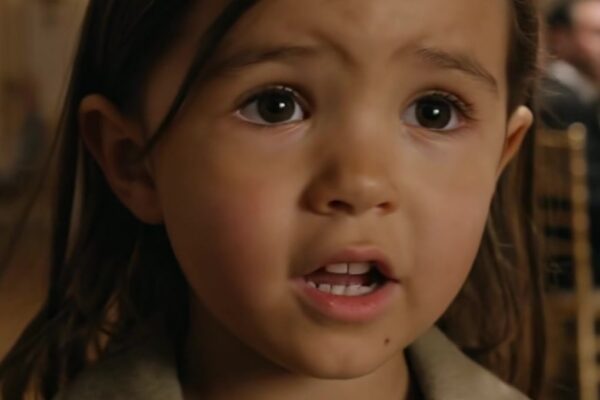
The boy never reached for the towering chocolate crowns in the display. He didn’t point at the frosted castles, didn’t beg for a slice with glittering sugar jewels. He only stared at the smallest cake—a modest circle the size of a saucer, barely tall enough to hold three thin candles—pressing his cheek against his mother’s coat as if he had already learned the shape of disappointment.
Elena held him on her hip, shifting his weight from one aching arm to the other. The bakery smelled like butter and warm vanilla, the kind of smell that belonged to homes with time in them. Marble gleamed beneath gold light. People at café tables laughed softly with forks in hand, leaving crumbs behind as if crumbs were nothing. Elena’s shoes were damp from the slush outside, her coat too thin for late winter, but she forced her mouth into something that could pass as a smile.
“Excuse me,” she said to the employee behind the counter. Her voice shook, then steadied on sheer will. “Do you… do you have anything that’s past date? Something you’d throw away? Just a small cake, if possible.”
The employee’s eyes traveled over her: the frayed cuff of her sleeve, the patch on her bag, the child’s knit cap with a pom-pom unraveling at the seam. He turned his head toward the woman working beside him, and a silent exchange passed between them—an amusement that didn’t require words.
“We don’t hand out leftovers,” he said. “This is a business.”
Elena swallowed, her throat tight. “I understand. It’s just… it’s my son’s birthday.”
The boy’s arms tightened around her neck, his fingers clutching the collar of her coat. His eyes never left the little cake. Elena could almost hear what he didn’t say: It’s okay, Mama. I’m not hungry. I can wait.
“Then buy one,” the employee replied. His politeness had a sharp edge now, like a knife set down too hard. “Or go somewhere else.”
The bakery quieted in a way Elena could feel in her skin. A fork paused mid-air at a nearby table. A woman in a wool hat stopped stirring her coffee. The warm lights suddenly made Elena feel exposed, like she stood under a spotlight on a stage built for other people.
“Please,” Elena whispered. “Even a slice. Anything. I’ll pay you back. I start work again next week.”
The employee’s hand came down on the glass with a crack that made the boy flinch. “Out,” he barked. “Don’t make a scene.”
Elena’s body moved on instinct—she turned her shoulder to shield her son, tucking his face into her coat. The boy made a small sound, more breath than cry, and Elena felt tears slip down her own cheeks. Not loud, not dramatic. Just a quiet leaking of everything she had held in all month: the eviction notice folded in her pocket, the interview that never called back, the long bus rides to cleaning jobs that ended when the hotel switched companies. She had promised her son a cake. She had promised him there would be candles. She had promised because promises were all she had left to offer.
She stepped backward, almost tripping over the threshold mat. “I’m sorry,” she murmured—apologizing, absurdly, to people who had done her harm. She turned toward the door.
At a table near the window, a man in a navy suit lowered his newspaper. The paper had been held up like a shield, but his gaze slid around it now, pinning itself to the boy’s face as if he recognized something there. Not the child himself, but the expression: a careful hope that had learned to keep itself small.
The man folded the newspaper once, slowly. His jaw tightened. He stood, chair legs scraping the marble floor in a sound that demanded attention.
“Wait,” he said.
Elena froze. So did the employee. Heads turned, drawn by the weight in the man’s voice. He stepped toward the counter with the measured pace of someone accustomed to being obeyed—not loud, not theatrical, but unmistakable.
“Is there a problem?” the employee asked, forcing an uneasy smile.
The man’s eyes stayed on Elena and the child for a moment longer, then moved to the employee. “I heard you tell her to leave.”
“Sir, we have policies. We can’t—”
“Policies,” the man repeated, tasting the word as if it were bitter. “Do your policies require you to slam your fist next to a child’s face?”
The employee’s cheeks colored. “She’s begging. It upsets other customers.”
The man looked around at the silent tables. “Does it upset you?” he asked the room.
No one answered. A woman with a pastry box half-open on her lap lowered her gaze. A teenager behind a laptop stared at the screen as if the letters might save him from being involved. The quiet thickened, and Elena wished—absurdly—that the floor would open and swallow her whole, spare her son the memory of this moment.
The man turned back to Elena. “How old is he?”
Elena’s lips trembled. “Six,” she managed. “Today.”
The boy blinked at the man, wary but curious. His face was pale from winter. His eyes were too serious for a birthday.
The man reached into his suit jacket, and for a heartbeat Elena expected a lecture, a card, a pitying gesture. Instead he took out his wallet and placed it on the counter with a soft thud, then slid it forward as if staking a claim.
“I want that smallest cake,” he said, nodding toward the little one. “And I want it boxed. And I want three candles. Blue, if you have them.”
The employee exhaled, relief loosening his shoulders. “Of course, sir.”
“And,” the man continued, voice sharpening, “I want you to put a ribbon on it and write ‘Happy Birthday’ with the neatest hand you can manage. Not because I’m paying, but because a child is watching.”
The employee faltered, then nodded, suddenly careful. “Yes, sir.”
Elena’s mouth opened, but no sound came out. She held her son tighter, unsure if she was supposed to speak or disappear.
The man leaned closer to her, lowering his voice so it belonged only to the two of them. “I’m not doing this to be seen,” he said. “But I am doing it because I remember.”
Elena searched his face. There were faint lines around his eyes, the kind that came from long nights and too much thinking. He looked like someone who had lived in rooms like this for a long time. Yet when he spoke the word remember, it carried the weight of darker places.
“You don’t have to—” Elena began, ashamed of her own gratitude.
He shook his head once. “Let him have today,” he said simply.
The employee returned with the small cake in a white box, a blue ribbon tied too tightly around it. He held it out as if the box might burn him. “Here.”
The man did not take it immediately. “Apologize,” he said.
The employee blinked. “Sir?”
“To her,” the man said, and his tone left no room for misunderstanding. “And to the boy.”
The employee’s throat bobbed. His eyes flickered toward the other staff, toward the customers watching. Pride fought with fear, and fear won. “I’m… sorry,” he muttered, not looking directly at Elena.
It was an imperfect apology, but it landed in the room like a bell. Elena felt something in her chest loosen by a fraction—an acknowledgment that she had not imagined the cruelty, that her son had not imagined it either.
The man finally took the box and knelt slightly so he was closer to the boy’s height. “Happy birthday,” he said, and his voice softened. “What’s your name?”
The boy hesitated, then whispered, “Milo.”
“Milo,” the man repeated, as if committing it to memory. He held out the cake box toward him. The boy didn’t reach at first; he looked at his mother, seeking permission the way children do when they’ve learned that taking things can come with a price.
Elena nodded, tears bright on her lashes. “It’s okay,” she breathed.
Milo wrapped his small hands around the box like it was fragile, precious, unreal. He hugged it to his chest, careful not to crush it, as though the ribbon might hold together more than cardboard and frosting—like it might hold together the day itself.
The man stood and straightened his suit cuffs. He slipped his wallet back into his jacket and glanced once more at the counter. “You’re lucky,” he said quietly to the employee, “that today I only wanted to buy a cake.”
Elena didn’t understand the full meaning of it until she saw, in the man’s other hand, the corner of a business card already printed, already waiting in the world for moments like this. He pressed it into her palm as they moved toward the door.
“Call this number,” he said. “Ask for Daniel Arman. Tell them I sent you. They’ll have work—clean work—and they’ll pay on time. And before you refuse, remember: this isn’t charity. It’s a correction.”
Outside, the wind slapped Elena’s face, cold and honest. Snowmelt ran in dirty streams along the curb. Milo held the cake close, his cheeks flushing with a joy he didn’t dare fully trust.
“Mama,” he whispered, peering down at the box. “Is it really for me?”
Elena looked back through the bakery window. Inside, the warm lights continued to glow, and people returned to their forks and conversations. Daniel Arman had already turned away, picking up his newspaper as if nothing had happened, as if he hadn’t shifted something in the air with a single word.
Elena brushed her knuckles over Milo’s hair. “Yes,” she said, voice breaking on the truth. “It’s yours. And tonight we’ll light the candles.”
Milo pressed his cheek against her coat again, but this time his breath came out in a soft laugh. The smallest cake in the world felt heavy in his arms—heavy with frosting and hope, heavy with the knowledge that someone, somewhere, had chosen to stop and say wait.
And for the first time in a long while, Elena walked home feeling as if the world had room for them.