The street was quiet in the way old streets often are—not empty, just holding their breath. Warm evening light poured down between narrow stone buildings, turning the air into a slow-moving haze of gold. Cobblestones held the heat of the day. Laundry lines sagged like tired arms above shuttered windows. Somewhere behind a wall, a radio murmured too low to make out words, as if even music had learned to speak softly here.
A man in a dark suit walked through it with the rigid pace of someone who had forgotten why people ever strolled. His shoes struck the stones in clipped, exact beats. He kept his jaw set and his eyes fixed ahead, staring past doorways and planters, past the lingering light, as if beauty were just another accusation. One hand hovered near his coat pocket in an unconscious, repetitive check—as though he feared the world would steal something from him again.
The thing he guarded wasn’t money. Not a phone. It was thin as a breath and just as fragile: a photograph worn soft at the edges, kept close to the heart like a promise that never came true.
He did not feel it slip free.
The photo slid from the mouth of his pocket and fluttered in the still air, turning once, twice, as if the street itself were deciding whether to let it fall. It landed face-up behind him on the cobblestones, catching the last sun on a smiling woman’s face.
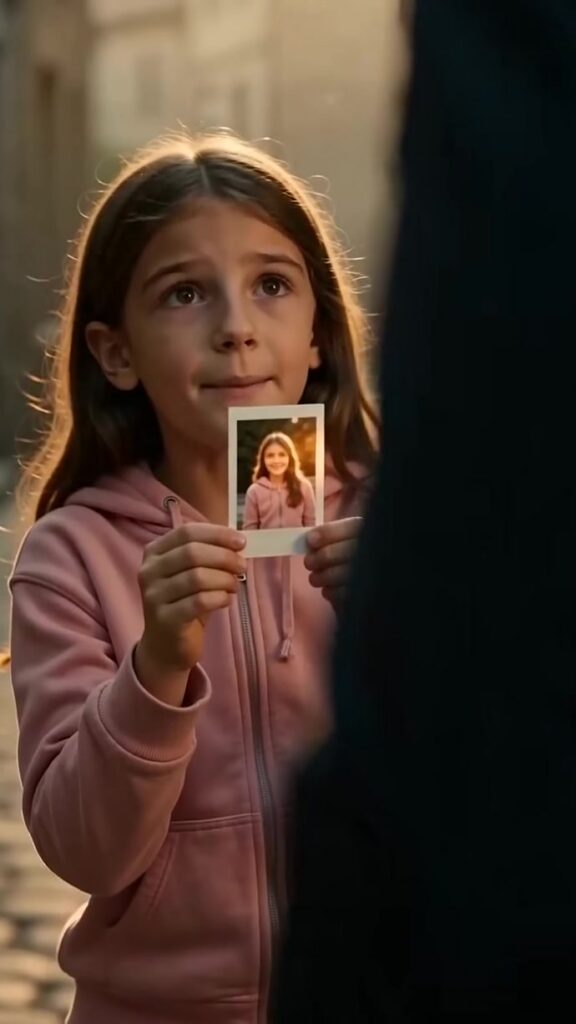
On a low stone step near a doorway sat a little girl, knees drawn up, palms pressed to either side of her ankles. She’d been counting something in the dust with a twig, then stopped when the paper moved like a small bird at her feet. She leaned forward and picked it up carefully with both hands, the way she’d been taught to lift a fallen sparrow.
At first her expression held nothing—only the blank patience of a child deciding what a thing is. Then, as her eyes focused, her forehead tightened. Her mouth opened a fraction. Something like recognition and shock argued across her face.
She looked from the photograph to the man’s retreating back. He was already halfway down the lane, a black mark moving through amber light. She watched him for one long breath, then called out—not loud, but clear enough that the old street seemed to hold the sound and carry it.
“Mister,” she said, and there was no trembling in it, only curiosity sharpened by certainty. “Why do you have a picture of my mommy?”
It was as if the last bit of wind died on command. Even the radio behind the wall seemed to lower itself into silence.
The man stopped mid-step. Not with theatrical slowness, not with a spin. He simply froze as though his body had been corrected by an invisible hand. His shoulders rose and tightened beneath his jacket. Then, carefully, he turned around.
The little girl remained on the step, holding the photograph upright, her fingers pinching the corners so she wouldn’t smudge it. She did not look guilty. She looked as though she had found a lost name and wanted to give it back.
When the man’s eyes landed on the image, something in his face broke without permission. The controlled lines around his mouth loosened. His gaze sharpened, then flickered, as if his mind couldn’t decide between memory and hallucination.
“What did you say?” His voice came out scraped and hoarse, like a door forced open after years shut.
“My mommy,” the girl repeated, simple as arithmetic. She lifted her chin toward the photo, then toward him, connecting the two with her eyes. “That’s her.”
He walked back toward her, but his steps no longer sounded certain. Each one landed like a question. His hand rose toward the photograph, then dropped, then rose again. His breath was too loud in the quiet, and he hated that the street could hear him unravel.
“That’s…” He swallowed. “That’s my wife.” The words tasted wrong. He had said them to a stone grave, to a priest, to a room full of condolences that smelled like lilies and pity. “She died years ago.”
The little girl’s small hands tightened. For a second she hugged the photograph to her chest—not possessive, but protective—then held it out again. She looked at him the way children look at adults when adults insist on something obviously untrue.
“No,” she said, and there was a softness in it now, as if she didn’t want to hurt him. “My mom is alive.”
The man stared at her. The street seemed to narrow around him. The warm light suddenly felt too bright, too exposing.
Alive meant a dozen things at once: that the coffin he’d watched disappear was empty, that the ashes he’d been handed were not hers, that the letters he’d received afterward—businesslike, final—had been written by someone else’s hand. Alive meant grief had been manufactured and sold back to him like a product. Alive meant his mourning had been staged, and he had played his part with obedient devastation.
His fingers hovered inches from the photograph. He did not take it. He could not, not yet. Taking it would be admission that it had ever fallen from him, that he had ever let go.
“What is your name?” he managed, because names were safer than miracles.
“Eva,” the girl said. She glanced down at the picture and back up. “She cries when she looks at your picture.”
Those words were not a dagger. They were worse—an open hand placed on a bruise. The man’s eyes stung. He hadn’t expected tears anymore; he’d trained himself out of them the way soldiers train themselves out of flinching.
“She… has a picture of me?” he asked.
Eva nodded firmly, as if this should have been obvious. “In her drawer. Under her scarves.” Then, as if remembering a rule, she added, “She thinks I don’t know.”
The man’s throat worked. He tasted metal. The photograph trembled in the girl’s hands, either from her excitement or from his shaking reaching her through the air.
“Where is she?” he whispered.
Eva’s gaze flicked past him, down the lane toward a darker bend where the sunlight didn’t reach. “She’s there,” she said, and pointed with one finger while still holding the photo. “We live in the blue door house.”
The blue door. He knew this street from before it had become a border between his life and whatever had been done to it. He had come here tonight because he’d finally allowed himself to follow a rumor—a name spoken in a train station, a hint passed like contraband: She wasn’t buried. She was hidden. Don’t ask why. Don’t ask who. Just go.
He had told himself he came for closure. Now closure stood on a step holding his wife’s face in her palms.
Before he could speak again, a woman’s voice cut through the hush from deeper in the alley—close enough to be real, far enough to be feared.
“Eva!”
The little girl’s shoulders jumped, then settled. She turned her head toward the sound. The man turned too, but slower, as though his neck was made of glass.
Footsteps approached: cautious, quick, then hesitant. A shadow appeared first, then the outline of a figure at the bend where light met shade. The man’s heart slammed against his ribs, each beat a demand for proof.
She stepped forward into the amber spill.
Older than the photograph by a few years, but unmistakable. The same curve of cheek. The same mouth that looked like it was holding back a laugh. Her hair was pulled back now, darker in the dim, and there were lines of wear at the corners of her eyes—lines that did not belong to the dead. She carried a folded cloth in her hands as if she’d been interrupted mid-task, and her expression was a careful mask built over something frantic.
Her eyes went first to Eva, then to the photograph, and then—slowly, unwillingly—to the man standing in the middle of the street as if he had been placed there by fate’s cruel hand.
The cloth slipped from her fingers. It landed soundlessly, like surrender.
For a long moment no one moved. The street held its breath so completely that even the dust seemed suspended, waiting for permission to fall.
The man’s lips parted. His voice did not come. He had rehearsed a thousand imaginary reunions in the years since her funeral: shouting, pleading, accusing, forgiving, collapsing. None of them fit the reality of her standing alive under a fading sun, staring at him with a terror that made his stomach twist.
“Lena,” he finally said, and the name was not an accusation. It was a prayer he hadn’t believed in until it answered.
Her mouth opened. She did not say his name back. She looked at Eva, and something in her gaze begged the child to disappear, to go inside, to make this moment private. Eva, however, remained on the step, holding the photograph between them like an uninvited bridge.
Lena’s eyes returned to the man, shining and frightened. “You shouldn’t be here,” she whispered, and the words carried the weight of warning, not rejection.
The man stepped forward once, just once, and the cobblestone under his shoe seemed to crack the silence. “I buried you,” he said, voice low and breaking. “They made me bury you.”
Lena flinched at the plural. Her gaze flicked to the mouth of the street as if expecting someone to appear there at any moment. “I didn’t choose it,” she said. “I tried to come back. I—” Her breath hitched. “It wasn’t supposed to be this long.”
Eva looked between them, suddenly aware that the air had changed. She clutched the photograph tighter and slid off the step, small feet on stone. “Mommy?” she asked, uncertain for the first time.
Lena’s face softened for a heartbeat when she looked at her daughter. “Go inside, Eva,” she said, gentler now but urgent. “Lock the door. Please.”
Eva hesitated, then held the photograph out toward the man one more time, as if returning it was the only way she could make sense of what she’d started. The man took it at last. His fingers closed around the worn paper, and the contact felt like touching a wound and a blessing at once.
When Eva ran toward the blue door, her footsteps were suddenly the loudest thing on the street. Lena watched her go, then faced the man again. The sunlight was thinning, the gold draining toward gray.
“They will come,” Lena said. “If they know you found me, they’ll come.”
The man lifted the photograph between them. In it, she smiled without fear. In front of him, she looked like someone who had survived by learning new kinds of fear.
He folded the picture carefully, as if it might shatter, and slipped it back into his pocket—not as a secret, but as a vow. He met her eyes, and the grief that had hollowed him for years turned, slowly, into something else: anger with direction, love with teeth.
“Then we don’t stand here,” he said. “We go. Tonight.”
Lena’s breath trembled. Behind her, the blue door clicked, the sound of a lock turning like the first move in a long-delayed escape.
The old street exhaled at last—not because the danger was over, but because the story had finally decided to continue.