The street was unusually quiet, but not peaceful. It had that kind of hush that isn’t calm, just careful—like the whole block was holding its breath so it wouldn’t have to get involved. People moved fast, collars up, eyes forward, hands buried in pockets like they were hiding something. If anyone glanced to the side, it was only long enough to confirm what they already planned to ignore.
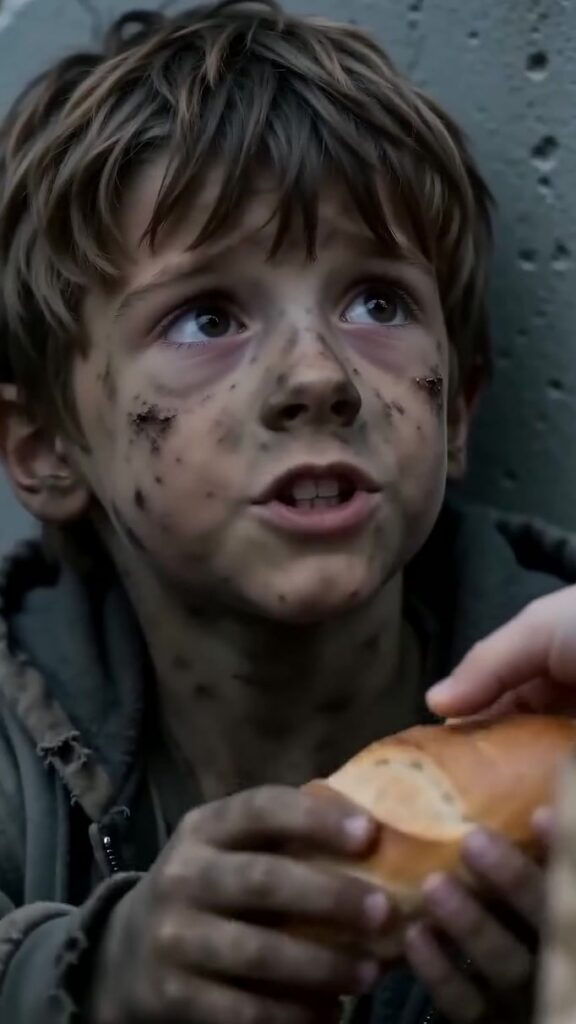
Against a cracked concrete wall, just under a faded poster advertising a band that probably broke up years ago, an eight-year-old boy sat with his knees pulled to his chest. His jacket had a tear along the sleeve that flapped when the wind pressed through the alley. His shoes looked like they’d been arguing with the sidewalk for months and were losing. He had the kind of stillness that didn’t come from patience—it came from not having the energy to move.
His name was Eli. Not that anyone walking past knew or cared. Names only mattered when someone said them.
He watched legs go by. Sneakers. Work boots. A pair of shiny heels that clicked like little judges. Every once in a while a coat brushed the air near him and carried the smell of warm places: coffee, detergent, someone’s soap. His stomach clenched like it was trying to fold itself into nothing. He’d tried begging earlier, but his voice had gotten thin and strange, like it didn’t belong to him anymore. Eventually he’d stopped speaking altogether because silence hurt less than being unheard.
Across the street, a bakery glowed. The windows were fogged from heat and sugar. People stepped in and came out with bags that made Eli’s mouth water just from the crinkle. Once, a woman with a paper cup looked straight at him, then immediately checked her phone like it had texted her an emergency. Eli didn’t bother hating her. Hating took fuel.
Then, right when the afternoon light started turning everything the color of old pennies, another kid appeared.
He was also about eight, but he looked like he belonged on a postcard. Neat hair. Clean mittens. A warm camel-colored coat that fit him like someone actually measured his arms. He carried a small loaf of bread wrapped in thin paper, and the smell of it cut through the cold like a hand reaching into Eli’s chest.
The boy stopped so suddenly that the people behind him had to sidestep. One man muttered something under his breath and kept going. The kid didn’t seem to notice. His gaze landed on Eli and stuck there, wide and unsure, like he’d just stumbled onto a secret everyone else had agreed not to see.
“Are you okay?” the standing boy asked. His voice was quiet, but it didn’t sound scared. More like it had never learned the skill of pretending not to care.
Eli stared at the bread instead of the boy’s face. He’d seen “kindness” before—fake kindness, the kind that came with a laugh from older kids afterward. He didn’t have the strength to gamble on being tricked today.
The standing boy shifted his weight, then did something so fast and simple it didn’t feel real: he tore the loaf in half. No drama. No long speech. Just a clean rip, steam puffing out like the bread was sighing.
“Take it,” he said softly, holding one half out. “It’s still warm.”
Eli’s hands didn’t move at first. Hunger made him desperate, but it also made him careful. Taking something meant owing something. Owing was dangerous when you had nothing to pay with.
But the smell… the smell was a whole different kind of argument. Eli reached out slowly, like he was approaching an animal that might bite. His fingers touched the bread. Nothing bad happened. No one laughed. The boy didn’t pull it away at the last second.
“Thank you,” Eli whispered. His voice scraped out of his throat, rough as sandpaper. He took a bite, and for a second the world blurred because the taste of real food felt like being punched and hugged at the same time. Tears showed up without permission. He hated that part, but he couldn’t stop it.
The standing boy didn’t walk away the moment the good deed was done. Instead, he lowered himself down onto the cold pavement like it didn’t matter. He hesitated, then gently put an arm around Eli’s shoulders. It was awkward, kid-style, but warm. The kind of warm that reminded Eli there were still bodies meant to be near other bodies.
“My name’s Noah,” the boy said, like it was important Eli know he was a real person and not a miracle passing through. “I was going home from the bakery. My grandma sent me.”
Eli swallowed another bite. “I’m Eli.” The name felt strange on his tongue, like it hadn’t been used in a while. “I’m… I’m waiting.”
Noah frowned. “For who?”
Eli shrugged, a tiny movement. “I don’t know. Someone. Anybody. I thought… if I stayed here, maybe someone would notice.”
Noah looked up and down the street. People hurried past them like water avoiding a rock. A bus sighed at the corner. Somewhere a dog barked. Nobody looked. Noah’s face tightened, not with fear but with a kind of offended disbelief, like the rules of the world had been explained wrong.
He opened his mouth to say something, but the sound that answered first wasn’t words.
A door slammed open behind them with the kind of force that made the air jump. It wasn’t the bakery door. It was the metal back door of the building Eli was leaning against, the one with the chipped paint and a “NO LOITERING” sign that had been scratched with marker until it read “NO.”
A man stepped out. Big coat, unshaved face, eyes that looked like they’d been awake for days. He held a cigarette he wasn’t smoking, just pinched between his fingers like a prop. When he saw the boys, his expression twisted, annoyed, as if they were litter someone had left on his doorstep.
“What’re you doing here?” he snapped. His voice had a sharp edge, the kind that made kids flinch before they even knew why.
Eli’s shoulders went up around his ears. He knew that tone. It usually came right before being shoved, yelled at, chased away. The cold suddenly felt sharper again.
Noah stood up so fast his coat flared. He didn’t step back. He stepped in front of Eli, not like a hero in a movie, but like a kid who hadn’t learned to be afraid in the right places yet.
“We’re not doing anything,” Noah said, trying to sound bigger than he was. “He’s just eating.”
The man’s gaze flicked to the bread. “You feeding strays now?”
Noah’s jaw clenched. “He’s not a stray. He’s a kid.”
The man took a step closer, and Noah’s confidence wobbled for the first time. Eli could feel it. Noah might have been warm and brave, but he was still eight. The street didn’t care how good your intentions were.
Eli tugged weakly on Noah’s sleeve. “It’s okay,” he muttered. “Just… don’t make him mad.”
Noah didn’t look back. His eyes darted around, like he was searching the street for an adult—any adult—with a conscience. But the street stayed quiet in the worst way. People pretended the air was suddenly interesting. The bakery window reflected their faces like ghosts.
And then Noah did something Eli didn’t expect. He raised his voice. Not a shout, not a scream—just loud enough to crack the agreement everyone else seemed to be following.
“Hey!” Noah called to the passersby. “He’s hungry. He’s freezing. Can somebody help?”
Heads turned. Not many, but enough. A woman slowed, clutching her bag tighter, then stopped. A man with a backpack hesitated mid-step. Someone across the street stared openly now, caught between embarrassment and responsibility.
The big man frowned, suddenly aware he had an audience. He didn’t like being seen.
Noah swallowed, but he kept going, voice shaking just a little. “I’m calling my grandma,” he added, and pulled a small phone from his pocket with hands that were trying hard not to tremble. “She knows people. She’ll come.”
Eli didn’t know if any of that was true. But the way Noah said it made it sound like the world could still have backup.
The man stared at the phone, then at the handful of watching strangers. He spat to the side, muttered something that sounded like a curse, and retreated back through the door. It slammed again, but this time it sounded smaller.
Noah didn’t move for a second. Then his shoulders dropped like he’d been holding them up with pure stubbornness. He turned back to Eli and crouched down again.
“Sorry,” Noah whispered, as if he’d caused the problem by noticing it. “That guy’s… awful.”
Eli clutched the bread like it might disappear. “You didn’t have to do that,” he said. “People don’t like when you make them look.”
Noah’s mouth pulled into a sad half-smile. “Yeah,” he said. “But I don’t like when they don’t.”
He tapped his phone screen, then held it to his ear. “Grandma?” he said, voice suddenly softer. “I’m on Alder Street. There’s a boy here. He needs help. Can you come? Please?”
Eli stared at him, at the clean coat and the warm mittens and the ridiculous idea that someone could just call a safe person into existence. The street was still quiet, still not peaceful, but something had shifted. A few people were still watching. One woman even took a step closer, her face pinched like she’d been fighting herself and finally decided to lose.
For the first time all day, Eli felt something other than cold and hunger in his chest. Not hope exactly. Hope was a big word. But maybe… maybe a doorway had cracked open somewhere, and warm air was starting to leak through.
Noah lowered the phone and looked at Eli like this was obvious. “You’re coming with us,” he said. Not a question. Not a maybe. “Okay?”
Eli blinked hard, then nodded once, small and shaky, still chewing the last bite of bread like it was proof that kindness could be real.
On Alder Street, where everyone hurried past to avoid being responsible, two boys sat against a wall and made responsibility impossible to ignore.