The wedding had been designed to look perfect—engineered, almost, like a set built for photographs that would outlive the day. White roses marched in careful ranks along the aisle. Lanterns hung from the old oaks like pale fruit. A string quartet tucked itself into the shade and played music that seemed to float rather than sound. Even the breeze behaved, stirring the bride’s veil with just enough softness to look intentional.
Elena stood at the end of the aisle with her father’s arm hooked through hers and her heart pressed tightly into her ribs. She could taste champagne on the air, could hear the small, happy murmurs of guests who believed they were witnessing the beginning of a beautiful life. Somewhere behind the guests a fountain burbled, a gentle sound meant to convince everyone that nothing jagged could happen here.
At the front, Adrian Vale waited with the kind of calm people called reassuring. He wore a gray suit that matched the sky’s brighter edge. His hands were steady. His smile seemed measured for sincerity. Elena had once loved that about him—how nothing seemed able to knock him off his center.
“You look radiant,” her father whispered, and Elena nodded because her throat was too full for anything else. She had wanted this: the perfect day, the clean beginning, the life that would erase the years of uncertainty. The planning had been exhaustive. The seating chart had been debated like diplomacy. Even the roses had been imported because Elena’s mother insisted local blooms were unpredictable.
“Dearly beloved,” the officiant began. The words had the smoothness of ritual. People leaned forward at the familiar points. Phones were already angled discreetly, ready to capture the ring, the kiss, the moment when the story became official.
Elena’s gaze fixed on Adrian’s face. He looked at her like she was the only person in the garden. She believed it—she had trained herself to believe it. When he took her hands, his fingers were cool and reassuring. When he promised her a lifetime, the guests sighed in that practiced, collective way of people who wanted to feel something pure.
The ring bearer—a solemn child with a pillow clutched like a sacred object—delivered the rings. Adrian accepted Elena’s with a careful grip, holding it between his thumb and forefinger. A bright fleck of sunlight caught the stone and sent a small, triumphant flash across the guests. Elena’s chest loosened. The ceremony had reached its most important punctuation mark.
“Now,” the officiant said, “place the ring on her finger.”
A sound broke the garden’s choreography—first a wet slap of shoes on stone, then the scrape of chair legs as people twisted to look. It wasn’t the music, which faltered a beat too late. It wasn’t a laugh. It was a desperate, ragged breath, the kind people make when they have been running and cannot afford to stop.
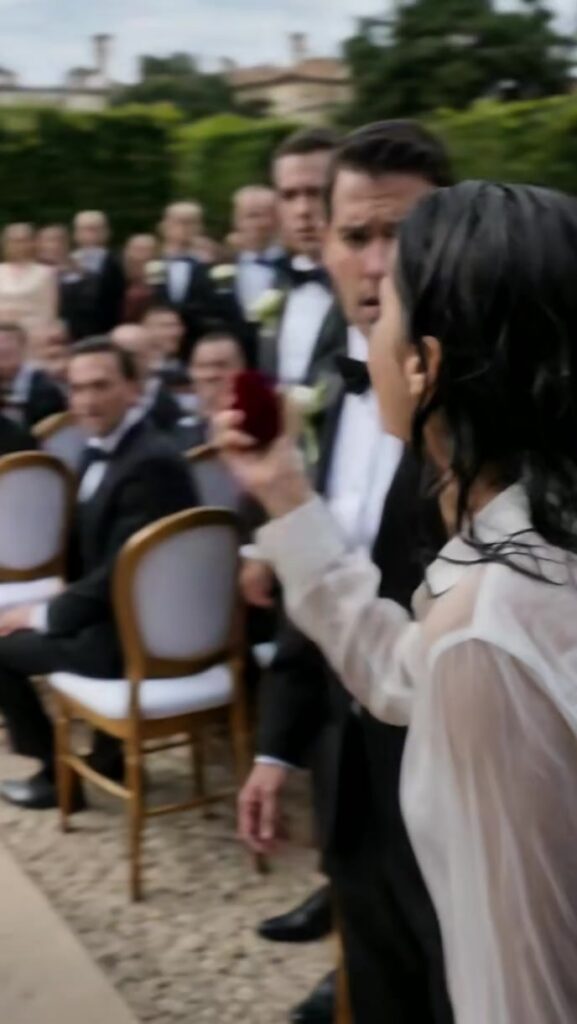
A woman shoved through the aisle from the back, dripping as if she’d climbed out of a river. Her hair clung in dark ropes to her face. Her dress—once perhaps formal—was stained and heavy with rain. Her arms shook with the effort of staying upright, and yet she held something to her chest with fierce protectiveness: a velvet box, old-fashioned, the kind a jeweler might give if the year were not this year.
She lifted her head and shouted, voice cracked but loud enough to cut the silk of the afternoon. “Don’t let him put that ring on her!”
The quartet’s bows stalled. A single violin string whined as if in pain. Every head turned. Elena felt her smile fail like glass under sudden heat. Her father’s hand tightened on her arm, a reflex to keep her steady, but it made her feel trapped.
Adrian’s expression changed so quickly that Elena missed the steps between calm and fear. For the briefest moment his face emptied. Then it filled again with something rehearsed: confusion, irritation. “What is this?” he said, too controlled, too careful. “Who are you?”
Groomsmen moved, instinctive, to block the woman. She jerked away, raising the velvet box as if it were a weapon. “He doesn’t get to do this again,” she said, her words trembling with water and rage. “He already married someone with that ring. Ten years ago.”
A hiss of disbelief went through the guests, followed by the unmistakable click of phones unlocking. Elena could see hands rising, screens glowing. The perfect day began to fracture into content.
Elena’s mouth opened but no sound came. Her eyes pinned Adrian. “What is she talking about?” she managed, the question scraping up from somewhere deep and raw.
Adrian’s jaw tightened. “This is insane,” he said. “She’s—she’s confused. Security—”
But the woman took one step closer, and in her eyes there was no confusion. Only exhaustion, and something colder beneath it: certainty. “Open it,” she begged, not to Adrian, but to the people watching. “Please. Before he lies his way out.”
An elderly man in the first row rose with sudden force. Uncle Raymond—Elena’s great-uncle, a man who had once been gentle enough to feed birds from his hand—now looked carved from stone. He walked toward the aisle with a stern, trembling purpose. When a groomsman tried to stop him, Raymond lifted a palm and the younger man froze, chastened by age and authority.
Raymond snatched the box from the woman, his fingers shaking more than hers. He held it close, as if afraid it might vanish. Then, in a garden that had gone so quiet Elena could hear the fountain’s steady pulse, he opened it.
Light caught the ring inside: gold, plain except for a small, thoughtful engraving on the inner band. Raymond stared at it as though the letters were cutting into his eyes. All the color drained from his face. The sound he made wasn’t a gasp; it was a broken exhale, the kind grief forces from old lungs.
His voice came out thin. “This date…”
Elena felt her father shift beside her, rigid. The guests leaned forward in a single motion, hungry and horrified.
Raymond looked up at Adrian with something like disbelief that turned swiftly into dread. “This ring was ordered for my daughter,” he said, each word heavy, as if it had to be lifted. “The week she vanished.”
Elena’s skin went cold. The garden tilted. Ten years ago was a story her family spoke of in lowered voices: Celia, Raymond’s youngest, bright and stubborn, last seen leaving a bar near the harbor, never found despite searches and prayers and the slow surrender to time. Elena had been a teenager then, and Celia’s disappearance had become a warning in every conversation about safety.
Adrian swallowed. His gaze flicked, not to Elena, but beyond her, scanning for exits. “That’s not—” he began, but the words didn’t form fast enough.
The soaked woman stepped into the open space where the aisle met the altar, water pooling at her feet. She wiped her mouth with the back of her hand. “He told her he loved her,” she said, voice softer now, more lethal for it. “He promised a future. He gave her that ring and said it meant she’d never be alone.”
Elena stared at Adrian as if he were transforming in front of her. His perfect posture had collapsed into tension. The calmness she had admired now looked like restraint—like a lid pressed hard on something boiling.
“Who are you?” Elena asked the woman, the words shaking out of her.
The woman’s eyes filled, not with theatrical tears, but with the kind that come from holding a truth too long. “My name is Mara,” she said. “I was in the room when she begged him to let her go.”
Someone in the crowd made a strangled sound. Elena’s mother stood abruptly, hand over her mouth. The officiant had stepped backward as if the air near the altar was poisonous.
Raymond gripped the open box so hard Elena thought it might snap. “Celia?” he whispered, the name a wound reopened. “Do you know what happened to her?”
Adrian’s voice rose, sharp. “This is a lie!” He reached for Elena’s hand, a reflex or a claim, but she flinched away, the gesture slicing what remained of the illusion.
Mara’s shoulders trembled. She looked at Elena then, really looked, as if trying to decide how much to shatter. “She didn’t vanish,” Mara said, and the garden seemed to inhale around her. “He made sure no one could find her.”
The words didn’t land like a single blow; they spread, seeping through every perfect detail, staining the roses and the linens and the music that had been meant to bless this union. Elena’s mind scrambled for something solid—an explanation, a mistake, a reason the world would make sense again.
But Adrian’s eyes—those steady, reassuring eyes—had stopped pretending. And in that moment Elena understood with a clarity so cruel it felt like light: the wedding had been designed to look perfect not because perfection was love, but because perfection was camouflage.
Mara reached into the soaked folds of her dress and pulled out a crumpled envelope sealed in plastic. She held it up, her hand shaking. “She wrote this,” she said, voice breaking. “She hid it where he couldn’t see. I’ve carried it for ten years because I was afraid. Today I saw the invitations, and I realized he was about to erase her all over again.”
Elena’s breath came in short, painful pulls. She didn’t know yet what the letter said. She didn’t know yet where the truth would lead—to police, to headlines, to the ruin of her family’s name, to a decade-old grave that might finally be found.
She only knew the ring in Adrian’s hand was suddenly the heaviest thing in the world, and that the perfect beginning she had wanted was ending before it could start, torn open by a woman dripping with rain and courage.
“Read it,” Elena whispered, though she wasn’t sure she could survive the sound of the words.
Raymond’s hands shook as he took the envelope. The guests held their phones higher. The fountain kept burbling, indifferent. And somewhere, beneath the white roses and the polished vows, the truth finally clawed its way into the light.