The wedding looked like a dream, the kind of scene that belonged inside a glass dome you could shake and watch glitter fall. White roses rose in disciplined towers along the aisle. Chandeliers hung from temporary wrought-iron arches as if the sky itself had agreed to be rented for the afternoon. Gold chairs lined up in obedient rows on the pale stone terrace, and beyond them the garden rolled down to a lake that reflected everything—flowers, satin, wealth—with the calm indifference of water.
Lysandra Vale stood at the edge of the aisle and let herself be admired. Her gown was a constellation of beadwork that turned her into a moving star. She had practiced every expression in the mirror: serene joy, gracious gratitude, the modest smile that suggested she was both chosen and humble enough to accept it. Guests—bankers, art patrons, politicians, people who never carried their own bags—leaned toward one another in whispers. The string quartet brushed the air with something tender and expensive.
At the far end, under the arch of roses and candlelight, Father Corvin waited with his book. His face was solemn, his hands steady, his gaze trained on the groom as if the entire purpose of the ceremony was to watch whether a man’s mouth would lie when it promised.
Gideon Sorel did not look like a liar. He wore his tailored suit as if it had always belonged to him. His smile was calm, his hair perfect. When his eyes met Lysandra’s, he softened in a way that made people sigh, as though they had been granted proof that love could exist among the ruthless.
Yet Lysandra’s attention snagged on a loose thread in the perfection: a staff member near the side gate, half-hidden behind a hedge. She was young, wearing the venue’s plain gray uniform, hair pinned back too tightly as if she’d been taught that neatness could make you invisible. She held something folded against her chest, white fabric tucked beneath her forearm as though she was trying to keep it from touching the world.
Lysandra felt heat rise in her throat. She knew every item on her bridal list. She had counted them. She had touched them. She had demanded they be delivered and stored and guarded. That fabric was her spare veil—hand-sewn lace, imported, irreplaceable, the backup she’d insisted upon because she refused to be surprised by anything less than perfection.
She turned sharply, and the dream shuddered.
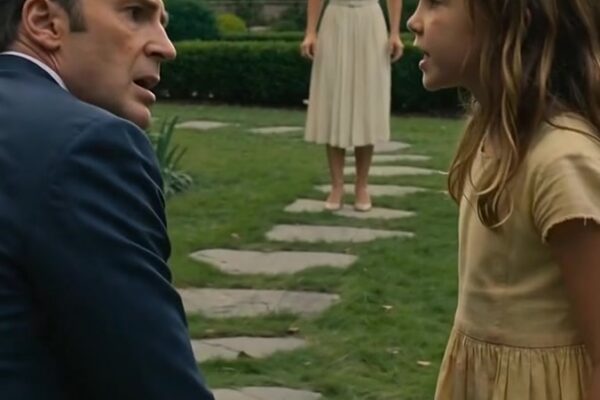
Without waiting for an usher or a security guard, Lysandra crossed the stone in fast, glittering steps. Her smile died as if cut from her face. She reached the staff woman, grabbed her by the hair at the base of her skull, and yanked her forward so hard the folded fabric slipped and nearly fell.
“You pathetic thief,” Lysandra hissed, loud enough for the first rows to hear. Then she raised her voice for the garden to consume. “You thought you could steal from my wedding?”
The staff woman cried out and dropped to her knees, hands flailing for balance on the stone. The chandeliers trembled slightly in the breeze; the violins faltered and then stopped altogether. A scrape of chair legs ran through the guests like an animal startled awake. Phones rose, lenses catching sunlight.
Lysandra snatched the veil from the woman’s arms and shook it as though it were a confession. “Show them what else you took!” she shouted. Her voice carried the authority of money and a lifetime of never being told no.
The staff woman raised an arm to shield her face. She trembled so badly her fingers fluttered like broken wings. “I didn’t—please—” she tried, but the words collapsed into sobs.
Then, as Lysandra snapped the fabric open to display it, something slipped from an inner fold and fluttered down. A small sealed note, handwritten, the paper thick and old, landed on the grass with the quiet finality of a stone dropped into a well.
Father Corvin stepped forward without thinking. He moved like a man compelled by an invisible tug. He bent, picked up the note, and for a moment his body blocked it from view. But everyone saw the change in him. Color drained from his face, as if someone had erased him with a cloth. His hand began to shake.
His gaze snapped to Gideon. Then to the staff woman. Then back to the note, the seal unbroken.
He spoke as though he didn’t mean to. The words fell out of him in a hoarse whisper that still reached the first rows, and then the second, and then spread through the garden until it was the only sound anyone could hear.
“This was written by the groom’s first fiancée,” Father Corvin said, “the morning she disappeared.”
The air emptied. The lake seemed to stop reflecting. Even the chandeliers looked suddenly too bright, too merciless.
Lysandra’s hands went cold around the veil. She turned slowly, as if her body were moving through deep water, toward Gideon. His smile had vanished. His lips parted, and for a fraction of a second he looked not shocked but cornered, like an animal hearing a trap snap shut.
The staff woman lifted her face. Tears clung to her lashes, but her eyes were fixed, clear, and oddly steady. “My mother told me never to open it,” she said, voice raw, “unless the woman replacing her humiliated me in front of everyone.”
A shiver moved through the guests. Someone in the back gasped as if they’d swallowed water.
Gideon swallowed. “This is insane,” he said, too quickly. “Father, whoever that is—this is—”
Father Corvin didn’t look away from the staff woman. His pupils widened, recognition dawning like a nightmare remembering itself. He stepped closer, studying her face with the horror of someone seeing a ghost not on a wall but breathing in front of him.
“She has the same eyes,” he whispered.
Lysandra felt the world tilt. The staff woman’s eyes were an unusual gray-green, rimmed dark, the kind of eyes you remembered even after years. Gideon’s first fiancée, Maren, had been spoken of in quiet circles as a tragedy. A vanished woman. A broken engagement. A rich man’s sorrow handled politely and then locked away.
“What is your name?” Father Corvin asked.
The staff woman’s chin lifted a fraction. “Elowen,” she said. “Elowen Hart. My mother was Maren Hart.”
The name struck like a bell. Lysandra’s chest tightened until she couldn’t draw a full breath. She heard her own pulse louder than the murmuring crowd.
Gideon took one step back. Behind him, the floral arch wavered in the heat. “You’re lying,” he said, but the words had no weight.
Elowen looked at the sealed note in the priest’s trembling hand. “She couldn’t protect herself,” she said. “So she left protection for me. She said someday a bride would stand where she was supposed to stand. Someday someone would punish me for existing. And then I could finally bring the truth into the light.”
Lysandra’s fingers clenched around the veil until the lace bit into her skin. “Open it,” she demanded, though her voice betrayed her with a faint crack. She didn’t know who she was ordering—the priest, the girl, the universe—but she needed the paper to speak because everyone’s eyes had turned into weapons.
Father Corvin stared at Gideon once more, then broke the seal with a careful thumb. The sound of tearing was small, but it carried across the garden like thunder.
He unfolded the note. His lips moved silently over the first line. Then his shoulders sagged as if the words were heavier than stone. When he read aloud, his voice was steadier than his hands.
“If you are reading this,” he began, “then I am gone in the way Gideon told me I would be if I ever spoke. He said accidents happen to women who ruin men’s futures.”
A ripple of horror went through the chairs. Several guests lowered their phones, suddenly ashamed to be holding them.
Father Corvin continued, swallowing between sentences. “He told me love was a favor he could withdraw. He told me my voice was a debt. Father Corvin knows what I confessed. If he is still alive, ask him why he let me walk away that night.”
Father Corvin flinched as though struck.
“I am pregnant,” he read, and the garden audibly inhaled. “He said it would be taken care of. When I said no, he said he would take care of me.”
Lysandra’s vision narrowed. She looked at Gideon, waiting for outrage, denial, anything that sounded like innocence. Instead she saw calculation, the kind that happens when a person realizes the room has turned against him and begins searching for exits.
Father Corvin’s voice grew quiet. “If my child lives, I want her to know I did not abandon her. I hid this note where he would never think to look—inside the lace he once bought me as an apology. It was meant for my wedding. If he marries another, I want that lace to cut his hands.”
Silence fell so hard it felt physical. Lysandra’s stomach rolled. She looked down at the veil she’d been clutching, at the delicate lace she’d praised for its beauty, now suddenly transformed into something sharp.
Elowen’s breathing steadied. “She left me with people who owed her kindness,” she said. “I grew up far away. I came back when I saw his engagement announced, when I recognized the place, the garden, the priest’s name. I didn’t come to steal. I came to return what was hidden.”
Gideon’s composure fractured. “This is extortion,” he snapped, his voice rising, and for the first time the mask slipped enough for something ugly to show through. “You think you can ruin me with a dead woman’s letter?”
Father Corvin folded the note with reverence, as if closing a wound. “Maren was not dead when she wrote this,” he said. “And I…” His voice broke. “I believed him when he said she had run away. I believed him because it was easier.”
Lysandra felt something inside her go brittle and snap. She stepped away from Gideon, the space between them widening like a crack in ice. She looked at the guests—at their perfect clothes, their hungry eyes—and realized she was standing at the center of a spectacle she could never control.
Elowen rose slowly from her knees. She did not wipe her tears. She let them remain, proof of humiliation endured and survived. “My mother wanted one thing,” she said. “Not revenge. Not money. Witnesses.”
In the distance, a siren began to wail—faint at first, then closer, as if the world beyond the garden had heard the note being read and decided it was time to intrude.
Lysandra looked at Gideon one last time. His eyes flicked toward the hedge-lined path, toward the gate, toward escape. He had always been beautiful. Now he was simply exposed.
The wedding still looked like a dream, if dreams could rot while you watched. The roses were still white. The chandeliers still shone. But the air had changed, thick with truth that had been waiting in folded lace for years.
Lysandra let the veil slip from her hands onto the grass beside the note’s shadow, as if setting down something she no longer wished to carry. Then she turned—not toward the aisle, not toward the altar—but toward Elowen.
“Tell me where she went,” she said, and her voice was not the bride’s voice at all. It was the voice of someone who had just realized that perfection is only a curtain, and behind it, people disappear.
Elowen met her gaze with those unmistakable eyes. “That,” she said softly, as the sirens grew louder, “is what we’re here to find out.”