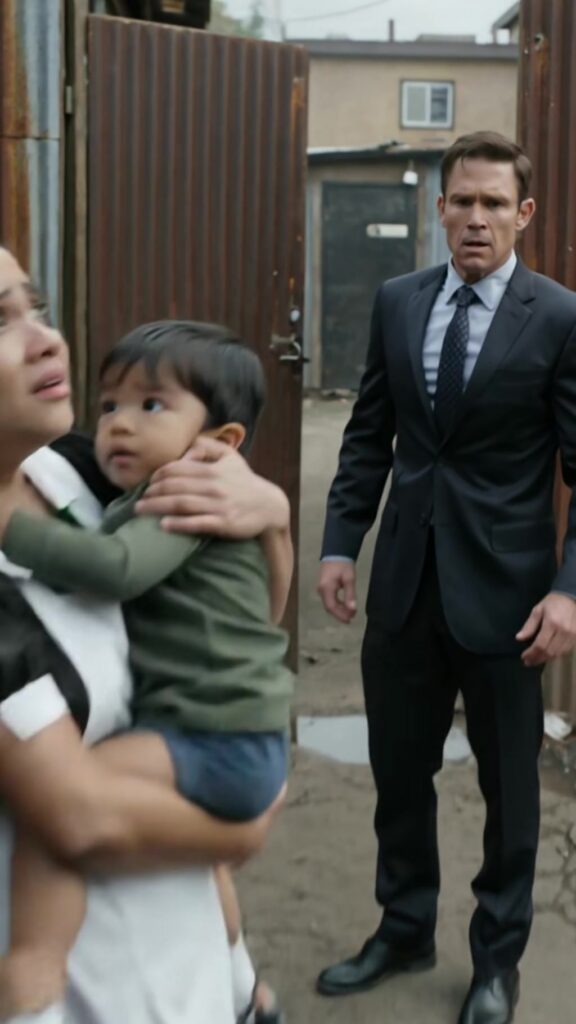
The wind threaded its way through warped sheets of tin and splintered boards, playing the alley like a cracked flute. Damp paper skittered along puddles the color of old oil. Beyond the maze of shacks, the city’s constant thrum rose and fell—traffic, machines, distant music—an indifferent pulse that made this narrow strip of shadow feel like a country with its borders sealed.
Marin pressed her back to the cold metal, trying to make her body larger than it was. She wrapped her arms around two small frames and held them as if her ribs could become a door. Her maid’s uniform—once stiff and black-and-white, once a badge of clean halls and polished silver—hung frayed at the seams. The cuffs were torn. The hem had been patched with a different shade of fabric, like a lie stitched into truth. Her shoes had been city-shoes once; now the soles peeled like bark.
“Mama,” the boy rasped, breath hot against her collarbone. His lungs were working too fast for his chest. He clutched her with desperate hands that still had the softness of childhood, though the nails carried grime. Behind Marin’s hip, her daughter held tight to the sleeve that remained, face half hidden, eyes wide and shining with the animal knowledge that footsteps could mean hunger, or worse.
Those footsteps arrived with purpose, hard and measured, their rhythm wrong for the alley. A man in an immaculate suit entered as if the place belonged to him. The pale light caught on his cufflinks; his shoes didn’t hesitate in the puddles. His anger reached Marin before he spoke, sharp and bright, an emotion he’d used like a tool all his life.
“So this is where you ran to,” he said, voice low enough to cut. “Do you understand what you’ve done? I trusted you.”
Marin’s throat tightened. She knew his name, of course—everyone in the house knew it, even if they whispered it as if sound itself might offend him. Mr. Havel. Owner of the tower with the mirrored windows, the kind of man who could send security to fetch a forgotten coat and call it kindness. Marin bowed her head because her body remembered rules even when her mind was breaking. “Please,” she managed. “Don’t dismiss me. I— I needed the wages. I had nowhere else.”
The boy’s face twisted as if the words hurt him. “Mama,” he cried again, louder, and the sound bounced off the metal walls until it seemed the alley was full of children. “Is he going to take you?” The girl whimpered and pressed her cheek into Marin’s side, clutching a strip of fabric like a lifeline.
Mr. Havel’s jaw worked. He had entered prepared for betrayal—the theft of time, the embarrassment of a servant with secrets. But the sight of the children ruptured the neat outline of his fury. He stared at their cracked shoes and the raw skin above the boy’s sock where elastic had bitten too deep. His gaze dropped to the boy’s throat, where a small silver cross lay against a threadbare shirt. It caught the light and flashed once, a quick, bright signal.
Mr. Havel went still, as if someone had struck him between the ribs. “No,” he breathed, the single syllable unraveling everything in his face. He took a step closer without meaning to. “That… that cross.” His eyes flicked to Marin’s neck, to the empty space where a chain might have been. The anger drained into something older, something frightened. “Why didn’t you tell me?” he asked, voice unsteady now, almost boyish in its rawness.
Marin’s arms tightened. Her shoulders curved, shielding. “Because the last time you promised to protect me,” she whispered, “you let your world swallow us.”
The boy sniffed, as if the alley had suddenly filled with smoke. He dug clumsily into Marin’s pocket and pulled out a photograph, its edges softened by folding and unfolding, by being held in nervous hands at night. He offered it to the suited man with the solemnity of a judge.
Mr. Havel took it. The image showed him younger, hair less silver at the temples, smile more sincere than the one he wore in newspapers. His arm was around Marin, her uniform new, her eyes bright with a hope that seemed impossible to the woman huddled in the alley now. On the back, in faded ink that had bled with moisture, a sentence trailed across the paper like a confession: If he finds us, forgive me.
The city’s hum receded. For a moment, the only sound was the wind and the slow ticking of Mr. Havel’s pulse. His fingers trembled against the photograph. “You left,” he said, but it wasn’t accusation anymore. It was a man trying to fit a knife back into the wound that made it.
Marin lifted her chin. Tears tracked through the dirt on her cheeks. “I didn’t leave to punish you,” she said. “I left because your father’s people came to my room at night. They said I’d disappear and no one would question it. I believed them. I still do.”
Something in Mr. Havel’s expression broke and reformed into horror. He looked at the boy again, at the cross, at the curve of his cheekbones that mirrored his own. He opened his mouth—perhaps to say a name, perhaps to say I’m sorry, perhaps to say I didn’t know—and that was when the alley itself answered.
A bass crash detonated at the far end: metal slamming against metal, the deep thud of a door kicked open, the rattle of boards and a rolling echo that turned the narrow space into a drum. Marin flinched so hard her teeth clicked. The girl gasped and buried her face. Mr. Havel spun, shoulders squaring by instinct, as if money could be armor.
Three men filled the mouth of the alley, silhouettes against daylight. Not local scavengers—too organized, too clean. Their jackets were plain, their eyes flat, and the one in front carried the calm of someone who had been given permission to do damage. He glanced from Marin to Mr. Havel and smiled without warmth. “Mr. Havel,” he called, as if greeting an old friend. “Your father sends his regards. He’d prefer you didn’t dig up what was buried.”
Marin’s breath froze. This was the nightmare she’d been outrunning for years, now wearing human faces. She tried to move backward, but the wall was there; the world was always there, closing in.
Mr. Havel looked at the children—at their small bodies pressed to Marin’s, at the boy’s shaking hands—and something in him changed. The polished anger that had once ruled him peeled away, revealing a ferocity that wasn’t about pride. He stepped in front of them, placing his own body between the family he hadn’t known and the men who had always known too much.
“Go,” he said to Marin, voice quiet but absolute. He reached behind himself, not looking, and his hand found the boy’s shoulder with surprising gentleness. “Take her. Run when I tell you.”
“You can’t,” Marin whispered. “They—”
“I can,” he cut in, and his eyes shone with a truth that was new to him, as if he’d only just learned what it cost to be a man. He raised his chin toward the intruders. “Tell my father,” he said, voice ringing against twisted metal and battered boards, “that what he tried to erase is standing right here.”
The men advanced. The wind whistled harder, dragging trash along the ground like impatient fingers. Mr. Havel didn’t retreat. He counted their steps, waited until their attention narrowed to him—until their confidence became a tunnel—and then he snapped, “Now!”
Marin moved on instinct, pulling the children with her through a gap between shacks she’d memorized like scripture. The boy stumbled; she caught him. The girl’s torn dress snagged on a nail; Marin yanked it free, leaving a strip behind like a breadcrumb of pink. Behind them came the sound of bodies colliding, a grunt, a curse, the clang of metal. A gunshot cracked the air, splitting the alley’s fragile silence. Marin didn’t look back.
At the mouth of the gap, she glanced once over her shoulder and saw Mr. Havel on one knee, still between the men and the place she’d been. His suit was smeared with grime. Blood darkened his sleeve. Yet his gaze found her, and in it was an instruction that felt like a vow: live. He lifted his hand, fingers shaking, and for the first time she saw not a wealthy employer but a father reaching for what he’d nearly lost without ever holding it.
Marin ran toward the city’s distant hum, toward a world that had always been close and impossibly far. The wind chased her through the maze, carrying the whistle of twisted metal and the echo of a choice finally made. In her pocket, the photograph pressed against her palm, warm from her grip, as if the past itself were trying to keep up.
Somewhere behind, the alley swallowed sound again. But the children’s breathing remained—ragged, real—and as they burst into a brighter street, Marin understood that the unreachable world was not a place beyond walls. It was a life demanded by courage. And if the city had a heart, it would have to make room for three more beats.