The woman wasn’t hiding from the police. She was hiding from the man who had sent them, and the difference mattered the way a locked door matters when someone has the key.
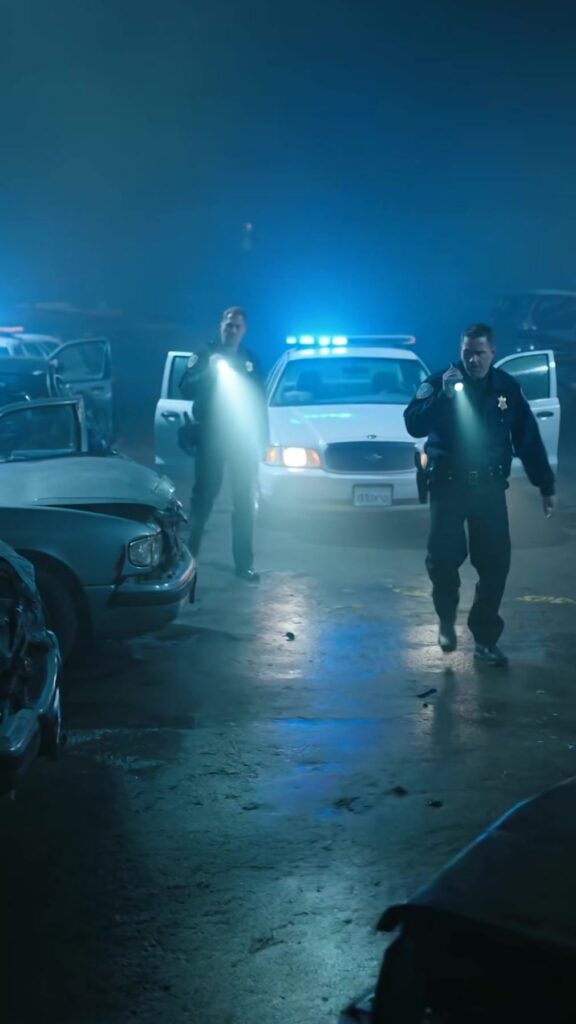
Marisol Velasquez crouched behind the wrecked teal sedan like it was the last honest thing in the impound lot. The hood was buckled, the windshield spiderwebbed, and the whole car smelled like old coolant and rain-soaked upholstery. She pressed her palm over the little girl’s mouth—not hard, just enough to keep a gasp from turning into a scream—and angled her own cheek into the cold metal so she could listen.
Sirens washed over the rows of confiscated cars and dead streetlights. The sound bounced, broke apart, came back wrong. Flashlights flickered in the distance, turning every puddle into a sheet of silver.
“Check the back fence,” a voice barked. “She has to be here.”
Marisol’s ribs felt like someone had stacked bricks inside her chest. Every breath was a slow argument with pain. Blood had dried in a dark fan along her cheek from where she’d caught the edge of a door running through a stairwell, and the sting kept yanking her back into the moment whenever her brain tried to float away.
Beside her, Nia—seven years old, yellow puffer jacket zipped to her chin, hair still clipped in two careful barrettes—shook like the lot was full of ghosts. Nia’s eyes stayed wide and glassy, not crying, because she was the kind of kid who followed rules even when rules made no sense.
Marisol had whispered them a new rule twenty minutes ago. “No sound, mi cielo. Not one.”
Now her daughter nodded against her, as if nodding could be done silently enough to count as nothing.
Three hours earlier, they had been in the office tower downtown where Marisol cleaned at night. The building always smelled like lemon disinfectant and expensive cologne. It was quiet the way money is quiet—no shouting, no laughter, just a steady hum of air vents and the occasional elevator ding from some late-working lawyer who’d forgotten what time was.
Nia had been asleep in a molded plastic chair by the vending machines, cheeks squished against her folded arms. Marisol had let her keep the yellow jacket on because the lobby got cold after midnight, and because that jacket was a little sun when everything else was gray.
Marisol’s routine was simple. Empty trash. Wipe fingerprints off glass. Mop until the floor shone like it had never met a shoe. She’d worked there for eight months without learning anyone’s name, which was fine. Names were expensive. She preferred invisibility. Invisibility kept you safe.
Except tonight, she opened the wrong door.
It wasn’t even a dramatic mistake. The hallway lights had been dimmed to “after-hours” and two doors sat close together. One led to the supply closet, where she kept extra bags and the good mop heads. The other was a conference room that belonged to the building’s security firm, the one that handled contracts for a bunch of city departments.
Marisol pushed it open with her shoulder, expecting the familiar scent of bleach.
Instead she walked into a low murmur and the thick smell of coffee and cigarette smoke.
Two men stood near the end of a long table. One wore a crisp dark uniform with a collar that looked starched enough to cut paper. The other was in a cheap jacket with a hood, face half-hidden, but his hands moved like someone used to getting what he wanted.
Between them: a black duffel bag. Heavy enough that the table legs vibrated when it landed. When the hooded man unzipped it, a flash of cash showed—bundles wrapped in paper bands. Something metallic glinted beneath. A gun, maybe more than one.
Marisol froze in the doorway, mop handle in her fist like it was a weapon she didn’t know how to use.
The uniformed man noticed her first. He didn’t jump. He didn’t shout. His face stayed calm, almost bored, like she’d interrupted him ordering lunch.
She recognized him from the news. Captain Daniel Reyes. The kind of officer who smiled for cameras at charity runs, who talked about community and trust. The kind of man who got quoted in headlines after press conferences and looked like he’d been born with a badge in his pocket.
Reyes said softly, “Close the door.”
Marisol couldn’t. Her fingers wouldn’t move.
The hooded man turned, and that’s when Marisol saw the third thing on the table: a photo. Not a mugshot, not evidence, not paperwork.
It was Nia.
Nia in her yellow jacket outside her school, holding a juice box, smiling at someone behind the camera like the world was friendly.
Marisol’s stomach dropped so hard she thought she might actually fall.
Reyes walked toward her with careful steps. “Ma’am,” he said, voice still polite. “You’re not supposed to be in here.”
Marisol’s brain moved fast in the way it only does when you’re about to lose everything. She didn’t answer. She backed up, the mop wheel bumping the doorframe. Then she ran.
She ran to the vending machine area, grabbed Nia like she weighed nothing, and sprinted for the service stairwell. Nia woke up mid-flight, eyes confused, mouth opening to ask why, and Marisol clamped a hand over it and whispered, “Quiet, baby. Please. Quiet.”
Alarms didn’t go off. No one shouted behind them. That was almost worse. It meant nobody wanted noise. It meant someone wanted this handled quietly.
Outside, the city was wet and bright, streetlights smeared by rain. Marisol didn’t have a car. She had a bus card with three rides left, fifteen dollars in her wallet, and a phone with a cracked screen. She cut through alleys, around construction fences, across a parking lot where someone was smoking under an awning. She called nobody. She trusted nobody.
And at some point—somewhere between fear and muscle memory—she looked back and saw patrol cars turning corners too neatly, like they had a map.
They weren’t chasing a kidnapper. They were herding a target.
By the time Marisol and Nia reached the impound lot at the edge of the river, her side was on fire, her hands were numb, and her mind had settled into a sharp, clean thought: If they find me, they won’t arrest me. They’ll erase me.
Now, crouched behind the teal wreck, she watched boots move between cars. Flashlight beams slid across broken mirrors and dented fenders. A dog barked somewhere, then went quiet.
“She’s got the kid,” one officer called. “We need her alive.”
Marisol almost laughed at the word alive, like it was a guarantee and not a bargaining chip.
Nia’s breath warmed Marisol’s wrist. The little girl’s small fingers were clenched tight in her own fist, the way kids hold onto candy so nobody can steal it.
Marisol whispered into her hair, “Stay still, okay? We’re playing statue.”
Nia nodded again, eyes fixed on something beyond Marisol’s shoulder. Her gaze was too focused. Too intentional.
Then, slowly, Nia opened her fist.
A badge lay in her palm, damp with sweat, catching a sliver of light. Marisol’s heart misfired. She didn’t remember Nia picking anything up. She didn’t remember anything except running and the pounding in her ears.
Engraved beneath a number were two words that made Marisol’s throat close: CAPTAIN REYES.
Marisol stared, and for a second she couldn’t hear the sirens, couldn’t feel her ribs, couldn’t even remember how to blink. The badge was real. Heavy. Official. And it meant Reyes had been close enough to them during the escape to lose it—or to plant it. Either option was terrifying.
Nia leaned toward Marisol’s ear, voice so quiet it barely existed. “Mama,” she whispered, “that’s the man who came to my school.”
Marisol’s blood went cold in a new way. Not fear cold—clarity cold.
“What man?” Marisol mouthed, not daring sound.
Nia’s eyes shone with memory, that strange kid certainty that adults always underestimate. “The nice policeman,” she breathed. “He said he was helping keep kids safe. He talked to my teacher. He asked my name.”
Behind them, a flashlight beam paused on the teal car’s trunk, lingering as if the officer was thinking, as if something in him had caught a scent.
Marisol pressed the badge into her own pocket and forced herself to think like someone who wanted to live. If Reyes had gone to the school, this wasn’t just a cover-up. This wasn’t a random witness problem. This was a plan, and Nia had been in it long before Marisol opened the wrong door.
She’d been hiding from the police because the police weren’t all police tonight. Some were just uniforms doing somebody else’s work.
Marisol’s phone buzzed, sudden and loud in her jacket pocket. She flinched so hard her ribs screamed. She slapped the screen without looking, desperate to silence it, but a message flashed bright enough to light her face.
UNKNOWN NUMBER: You can stop running. Give her back and we can fix this.
Marisol’s hands shook. Fix this. Like it was a scheduling mistake. Like her daughter’s photo on a table was a typo.
Nia’s eyes darted to the fence at the far edge of the lot where the river mist made everything hazy. “Mama,” she whispered, “I don’t want to go with him.”
Marisol swallowed, tasting metal. She cupped Nia’s face between her hands and let herself look straight into her daughter’s eyes, making a promise she didn’t know how to keep but would die trying anyway.
“You’re not going anywhere,” she breathed. “Not with him. Not with anyone.”
The flashlight beam moved again, sweeping past them by inches. An officer’s voice rose, impatient. “We’re running out of time!”
Marisol shifted her weight, readying to move, and felt the badge in her pocket like a burning coal. Proof. Maybe leverage. Maybe bait. Maybe the only thing that could turn this from a hunt into a story someone would have to answer for.
She looked toward the river fog, then toward the cluster of patrol cars at the entrance, then down at Nia’s yellow jacket, bright as a signal flare in the dark.
Somewhere out there was a person Reyes couldn’t control. Someone who still believed in paper trails and recordings and the idea that a captain couldn’t rewrite reality just because he wore a clean uniform.
Marisol didn’t know who that person was yet.
But she knew what she had to do next: stop being prey, and start making noise the kind that couldn’t be silenced in an impound lot.
She took Nia’s hand, squeezed once, and whispered, “When I say run, we run. And this time, baby—we run toward people.”