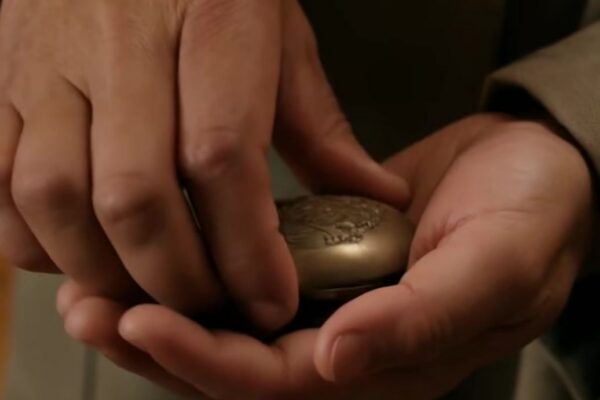
They came for closure, not confession. That was the lie Mara kept repeating in her head as the ferry shuddered away from the mainland and cut through slate-colored water. The island rose ahead like a clenched fist—black pines, a derelict lighthouse, and the courthouse that had once been the heart of a town that no longer existed on most maps.
Osprey Island had been “decommissioned” after the fire. That was the polite word. The newspapers had called it a tragedy. Mara’s mother had called it justice, once, in a voice that sounded like she was swallowing nails. Now her mother was dead, and Mara’s hands held a key taped inside the back cover of an old ledger that smelled of smoke even after twenty years.
Beside her on the ferry, Jonas Keene stared at the horizon as if he could bully it into changing. Jonas had been the one to phone her—his number unknown, his voice familiar enough to make something sour turn in her stomach. They had been children together, the last year before everything burned. They had not spoken since.
“It’s a quick thing,” he’d said over the phone. “We go in, we get what we need, we leave. No one wants this dragged out.”
A quick ending, Mara had thought. A neat line under a sentence that had never made sense.
The ferry docked at a pier warped by salt and neglect. A single ranger waited on shore, not in uniform but in a thick gray coat that made him look like a piece of driftwood given human shape. He glanced at their names on a clipboard with an expression that was too blank to be reassuring.
“You have until sundown,” he said. “After that, the tides turn ugly. Don’t go near the lighthouse.”
Jonas tried to laugh. It came out thin. “We’re not here for ghost stories.”
The ranger looked at Mara for a moment too long. “Good,” he said. “Because you’re here for something else.”
The courthouse sat inland, a squat building of stone and flaking paint. The town around it had collapsed into mossy foundations and twisted nails. Wind threaded through empty doorframes as if trying to remember what voices used to live there. Mara followed Jonas up cracked steps where the word JUSTICE still clung in iron letters above the entrance, missing its final E.
Inside, dust softened everything—benches, railing, the judge’s dais—until the room resembled a set waiting for actors who would never arrive. The air held an old dryness that caught in Mara’s throat, until she noticed the faintest undertone beneath it: cedar oil, like someone had tried to preserve the place from decay.
“My father wanted us to meet here,” Jonas said, voice lowered as if the walls might recognize him. “He left a note. Said there was something in the records room. Something that would… settle it.”
“Settle what?” Mara asked, though she already knew the answer he wouldn’t say: the fire, the blame, the trial that had ended before it began.
Jonas led her down a hallway where framed portraits leaned at odd angles. At the end was a heavy door with a brass plate reading ARCHIVE. Jonas pulled out a key of his own. The lock resisted, then surrendered with a tired click.
The room beyond was colder. Metal shelves held boxes labeled in careful ink. A single desk lamp sat at the center, its cord snaking into a wall outlet that shouldn’t have worked. But when Jonas turned the switch, light spilled out—steady, too bright, as if it had been waiting.
Mara’s skin prickled. “This place has power?”
Jonas didn’t answer. He was rummaging through a box marked CASE 84-17. His hands shook as he lifted a folder. The tab bore a name that made Mara’s chest constrict.
Rowan Hale.
Her father’s name.
“No,” she whispered, and the word was not denial so much as a prayer that nothing could answer.
Jonas set the folder down between them. “I didn’t know,” he said. “I swear. I thought it was about my father—about what he did. But this…” He swallowed. “This is about yours.”
Mara’s fingers hovered over the file, reluctant as if touching paper could ignite it. She opened it anyway. Inside were photocopies of letters, handwritten statements, a map of the island with red circles, and a photograph of the courthouse basement door hanging open like a mouth.
She flipped to a page titled FINAL TESTIMONY, unsigned.
The words swam, then sharpened: A list of payments. Names of officials. Dates. And in the margins, in a hand she recognized from birthday cards and grocery lists, a sentence written with angry certainty.
He is not dead. He is below.
Mara’s breath left her in a rush. She looked up at Jonas. “This is my mother’s handwriting.”
Jonas’s face had drained of color. “My father told me,” he said slowly, “that your father died in the fire.”
“Everyone said that,” Mara replied. “They said he saved people. That he went back in and didn’t come out.” Her voice cracked against the brittle air. “They built a story so we could stop asking questions.”
The lamp flickered, once, like an eyelid.
Mara closed the folder with a soft slap. “We should leave,” she said, though the words felt like betrayal. “Whatever this is—whatever they buried here—it’s not ours to dig up.”
Jonas’s jaw tightened. “It’s exactly ours.” He tapped the map. “Look.”
The red circles converged beneath the courthouse.
A sound came then—not the wind, not the settling of old boards. A low thud, followed by a dragging scrape, as if something heavy was being shifted across stone.
Mara froze. Her mind produced reasons first: pipes, animals, the building settling. But the sound came again, rhythmic, deliberate. It came from below.
Jonas’s eyes met hers, wide and bright with the kind of fear that needs a witness. “Basement,” he mouthed.
They found the stairwell behind a door marked STAFF ONLY. The air grew damp as they descended. Mara’s phone light carved a narrow tunnel through darkness. At the bottom, the corridor ended at a steel door. The same door from the photograph—its edge scarred, its paint blistered.
On the wall beside it hung a keypad, ancient and useless. But beneath it, a simple keyhole waited, patient as a trap.
Mara took out the ledger key from her pocket. Her hands were so cold the metal felt warm.
“Mara,” Jonas said, voice barely a thread. “We can turn back.”
She almost did. In her mind she saw her mother at the kitchen table, shoulders bowed, silently rewriting the past by omission. Mara had inherited that talent—how to survive by leaving pages blank.
But the island had called her here through the dead weight of unanswered years. And the sound behind the door was not a ghost story. It was insistence.
She slid the key in. It turned with an ease that made her stomach drop, as if the lock had never truly been locked at all. The door swung inward a few inches, exhaling cold air that smelled of salt and something metallic—like rain on rust.
Through the gap, Mara saw a room lined with shelves and cables, not a cellar but a hidden workshop. A single bulb burned overhead. On the far wall, a bank of monitors glowed with grainy black-and-white images: the pier, the ferry, the courthouse entrance, the archive room. Live feeds. Watching them watch it.
In the center of the room, a figure sat strapped to a chair, head bowed. Gray hair hung in ropes, face obscured. A chain ran from the chair to an eye bolt in the floor, the kind of restraint meant for storms, not people.
Jonas stumbled forward, a sound caught between horror and recognition. “Dad?”
The figure lifted his head. His eyes were open too wide, the whites yellowed. His mouth worked as if remembering how words were made. When he spoke, the voice was both familiar and ruined.
“Jonas,” he rasped. “You brought her.”
Mara’s blood turned to ice. “Who are you?” she demanded, though she knew. The cheekbones, the shape of the brow, the way the light made a stranger out of a man she had once feared and trusted.
“I’m the only one who stayed,” he said. “The only one who kept the bargain.”
Jonas shook his head, tears gathering without permission. “They said you died.”
“They said many things,” the man replied, and his gaze slid to Mara with a terrible clarity. “Your mother left you a key because she couldn’t finish it. She wanted an ending. A quick one.”
He smiled, and the expression did not belong on a human face in that light. “But this island doesn’t do endings. It does exchanges.”
Behind Mara, the steel door eased shut with a soft, final click. The lock turned by itself, as if guided by a hand made of tide and dark.
The monitors brightened, bathing the room in flickering white. In each screen, the courthouse above looked empty. No ranger at the pier. No ferry in the water.
Mara backed away until her shoulders met the cold metal of the door. Her mind raced for a plan, for a bargain, for something she could call the world back into place. Jonas stood rooted, staring at the man in the chair as if the sight could rewind time.
The strapped figure breathed in, slow and savoring, and the chains creaked like laughter. “You thought you came for closure,” he whispered. “But you came for inheritance.”
Mara pressed her palm against the door, feeling the chill seep into her bones. Above them, the courthouse—JUSTIC—kept its silent vigil over ruins. And in the basement, the story her mother had tried to end opened wide, not like a wound closing, but like a mouth ready to speak.