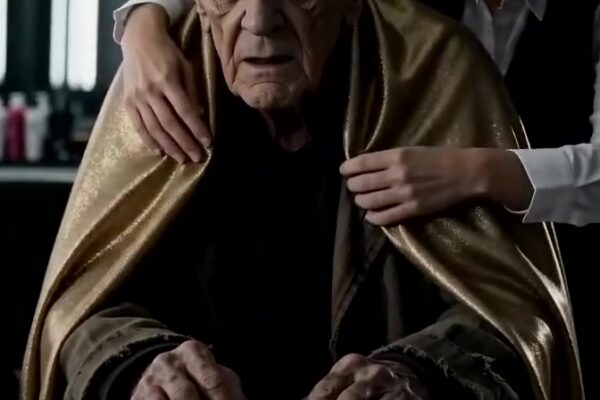
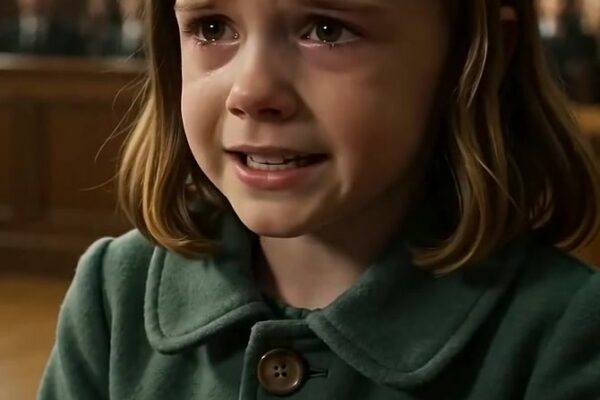
The box looked wrong in his hands.
Not because it was heavy—though it was—but because it did not belong to anyone who stood in the courthouse rotunda that morning. It was a plain cedar case, rubbed smooth at the corners, its brass latch dull with age. It looked like something you’d find in an attic and forget you ever saw, until the day you couldn’t stop thinking about it.
Calder Wren held it as if it were a sleeping animal.
Above him, the stained-glass dome of Hallowford’s old courthouse scattered colored light across the marble floor. The townspeople gathered in a loose ring, their winter coats steaming slightly as they came in from the cold. They had come for the inheritance hearing. They had come for spectacle. They had come, most of all, to see Calder fail.
“That’s it?” someone laughed. “All that fuss for a little wooden lunchbox?”
A ripple of amusement traveled through the crowd. Calder recognized the voice—Dorn Lask, whose family had owned three streets’ worth of storefronts and always spoke as if the air were theirs, too.
At the front steps, beneath the carved eagle that watched over the room, Attorney Sable Quinn cleared her throat. She was all edges: sharp shoulders, sharp cheekbones, a sharp gaze that never softened even when she smiled. She opened a folder and read in a voice trained to sound impartial.
“By the will of Marek Wren,” she said, “the property known as Wren House, its attached acreage, and any remaining liquid assets are to be distributed to the Town Trust—”
Calder felt the words hit him like sleet. Wren House. The last place his mother laughed. The place his father left and never returned. And his grandfather—Marek Wren, the man the whole town had called a miser and a myth—had given it away to the same people who spent years calling Calder a mistake.
Quinn’s voice continued. “—with one exception. Item Seven. To Calder Wren is bequeathed a cedar box, herein referred to as the Courier.”
The laughter came again, louder this time. Calder’s ears burned. Someone behind him whispered, “That’s what he gets for showing his face here.” Another voice: “Marek always hated him.”
Calder kept his eyes on the box. He had expected money, or at least the deed. He had expected something that could be measured and argued over. But not this.
Attorney Quinn stepped down, her heels ticking, and held out the Courier with a professional distance, as if it might stain her gloves. “It was in the safe,” she said quietly so only he could hear. “The lock’s… odd. Your grandfather’s instructions were explicit. You must take it. Here. In front of witnesses.”
Calder took it, and the mocking grew bolder.
“Open it!” Dorn Lask called. “Maybe there’s a note telling him to leave town.”
“Maybe there’s a mirror,” another man said, “so he can finally see what we’ve been seeing.”
The Courier sat in Calder’s palms, warmer than it should have been. He found the latch and lifted it. The brass resisted, then gave with a soft click that seemed far too loud in the rotunda. A hush took the crowd—not out of respect, but anticipation. People leaned forward, hungry for disappointment.
Calder raised the lid.
The air changed.
It was not a gust or a chill, not something a person could blame on drafts. It was as if the courthouse itself inhaled. The dust in the colored light stopped moving. The murmur of people’s breathing faltered, then vanished.
Inside the box lay a small disc of black glass, no bigger than a coin, set in velvet. It reflected nothing—not Calder’s face, not the stained glass, not the ceiling. It drank the light like a bruise. Next to it was a folded paper, sealed with wax stamped with the Wren crest: a raven carrying a key.
Calder’s fingers trembled as he broke the seal.
He read, and the words in his grandfather’s hand seemed to press themselves into his skin.
“If you are holding the Courier,” the note began, “then the town has done what it always does: chosen comfort over truth. They will laugh. Let them. Laughter is the last sound some people make before silence teaches them.”
Calder swallowed. Around him, dozens of faces hung suspended—smiles half-formed, lips parted as if mid-joke. It took him a moment to understand: they weren’t being polite. They couldn’t make a sound.
Dorn Lask’s mouth opened and closed. His eyes widened with sudden fear. He slapped a hand to his throat, then glared at Calder as if Calder had reached across the space and squeezed.
Calder’s own voice came out as a whisper. “What is this?”
Attorney Quinn tried to speak and couldn’t. She stared at Calder, then at the box, her composure cracking like thin ice. She pressed a fingertip to her lips, panic rising when no sound answered.
Calder looked back down at the note and kept reading, because what else could he do?
“The disc is a Listener,” Marek had written. “Not magic. Not superstition. A device built from the first ore pulled from Hallowford’s mine, when men still believed the earth should be asked before it was cut. The Listener does not harm. It simply removes the privilege of noise from those who have used noise to drown others.”
Calder’s chest tightened. He thought of the years he’d tried to speak at school meetings about the mine runoff, about the headaches and the dead fish in the creek, only to be laughed at. He thought of the council chamber where his mother had asked for help and was met with polite smiles and closed doors. He thought of the word they’d thrown at him again and again—ungrateful—as if gratitude were owed to people who had watched his family sink.
He read on. “The Courier was meant for the day you were forced to stand in this room and be small. I cannot stop them from underestimating you. But I can give you a moment in which their voices cannot trample yours.”
Calder lifted his gaze. The rotunda was a theater of frozen expressions. Some people clutched their throats. Others stared at him with hatred sharpened by helplessness. A few looked… ashamed, as if silence had finally made room for memory.
In the second row, an old woman—Mrs. Halden, who used to sneak Calder cookies when his mother wasn’t looking—pressed a trembling hand to her chest. Tears tracked down her face. She mouthed something he couldn’t hear, but he understood anyway: I’m sorry.
Calder’s hands tightened around the box. The disc of black glass seemed to watch him without eyes.
The last paragraph of Marek’s note was shorter, more jagged, as if written in a hurry or an anger he’d tried to swallow.
“Use the silence wisely. It will not last long. When their tongues return, they will pretend this never happened. Do not let them. Speak while you are the only sound they can imagine.”
Calder folded the paper with care, as though it might bruise. He looked at Attorney Quinn. Her lips moved in a frantic question—What did you do?—but no voice came. The crowd’s fear had turned to a wild, pleading desperation. They wanted noise back the way drowning men want air.
Calder stepped forward onto the marble dais where the town council usually posed for photographs and cut ribbons. He lifted the Courier so everyone could see it.
His voice, in the sudden vast silence, filled the rotunda like a bell.
“You’ve been laughing for years,” he said, and it was not a shout. He didn’t need one. “You laughed when my mother begged you to test the water. You laughed when I showed you the reports you didn’t want to read. You laughed because laughter is easy when you’re protected.”
Dorn Lask’s face turned a furious red. He tried to speak and failed. The veins in his neck stood out like cords.
Calder went on. “My grandfather built this town’s quiet corners. He paid your debts when you didn’t know. He kept records you didn’t want kept. You took from him and called it tradition. Now you’re going to listen.”
He reached into his coat and pulled out a thick envelope—copies of emails, lab results, meeting transcripts, photographs of the creek’s bright slicks. He had carried them for months, waiting for a moment when the room might stop interrupting him.
Calder set the envelope on the clerk’s table and flipped it open. Papers fanned out like pale wings.
“The mine has been poisoning us,” he said. “And you knew. Some of you signed the permits. Some of you took the money. All of you kept smiling.” He looked from face to face, and the silence made every blink, every swallow, every tremor visible. “Today you don’t get to talk over it.”
Outside, a police siren wailed faintly in the distance, muffled by thick walls and winter air. Inside, the town remained trapped in soundlessness, forced to watch their own secrets laid bare.
Calder felt the strange warmth of the Courier pulse once, like a heart slowing.
He didn’t know how long the silence would hold. Seconds? Minutes? He only knew his grandfather had been right about one thing: when noise is taken away, people finally have to face what they’ve been filling the space with.
Calder lifted the black disc from its velvet bed. It was colder than ice. He held it between thumb and forefinger and spoke one more time, not to punish them, but to mark the moment so they couldn’t later pretend it had been a dream.
“When your voices come back,” he said softly, “you can choose what you do with them. You can keep laughing. Or you can start telling the truth.”
And for the first time in Hallowford’s long, loud history, the entire town had nothing to say.