The bell over the café door had barely finished its tinny jingle when the boy lunged between tables like a thrown stone. Chairs scraped. A spoon clattered against a saucer and kept spinning until it fell on its side, the sound somehow louder than it should’ve been. He wasn’t big—sixteen, maybe—but his momentum made people pull back as if he carried a knife.
At the window seat, the woman in the cream coat jerked to her feet so abruptly her latte tipped and slid, leaving a pale river across the table. Her eyes flashed, fierce and practiced, the way someone looks when they’ve learned to make fear into a weapon. “What are you doing? Get away from me!”
Her voice cut through the low lunchtime murmurs, and the room answered with a hush. Faces turned without pretending not to. A couple stood, then another, the way a crowd does when it senses a story about to turn violent. Behind the counter, the barista froze with a milk jug in midair. No one moved to intervene. No one knew which kind of danger this was.
The boy stopped short, as if he’d hit an invisible wall. His chest rose and fell too quickly. His hands were empty, open, trembling. He wasn’t staring at her face. He was staring at her neck.
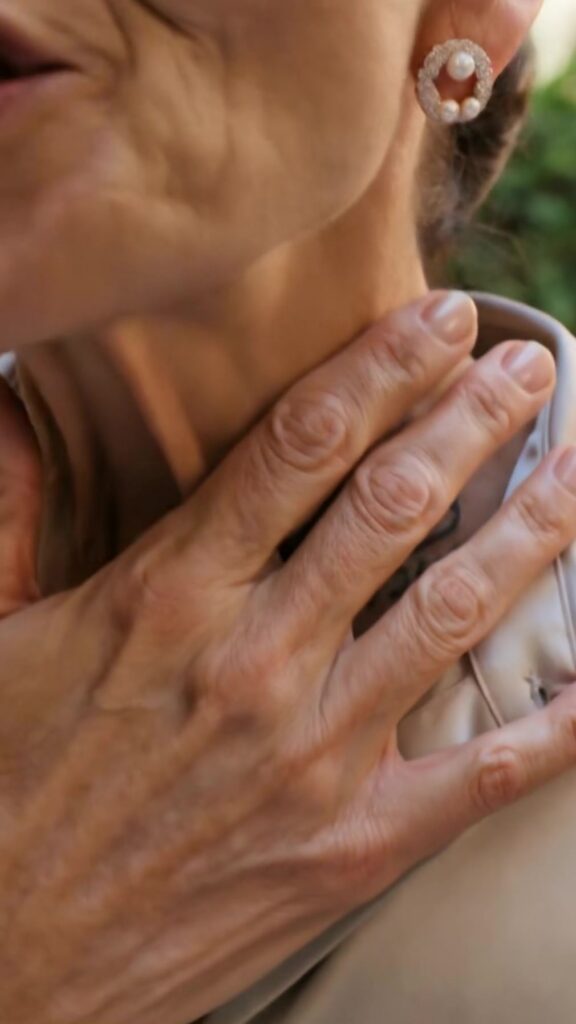
The woman followed his gaze and lifted her chin in defiance—until she saw what he saw reflected in the window glass: the edge of her collar had slipped, and just above the hollow where a heartbeat could be found, a small mark showed. Not a fashionable symbol, not a delicate charm—something older. Three thin lines, crossed like a broken compass, inked into skin as if the skin itself had grown around it.
People couldn’t see it from where they stood, but the boy could, and he looked at it like it had spoken his name. He took one step back. His voice, when it came, was not angry. It was stunned, too quiet for the sharpness of his posture. “My mother had the same one.”
Something shifted in the woman’s expression, as if a mask had slipped and she grabbed for it too late. Arrogance first—an automatic sneer, the kind that says you must be mistaken. Then shock, a crack that ran from the corner of her eye down to her mouth. Then fear, quick and involuntary. Her hand rose and covered her neck, fingers pressing the spot as if she could erase it with pressure.
“Who is your mother?” she asked. The words came out clipped, but there was a tremor under them. A tremor that didn’t belong to a woman who wore pearls on a Tuesday afternoon and spoke like she owned the air around her.
The boy swallowed hard. Tears stood bright but did not fall, held in place by the force of whatever had carried him here. “Don’t do that,” he said, and the café heard the sentence like a slap, because it wasn’t the voice of a child begging. It was the voice of someone who had rehearsed a moment of truth for years. “Don’t act like you don’t know.”
His fingers went to his pocket. For a second, the woman’s eyes flicked downward—trained, assessing—like she expected a weapon after all. But he pulled out only paper, worn and creased so many times the folds had become soft as cloth. He held it carefully with both hands, as if it might tear from the weight of attention.
He unfolded it once, then again. A photograph, old enough to have dulled at the edges, the color drained into a sepia sadness. The image showed a much younger woman with the same sharp cheekbones, the same slight tilt of the head that suggested impatience with the world. She was seated on a battered couch. A baby sat on her lap, bald and round, a hand clutching the woman’s finger. Her collar was open, and the tattoo—those three lines like a broken compass—was plain as a signature.
The café became silent in a way that felt unnatural, like a film had cut its sound. No cups. No whispers. Even the traffic outside seemed to recede, as if the street itself leaned in to listen.
The boy lifted his eyes from the photograph and locked them onto the woman. “She said… if I ever found you…” He paused, and the pause was heavy enough that everyone seemed to breathe around it instead of through it. “I should ask why you left me behind.”
The woman’s face drained, not white but hollow, like someone had turned off the light behind her skin. Her lips parted. For a second, she looked younger too—stripped of polish, stripped of certainty—revealing something raw and frightened. “That’s impossible,” she whispered. “It can’t be.”
Her gaze flicked to the photograph as if it might change when she looked away. Then to the boy. Then back. Her hand, still half-covering her neck, dropped slowly as if surrendering. She reached toward the picture with careful fingers, the gesture not greedy but reverent, like touching a relic.
The boy didn’t flinch this time. He held the photo steady, though his knuckles were white. “You were supposed to be dead,” he said, and the room felt the sentence land even without knowing its history. “That’s what she told me when I got old enough to ask. She said it like she was reading it from a letter she didn’t write.”
The woman’s fingers hovered a breath away from the glossy surface. “Who told her that?” she asked, and the question was suddenly not about the boy at all. It was about time. It was about a door that had been locked so long she had begun to believe it was a wall. “Tell me who told her I was—” She couldn’t finish.
Outside, a bus sighed at the curb. The sound seemed impossibly far away, like the world had moved on without permission. The boy’s breath hitched. A tear finally escaped and traced a line down his cheek. “Her name was Lidia,” he said. “Lidia Grane.” He watched the woman’s face for the impact, and when it landed, it landed hard.
The woman swayed. A hand shot out and caught the table edge, leaving a smear in the spilled milk. “Lidia,” she repeated, and it sounded like a prayer and a curse tangled together. Her eyes shone with something not quite tears yet. “She… she was my sister.”
The boy’s mouth opened, then closed. The story he’d carried to this café—mother and monster, abandonment and revenge—shuddered under a new weight. “No,” he said, but it came out smaller than before. “She said you were… she said you were the one who ran.”
“I did,” the woman breathed, and then, sharply, “I had to.” She reached again, closer this time, the tips of her fingers almost touching the photograph. “That mark—” Her hand rose and brushed the tattoo on her neck, a reflex of pain. “It wasn’t a choice. Not for her. Not for me.”
The boy’s eyes widened, the tears now pooling freely. “Then why didn’t you come back?” he demanded, and his voice broke in the middle, revealing the child underneath the anger. “Why did she die waiting for you to—” He stopped, choking on the words, because saying them aloud would make them irrevocably true in front of strangers.
The woman’s eyes snapped up. “She’s dead?” The question cracked into the café like glass. The boy nodded once, a brutal little motion. The woman’s hand finally touched the photograph, but instead of taking it, she traced the younger face with one trembling finger as if trying to confirm the contours were real.
When she spoke again, her voice was stripped of all pretense. “If Lidia is dead,” she said, “then whoever told her I was dead succeeded twice.” Her fingers curled, and for an instant something dangerous surfaced—an old fear turning into something sharper, something that could become fury. She looked at the boy as if seeing him not only as an accuser but as evidence. “And if you’re here… they failed a third time.”
The boy’s throat worked. “Who are ‘they’?” he whispered.
The woman’s gaze darted to the café door, to the street beyond, to the reflections in the glass that now seemed like hiding places. The air around her tightened. “Not here,” she said. “Not with this many eyes.” She reached for the photograph again—and just before she could pull it closer, the bell over the café door rang a second time, crisp and bright, and the woman’s head snapped toward the sound as if it had spoken her true name.
In the pause that followed, the boy’s fingers tightened on the paper, and the woman’s hand froze midair, suspended between past and present, between taking and being taken. Somewhere in the café, someone’s phone buzzed once, unanswered. The woman lowered her voice to a thread. “Tell me,” she said, staring past the boy at whoever had entered, “did anyone follow you?”