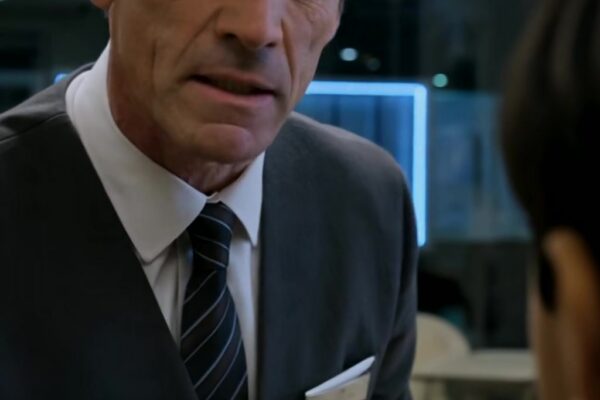
“What are you supposed to be?” he sneered, as if the question were a verdict already decided. The words floated over the polished marble like cigarette smoke, curling around the foot of the hospital bed and the men in white coats who kept glancing at the clock.
The boy didn’t answer. He stood at the end of the bed with his hands loose at his sides, too small for the room, too still for a room built on urgent movement. The private suite was a showroom of wealth: floor-to-ceiling windows, imported flowers, a leather chair no one dared sit in. The old man had demanded the best, and the hospital had obliged—staff, silence, and a story that would not leak beyond the brass-plated door.
Silas Vane—magnate, donor, patient—rested against a mound of pillows with a thick cast encasing his right foot and ankle. The cast was immaculate, unblemished as a fresh wall. Silas had been telling anyone who would listen that his injury was “a tragedy of fate,” that an accident had robbed him of mobility at the very moment he needed sympathy most. Each time he repeated it, his tone sharpened, as if daring fate to contradict him.
Three doctors waited with clipboards and careful faces. Dr. Lenora Wex, senior orthopedic consultant, kept her hands clasped tight so no one would notice her fingers shaking. Dr. Quill, the younger resident, hovered behind her, blinking too often. The third—an administrator disguised in a lab coat—had only one job: make sure the hospital’s generosity remained profitable.
The boy had arrived an hour earlier with no appointment, no file, no name that came up in the system. A security guard had tried to stop him until Lenora looked into his eyes and did what she almost never did: overruled procedure on instinct. Now the guard waited outside with crossed arms and a hand near his radio, like the boy might suddenly turn into something dangerous.
“If you’re here to beg,” Silas continued, voice thick with amusement, “try the lobby. If you’re here to pray, do it quietly. My foot is in no state to entertain theatrics.” He gestured grandly at the cast, as if it were a crown. “This is what hard work earns you, in the end. Pain. And people like you staring.”
The boy’s gaze moved over the cast as if he were reading it. Then he bent and picked up a smooth stone from the decorative bowl on the bedside table—the kind of thing meant to be touched for stress relief, not used for anything honest. Lenora opened her mouth. Quill inhaled sharply. The administrator’s eyes narrowed, calculating liability.
“Put that down,” Silas said, chuckling as if indulging a child’s curiosity. “Or are you going to fix me with geology?”
The boy lifted the stone. His arm did not tremble. His face did not shift into anger or fear. It was worse than either—an expression like winter water, calm because it had already chosen what it would freeze.
The stone came down with a clean, deliberate strike.
The crack sounded like a gunshot in the quiet room. Plaster burst outward in a white spray, skittering across the marble and bouncing against a pair of expensive shoes. The doctors jumped back on instinct. The administrator cursed under his breath. Silas’s laughter died mid-breath, replaced by a raw sound that was not pain but outrage, the kind of outrage that comes from being reminded you are not invincible.
“What have you done?” Silas bellowed, both hands clamping the bedrails. His knuckles whitened. His face flushed crimson. “Do you know who I am?”
The boy looked at the fractured surface. “It wasn’t mending,” he said, voice low, as if he were making an observation about weather. “It was hiding.”
Silence dropped heavy. Even the air-conditioning seemed to pause.
A hairline fissure crawled along the cast like a living thing. The boy raised the stone again.
“Stop!” Silas barked. For the first time, panic leached into his arrogance, thinning it. “Security—”
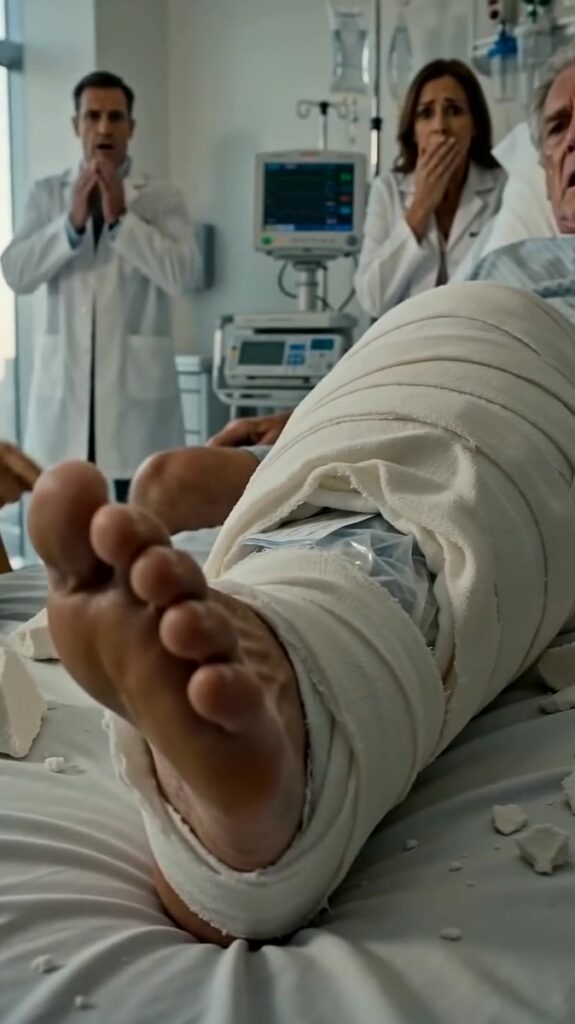
Too late. Another strike. Another crack. A chunk fell away and hit the floor with a dull thud, leaving a jagged opening. Lenora’s eyes locked on what should have been bruised, swollen flesh—what she had expected to see after weeks of immobilization.
Instead, there were toes. Clean. Warm-looking. Pink as if they had been in socks, not a cast. No discoloration. No swelling. No signs of healing because there had been nothing to heal.
Lenora covered her mouth without realizing she’d moved. Quill let out a small, involuntary gasp. Silas stared at his own exposed foot as if it had betrayed him.
The boy pointed, not at Silas’s face but at the toes. “Move them.”
No one breathed. The instruction hung in the air like a command a courtroom had forgotten it could issue.
Silas’s jaw worked. His eyes darted to Lenora, to the administrator, to the door. Then—almost imperceptibly—one toe twitched.
Quill made a sound like someone choking on disbelief. Lenora’s heartbeat roared in her ears. She took a step forward, forced herself into her role, and examined the exposed skin with trembling professional precision. It was not the foot of an injured man. It was a foot that had been kept pristine for a performance.
Silas licked his lips. Sweat gathered at his temples and ran down into his collar. “It’s… it’s complicated,” he began, but his words came out thin.
The boy stepped closer until the edge of the bed separated them by a mere handspan. In the suite’s reflected light, Silas’s eyes looked suddenly old—not powerful, just old. “Why pretend?” the boy asked. Not loudly. Not with anger. With the same cold clarity he’d used when he swung the stone.
Lenora knelt, peering into the cast’s inner lining where the padding had torn. Something glossy caught her attention, tucked between layers as carefully as contraband. She reached in and drew out a small plastic sleeve, sealed at the top, protected from sweat and movement. Quill leaned in, mouth slightly open.
Inside the sleeve was a folded sheet of paper, creased once, then again, as if it had been handled many times and returned to hiding. A signature stamped the bottom in heavy ink. A hospital letterhead sat at the top like an accusation.
Quill’s voice fell to a whisper. “What is this?”
Silas’s face collapsed in stages—the stubborn lift of his chin, the scornful set of his mouth, the practiced armor—each part dropping away as if the boy’s stone had struck more than plaster. “That doesn’t belong here,” he said too quickly. “That’s—someone planted that.”
Lenora unfolded the page. Her eyes scanned the first line. Then the second. The room seemed to tilt around her. The letter was not about an injury. It was about consent, about a transfer of assets into a trust, about a timeline calculated down to the hour. It referenced an “incapacity narrative” and listed witnesses, including a doctor’s name Lenora recognized—one who had resigned abruptly last month and refused to speak to anyone since.
The boy watched Silas, not the paper. “You wanted everyone to believe you were helpless,” he said softly, “so no one would ask what you were doing with both hands.”
Silas’s voice cracked. “You don’t understand.”
“I understand,” the boy replied. He turned his palm upward. In it, chalk-white dust clung from the shattered cast. It looked like ash. “You thought a story could hold forever if you wrapped it tight enough.” His eyes lifted, steady and merciless. “But stories are brittle.”
Outside, a siren wailed somewhere in the city, distant and indifferent. Inside, the luxury suite had become a stage where wealth could not buy silence fast enough. Lenora held the paper as if it might burn through her gloves, and in the boy’s stillness she felt, for the first time in years, the weight of choosing what kind of doctor she truly was.
Silas opened his mouth to order, to threaten, to bargain. Nothing came out but breath. The boy set the stone down gently, almost respectfully, and the restraint in that small motion felt more terrifying than the violence that had preceded it.
“You asked what I’m supposed to be,” the boy said, finally offering an answer without giving a name. “I’m what happens when the lie stops working.”
Then he turned toward the door, leaving plaster fragments behind like fallen masks, while the people in the room stared at the exposed foot, the hidden letter, and the old man whose power had just been cracked open for everyone to see.