The vault closed with a deep echo, the kind that didn’t just ring in the ears but settled into the bones like cold metal. The sound rolled down the hallway of reinforced concrete and sealed doors, then died into a hush so complete it felt engineered. In that hush, even breathing seemed like a violation.
No one followed him in.
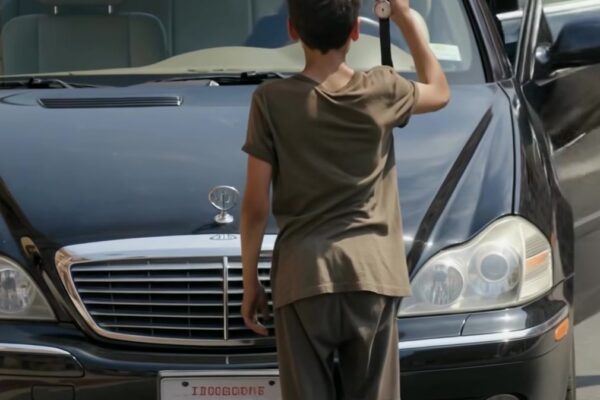
The boy moved as if he’d rehearsed it—slow steps, shoulders square, hands empty and visible. He wore a jacket that didn’t quite fit, sleeves tugged too far over his wrists. His hair was still damp from rain, but there was no shiver in him, no glance back toward the guarded entrance. The security officer at the gate had checked his invitation twice, then once more, then had called upstairs. After a long pause, the gate had clicked open.
Now the corridor narrowed toward the main counter, a long island of bulletproof glass and laminated wood. Behind it, monitors glowed with the watchful patience of machines. A woman with a tidy bun looked up from a ledger, eyes traveling from the boy’s shoes to his face as if measuring the distance between him and trouble.
“Can I help you?” she asked, politely, carefully, as if her words were a set of keys she didn’t want to drop.
He didn’t answer at first. He stopped at the counter and placed a small brass key onto the wood. It landed with a soft click that seemed indecently loud.
“You’re keeping something that isn’t yours,” he said.
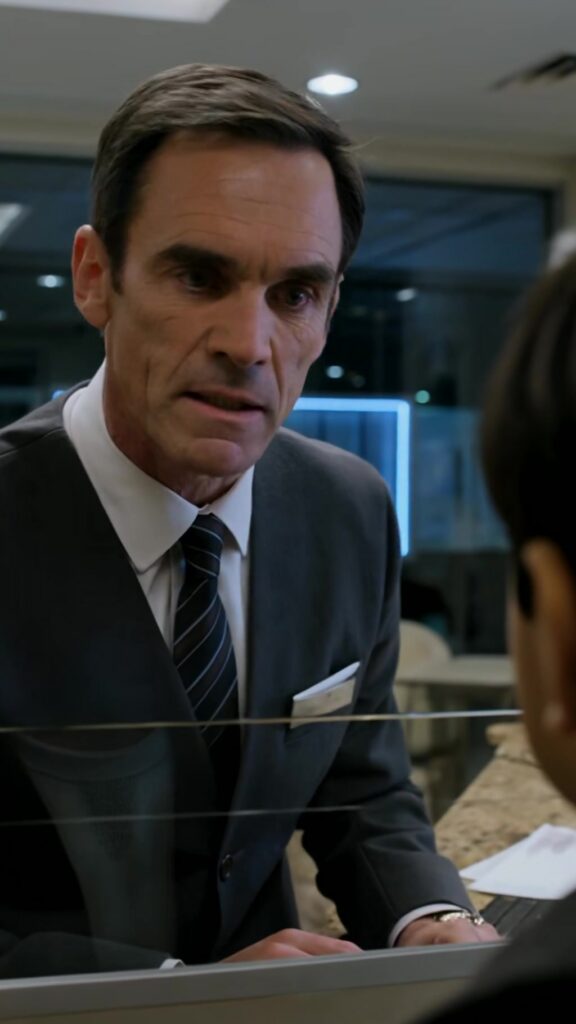
A chair scraped behind the glass. The manager emerged from an office door, smoothing the front of his vest as though he’d been interrupted in the middle of an important thought. He wore a smile that didn’t reach his eyes—an expression practiced in front of mirrors and lawsuits.
“Lost your way?” the manager asked. His voice carried the faint amusement of someone speaking to a stray dog in a suit shop. “This area isn’t for… public curiosity.”
The boy’s gaze didn’t waver. His eyes were dark and steady, and for a moment the manager’s smile faltered, as if he’d recognized a face from a photograph and hated the feeling.
“My grandfather trusted you,” the boy said. “He said your bank was the safest place left in this city.”
“Ah,” the manager replied, drawing the syllable out. “Family business. That always makes things emotional.” He slid closer to the glass, hands braced on the counter as though leaning in to offer compassion. “Names?”
“Elias Harrow,” the boy said.
The manager’s eyelids tightened. The woman at the ledger stopped moving her pen.
“He disappeared,” the boy continued, and the word fell into the room like a weight dropped from height. Not lost. Not passed away. Disappeared—an absence with teeth.
The manager’s posture shifted, subtle but unmistakable, like a man adjusting to the sudden possibility of a knife behind him. “People leave,” he said, but the softness was gone. “They choose to. They run. Debts, regrets… families they don’t want.”
“He didn’t run,” the boy answered. “He came here.”
Silence spread the way ink spreads in water. The monitors continued their quiet blinking. Somewhere deeper in the building, a ventilation fan hummed, indifferent.
“You’re too late,” the manager said at last. He tried to make it sound like mercy.
The boy slid the brass key forward, just enough that it tapped the glass edge. “Open vault seventeen.”
The woman’s eyes flicked to the manager. The manager stared at the key as if it were alive.
“You’re not authorized—” the woman began.
“Open it,” the boy repeated. Not louder. Not angrier. Just final.
The manager straightened, then forced a light laugh that broke in the middle. “Vault seventeen has been dormant for years,” he said. “No active account, no access permissions. We can’t—”
“You can,” the boy interrupted. “You locked it.”
For a second the manager looked like he might refuse purely out of pride. Then his gaze slid to a corner camera, and something in him calculated risk—legal, personal, political—like a man reading a balance sheet of consequences. He made a small gesture. The woman swallowed and reached for the console.
She entered an administrator sequence. Her fingers hesitated over the keys, then moved faster, as if she wanted the moment done. A progress bar appeared on the screen behind her. The system chimed. Then the monitors went pale.
“That’s… strange,” she murmured. Another chime sounded, lower this time, like a warning. She typed again. The console flickered, and a line of text appeared where menus should have been.
Sealed from the inside.
The woman’s breath caught. “That can’t be right,” she said, as if arguing with physics.
Security shifted near the door—two guards in dark uniforms, hands drifting toward the places where authority becomes violence. One of them stepped forward. “Who gave you that key?” he demanded, aiming the question at the boy like a flashlight beam.
The boy’s hands remained on the counter, palms down, gentle. “The one still inside,” he said quietly.
It wasn’t the words alone—it was the certainty in his tone, the way he spoke as if he’d had a conversation that morning, as if the answer didn’t require belief to be true.
The manager’s face drained, color leaving in stages. “That’s impossible,” he whispered, but the lie was for himself.
The console gave a harsh buzz. The lock release sequence appeared on-screen, bypassing permissions with a rigidity that felt less like software and more like a demand. In the hallway beyond, gears engaged. There was a slow, reluctant grinding, a sound like a throat clearing after years of silence.
“Stop,” the manager said, suddenly loud. “Stop it right now.”
No one moved. Even the guards were frozen, caught between protocol and the primitive instinct not to touch something that shouldn’t open.
Down the corridor, vault seventeen’s door—thick as a city wall—unlatched with a long, aching groan. The air that breathed out was colder than the room, old and dry and faintly chemical, like paper stored in a coffin.
The boy walked forward. Calm. Silent. Not triumphant—only resolved, as if every step had been paid for in advance with sleepless nights.
The vault interior was empty.
No shelves stacked with documents. No jewel cases. No gray safety deposit drawers. Just bare metal walls and a floor marked with scuffs, as though something heavy had been dragged out years ago. The emptiness had a staged quality, like a room cleaned too thoroughly after a crime.
Except for a single box placed precisely in the center.
It was small, no bigger than a shoebox, wrapped in oilcloth that had yellowed with age. A label, handwritten, clung to the top. The ink had bled slightly, but the name was still legible.
Harrow.
The manager hurried down the corridor, his shoes too loud, his breath jagged. “Don’t,” he said, and now the word sounded like prayer.
The boy knelt. He didn’t look back. He didn’t ask permission. He peeled the oilcloth away with careful fingers, as if he expected it to scream. Beneath it was a wooden lid with a simple latch, worn by hands that had opened and closed it too many times.
He turned the box toward himself, and the latch clicked free.
The manager reached out as though to snatch it away, then stopped, his hand hovering in the air. His lips trembled. His eyes filled with a terrible recognition.
Too late.
The boy lifted the lid.
Inside lay a compact reel of tape, an old style used for dictation, labeled in Elias Harrow’s neat, slanted handwriting. Beneath it was a folded bank document stamped FINAL CUSTODY TRANSFER, and beneath that—a ring.
A signet ring. Heavy gold. The Harrow crest engraved into the face. A smear of dried, dark rust marred one side, as if it had been pressed too long against skin that bled.
The boy’s throat worked once. He didn’t cry. He only stared at the objects like they were a language he’d been born understanding.
Behind him, the manager made a small sound, a half-swallowed gasp. He swayed as if the corridor had tilted. “No,” he breathed, and it was not denial—it was fear of what the evidence would become in the world.
The woman from the counter had followed at a distance, hands clasped tightly at her waist. One guard whispered something into his radio, but his voice wavered.
The boy picked up the tape reel. On its label, a date was written. And beneath the date, one sentence, cramped as though penned in haste.
If I do not leave this building, play this for my grandson.
The manager’s knees buckled. He caught himself against the wall, then slid down, suddenly incapable of standing in the presence of a truth he’d buried behind steel and policy.
“You said he ran,” the boy said, voice barely above the vault’s chilled breath. “You said people choose to leave.”
The manager stared at the ring as if it were a verdict. His chest rose and fell too quickly, like a man drowning on dry land. “I didn’t… I didn’t think anyone would come back,” he whispered.
The boy closed the box gently, trapping the past inside for one more heartbeat. Then he stood and faced the man who had laughed at him.
“Someone was inside,” he said. “Someone still is, in the only way that matters.” He held up the tape. “And now everyone will hear him.”
The deep echo of the vault’s closing had once been a promise: shut away, forgotten, safe. But as the boy walked out with the box against his chest, the sound seemed to change shape in memory, becoming something else entirely.
Not a seal.
A confession.