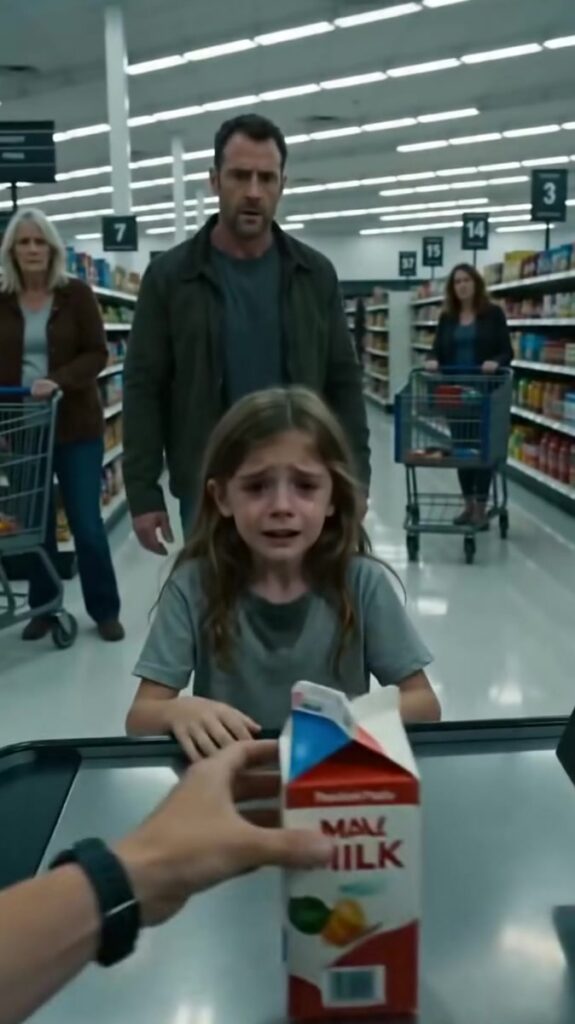
The plea cracked through the grocery store like a glass dropped on concrete.
“Please—can I pay tomorrow?!”
For a beat, even the refrigerator hum seemed to lower itself out of respect. Shopping carts stopped mid-squeak. A woman with a bouquet of cilantro froze with her hand in the air. Somewhere near the back, a child stopped whining and stared.
At the register stood a girl no older than ten, thin as a coat hanger and bundled in a sweater too big for her. She hugged a bottle of milk to her chest with both hands, knuckles white, fingers trembling around the plastic. Her eyes were wet but defiant, as if she’d already cried enough and was bargaining with the world to let her keep the rest.
The cashier—Nina, name tag crooked, hair shoved into a tired bun—looked at the screen, then at the girl. The total was small. Smaller than most impulse buys. Still, rules were rules, and rules were the only thing that kept people from turning desperation into a currency.
“Honey,” Nina said, voice low, “I can’t do that.”
The girl didn’t flinch. She didn’t set the milk down. She just breathed, shallow and fast, as if her lungs were rationing air the way she rationed everything else. “My brother cries all night,” she whispered. “His tummy hurts. He says it feels like there’s bees.”
Silence gathered in the fluorescent light. It was uncomfortable in the way truth often is—too blunt, too ordinary, too close to anyone’s own kitchen table.
Nina’s gaze shifted briefly toward the security camera above the cigarettes. Then she looked back at the girl. Her expression tightened in that particular adult way that meant she was trying not to show something—anger, pity, fear, memory. She swallowed. “Do you have… anyone with you?”
The girl shook her head. “My mom’s at work. She doesn’t get paid until tomorrow.”
Behind her in line stood a man in a dark coat, hands in his pockets, posture straight enough to be military or practiced. He’d been staring from the moment the girl spoke, not with the usual curious judgment of a stranger, but with a focus that made the air feel colder. The kind of focus you saw in people who had spent years searching for a particular face in every crowd.
Nina exhaled like she’d just made a decision that would follow her home. She tapped something on the register—voided, re-entered, voided again. The screen blinked. Then she moved quickly, stepping away from her station and walking down the closest aisle. When she returned, her arms were full: a loaf of bread, a jar of peanut butter, a small bag of rice, a bunch of bananas, a packet of soup, and a box of tea. She dropped them into a paper bag with a gentleness that made the bag seem heavier than it was.
“Take it,” Nina said, pushing the bag and the milk across the counter. “Don’t argue with me.”
The girl froze, as if generosity was a trap she didn’t have time to decipher. Her mouth opened, closed, opened again. “I—”
“Go,” Nina said softly, eyes shining with the sort of stubborn compassion that costs something.
“Thank you,” the girl breathed. The words came out like she had to force them through a throat tight with pride. She grabbed the bag and the milk together and ran, sneakers slapping the tile, her oversized sweater flapping like a cape that didn’t quite fit.
The automatic doors sighed open. Night air rushed in. The store’s sterile brightness spilled onto the sidewalk, turning the cold outside briefly golden.
The man in the dark coat moved the instant the girl did, stepping out of line without a word. His cart sat abandoned with a few sensible items—coffee, eggs, a can of soup—like he’d entered the store intending to live a normal evening until something changed the shape of it.
Nina watched him go, unease crawling up the back of her neck. “Sir,” she called, but he didn’t look back.
Outside, the parking lot was wet from an earlier drizzle, the asphalt reflecting the store sign in broken pieces of light. The girl ran toward the far edge where apartment buildings huddled close together, their windows scattered with muted television flickers. The man followed at a pace that wasn’t quite running, but wasn’t casual either—determined, as if he feared that if he didn’t keep her in sight, she would vanish the way answers do when you reach for them.
“Hey,” he called, voice carrying over the hiss of passing cars. “Wait.”
The girl tightened her grip on the bag and picked up speed.
He lengthened his stride. “I’m not going to take anything,” he said, breath quickening. “I just—please. I need to ask you something.”
She slowed, then stopped near a streetlamp that buzzed faintly. She turned in small increments, like an animal deciding whether a cornered bite would cost more than flight. Her chin lifted. “What?”
Up close, the man’s face looked older than it had under the store lights. There were fine lines around his eyes and a scar cut through one eyebrow, as if a different life had once tried to mark him permanently. His gaze dropped to her hands—small, shaking, clutching milk like it was oxygen—and something tightened in his expression.
“What’s your mom’s name?” he asked.
The girl’s brows knit. “Why?”
“Because,” he said, and the word came out rough, “I think I might know her.”
She hugged the bag closer, shoulders rising. Suspicion flickered in her wet eyes. Then, as if she was too tired to keep secrets that weren’t hers, she said, “Marilyn.”
The name hit the man like a blow. The color drained from his cheeks. His lips parted, and for a moment he looked younger—caught between hope and horror, as if the past had reached up from the pavement and grabbed his ankle.
“That’s… not possible,” he whispered. “Marilyn Caldwell?”
The girl’s mouth tightened. “Everyone calls her just Marilyn.”
His hands came out of his pockets slowly. They were trembling now too, but not from cold. From memory. From the sudden, terrifying proximity of something he’d buried so deep he’d convinced himself it was a dream.
“Does she—” His voice broke. He swallowed, forced it steady. “Does she have a brother named Daniel?”
The girl stared. “My brother’s named Danny,” she said cautiously, as if the world was shifting under her feet and she didn’t know which direction was safe. “But… Mom doesn’t talk about brothers. She says we don’t have family.”
The man’s eyes shone under the streetlamp. “No,” he said, shaking his head. “No, she had family. She had me.”
The girl took a step back. The bag crinkled loudly, too loud. “You’re lying.”
“I wish I was.” His breath came in thin, sharp pulls. “Listen to me. I’ve been looking for her for fifteen years.”
Fifteen years ago, Marilyn had disappeared from his life in a single afternoon—no note, no call, no goodbye. He had been deployed, unreachable for days, and when he returned, her apartment was empty, her phone disconnected. The police had shrugged, called it an adult choice. His mother had called it abandonment. He’d called it impossible until the weeks became months and the months became a hollow decade.
He had learned to live with a question that never stopped bleeding. And now it was standing in front of him, holding milk like a lifeline, wearing Marilyn’s eyes.
“Where do you live?” he asked, and hated how urgent it sounded.
“I’m not telling you,” the girl said, voice shaking again. “We don’t talk to strangers.”
“Good,” he said quickly. “That’s good. Don’t. But—” He took a step forward, then stopped himself, keeping a careful distance. “Tell me this. What does your mom do for work?”
“Nights at the nursing home.”
The man closed his eyes, just for a second, as if he needed darkness to hold his thoughts together. Marilyn had once said she wanted to work with old people because they were honest about fear. Because they didn’t pretend time wasn’t taking everything.
When he opened his eyes, there was a decision in them. Not a gentle one. The kind that comes when you realize fate has handed you a door and you might not get another.
“I’m not here to hurt you,” he said. “I swear it. My name is Eli.” The name felt strange in his mouth after so long without speaking it to anyone who mattered. “Eli Caldwell.”
The girl’s eyes widened at the last name. She glanced down at the milk, then back up, as if calculating whether names could be stolen the way food could.
“My mom’s not Caldwell,” she said, but the certainty in her voice was too rehearsed. “She’s… she’s Marilyn Hart.”
Eli flinched. Hart. A new last name. A new life. A new story built over whatever had happened to make her run.
From the corner of his vision, he saw movement: a car idling near the curb, headlights dimmed. It had been there when he exited the store; he’d noticed because old habits made him notice everything. Now, the driver shifted, and the outline of a figure leaned forward, watching them beneath the glare of the streetlamp.
Eli’s stomach dropped.
The girl followed his gaze and stiffened. “I have to go,” she whispered, fear suddenly sharp and practiced. “I can’t be late.”
“Late for what?” Eli asked, but his voice was already drowned by the click of a car door opening.
The figure stepped out—tall, hood up, moving with the kind of certainty that didn’t belong in a quiet neighborhood.
The girl backed away, clutching the bag so hard it tore a little at the seam. “Don’t,” she pleaded, but it wasn’t aimed at Eli. It was aimed at the night.
Eli’s pulse hammered. He reached into his coat, not for a weapon—he didn’t carry one anymore—but for his phone. He had one chance to choose correctly: call the police and risk the girl running, or hold still and risk losing her forever.
Under the buzzing streetlamp, the hooded figure started toward them, and Eli heard himself speak, the words forced out by instinct and dread.
“Marilyn,” he said into the cold air, as if she could hear him through years and walls, “what did you do?”
The girl’s eyes filled again. “I don’t know,” she whispered. “I just wanted to pay tomorrow.”
And the night kept walking toward them, steady as a verdict.