Snow fell as if it had all the time in the world, each flake turning slowly before choosing where to land. It softened the angles of the streetlights, blurred the tire tracks into pale scars, and made the gray boulevard look like a photograph left too long in the sun. Cars hissed past at the far intersection, but their sound arrived muffled, as though the city had been wrapped in wool.
Near the bus stop, a public bench sagged under years of weather and old varnish. Someone had carved initials into one armrest; the grooves were filled with snow, turning the letters into white wounds. A woman sat there with her shoulders hunched and her coat pulled tight, but the cold seemed to live inside her, deeper than fabric could reach. Her hair—once dark, now threaded with premature gray—had collected frost. She watched people move by without seeing them, as if she had been left behind by the world on purpose.
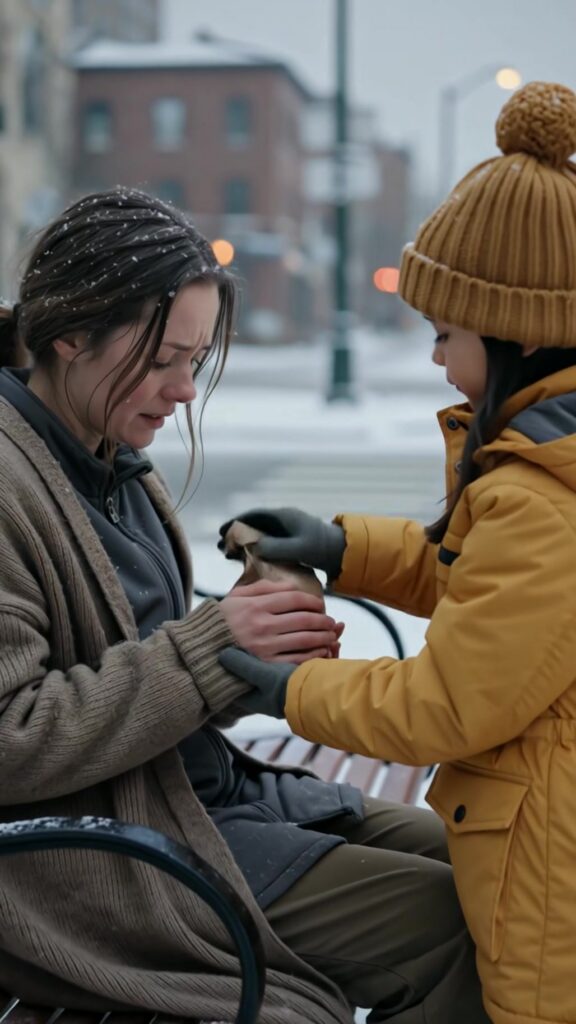
A child’s boots crunched along the sidewalk. The sound was small but determined, a rhythm that didn’t match the timid shuffling of commuters. The girl wore a bright mustard jacket that looked almost defiant against the winter’s dull palette. Her hat was pulled down over her ears, and her mittens were too big, swallowing her wrists. She carried a folded brown paper bag in both hands, held out in front of her as though it were fragile.
She stopped at the end of the bench, close enough that the woman could smell clean laundry on her sleeve—an almost painful scent. The woman looked up slowly, eyes narrowed against the falling snow. Her face was tired in a way that did not come from lack of sleep alone; it carried the lines of long decisions and longer regrets. The girl’s breath drifted between them in a pale ribbon.
“Are you cold?” the girl asked. Her voice was soft, careful with its own courage.
The woman tried for a smile, the kind people used when they wanted to disappear politely. “A little,” she said, then added, as if it were a rule, “But I’m fine.”
The girl didn’t accept that answer. She stepped closer and lifted the bag higher. “These are for you.” She sounded less like she was offering and more like she was correcting something that had gone wrong. “My dad got them. But you look like you need them more.”
The woman stared at the bag as though it might bite. She could see the grease spots seeping through the paper, the faint outline of something round and warm inside. Her stomach tightened with a hunger she had been pretending not to feel for days. When she reached out, her fingers were bare—red at the knuckles, swollen from cold and cheap soap. The girl’s mitten met her skin, and for a moment warmth passed like a message between strangers.
“Thank you,” the woman whispered. Her fingers closed around the bag as if it might float away. She lowered it to her lap, and the smell hit her fully: bread, butter, cinnamon, the kind of comfort that belonged to kitchens, not sidewalks. Snow gathered on her eyelashes when she blinked.
The girl did not leave. She studied the woman’s face with an unsettling steadiness, as if she had been practicing for this exact moment. “Do you have a home?” she asked.
The woman’s mouth twitched. “Not right now.” She meant it to be light, a half-joke, but it came out heavy. She had a shelter voucher crumpled in her pocket and a pride that refused to let her use it until it was too late. She had once had an apartment with yellow curtains and a kettle that sang. She had once had someone who said her name with love. Then the hospital bills came, and the phone stopped ringing, and she learned how fast a life could slide off a table when the world decided you were too expensive to keep.
“You should,” the girl said, as if stating a fact. Then, almost quietly, “And I need a mom.”
The sentence did not shout, but it landed like a door slamming. The woman’s breath caught in her throat. Her hands tightened around the bag until the paper crinkled. She looked up, suddenly too alert, and the city’s muted hush seemed to sharpen at the edges.
“What did you say?” Her voice was not disbelief so much as a kind of being struck awake. There was something in it that had been missing from her own mouth for a long time: fear of hope.
The girl’s eyes stayed open, honest. “I said I need a mom,” she repeated. “A real one. Not just someone who drops me off and picks me up.” She hesitated, then added, “Dad tries. But he’s… always tired. And he gets quiet. When he gets quiet, it’s like I’m talking into snow.”
The woman’s gaze flicked past the girl, down the sidewalk. There was a man standing near a lamppost across the street, half-shadowed by the falling flakes. He looked like someone who had dressed in a hurry—scarf crooked, hair damp. He wasn’t approaching. He wasn’t leaving. He watched with his hands shoved deep into his pockets, holding himself still as if any movement might break something delicate.
The woman felt heat rise behind her eyes, sudden and humiliating. She shook her head once, as if to scatter the thought. “Sweetheart,” she began, choosing the gentlest word she could find, “you don’t know me.”
“I do,” the girl said, and her certainty made the air colder. “You’re Mara.”
The name was the woman’s, and hearing it from a stranger’s mouth was like being called from underwater. Her spine stiffened. She had not introduced herself. She had not spoken it in days. The girl watched her flinch and softened her voice. “Dad said I shouldn’t talk to strangers,” she admitted. “But he also said you were never really a stranger. He said you were brave once. He said you used to sing when the radio broke.”
The world tilted. The woman’s head turned toward the man across the street. His face was partly obscured by snow, but she recognized the line of his jaw, the way he held his weight as if expecting impact. Memory rushed in—an apartment with yellow curtains, a kettle singing, a man laughing while she tried to fix an old radio with a butter knife. Then the hospital corridor, the paperwork, the argument she’d started because she didn’t know how to stop being angry at pain.
The man took a step forward, then stopped, as though giving her permission to choose what happened next. His eyes were rimmed red in the cold, or from something else. He lifted one hand in a small, helpless gesture.
The girl climbed onto the bench beside Mara without being asked, her jacket squeaking against the weathered wood. She leaned in, close enough that Mara could feel the warmth of her small body through layers of fabric. “He said you left,” the girl whispered. “But I think you got lost. Sometimes grown-ups get lost longer than kids.”
Mara swallowed hard. She looked down at the bag in her lap, then back at the child. “What’s your name?”
“Elin,” the girl said. “Like the song.”
Mara let out a sound that was almost a laugh and almost a sob. Snow settled on Elin’s hat, bright against the mustard cloth. “Elin,” Mara repeated, tasting the name like it was warm. “I can’t be what you think I am.”
Elin’s mittened hand reached for Mara’s bare one again, firm and steady. “You can be what you are,” she said. “Just… here.”
Across the street, the man finally crossed, the snow swirling around his legs. When he reached the curb, he stopped a few feet away, as if the space between them had weight. His voice, when it came, was rough. “Mara.” He didn’t ask a question. He didn’t offer an accusation. He simply said her name the way one says a prayer that might not be answered.
Mara looked at him and felt the bench beneath her, the paper bag in her lap, the child’s small hand holding hers. The cold was still there, but something had shifted, a seam in the winter. She inhaled, and for the first time in a long while, the air did not feel like punishment.
“I’m not fine,” she said, and the honesty shook her. She lifted the bag slightly, a ridiculous offering, and then lowered it again as if she were surrendering. “I don’t know how to come back.”
The man’s shoulders sagged, and in that movement she saw the years he’d carried without her. “Then don’t come back all at once,” he said. “Just… come closer.”
Elin shifted on the bench to make room, as if she had been arranging this scene all along. Snow continued to fall in slow, quiet flakes, softening the edges of the gray street, and for a moment the city stayed muted—except for the small sound of three people breathing in the cold, trying to become a family at the exact point where everything might have broken.